Aave token holders want CRV borrowing disabled from its Ethereum and Polygon V3 markets after Curve exploit
- Aave token holders want CRV borrowing disabled from its Ethereum and Polygon V3 markets after recent Curve exploit
- Aave token holders want to reduce the network’s exposure to CRV, the ticker for the Curve ecosystem.
- Specifically, they want it disabled from the network’s Ethereum and Polygon V3 markets, with almost 100% in support.

The proposal comes as community members respond to Curve founder Michael Egorov’s recent liquidation crisis.
Aave token holders have reacted to the recent exploit in the Curve Protocol with a governance vote, proposing to minimize the network’s exposure to CRV liquidation. After the hack, Curve founder Michael Egorov was on the brink of liquidation, having invested 34% of CRV’s total market capitalization to borrow at least $63 million.
Also Read: Coinbase Ventures’ foray into Ethereum liquid staking network Rocket Pool fuels 15% rally for RPL.
Aave token holders want exposure to CRV minimized
Aave community members want CRV borrowing disabled from their Ethereum and Polygon V3 markets, a move that, in their opinion, would minimize their exposure to the token by reducing its liquidation threshold.
Citing Omer Goldberg, the CEO of on-chain risk management platform Chaos Labs:
[The driving force behind the proposal and vote] is to disable the ability to short CRV via the Aave protocol.
The proposal comes after the Curve founder put the network in debt because of his borrowing position on the Aave lending protocol. It is worth mentioning that Egorov is now in the clear; however, no longer facing liquidation after capitalizing on several over-the-counter (OTC) deals to sell CRV and raise more than $42 million. The raise was then channeled towards settling part of what he owed.
Nevertheless, Aave community members are not assuaged by the Curve executive settling most of his debt, and want to reduce their exposure to CRV. To this end, they commenced a vote to pass or fail the proposal on August 10. While the voting ends on August 13, it already appears to be a case of approval by a landslide.
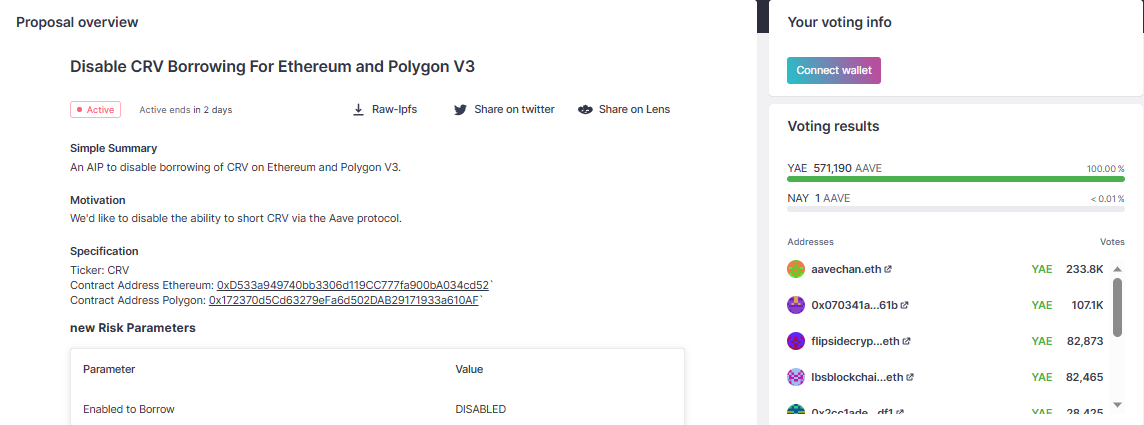
Aave proposal vote
If it does pass, cryptocurrency users may no longer be able to borrow CRV for dumping purposes, an action that would otherwise cause a price slump.
Meanwhile, both AAVE and CRV tokens are trying to escape the thicket around the recent hack and subsequent liquidation threat, consolidating along uptrend lines but the bearish pull remains strong.
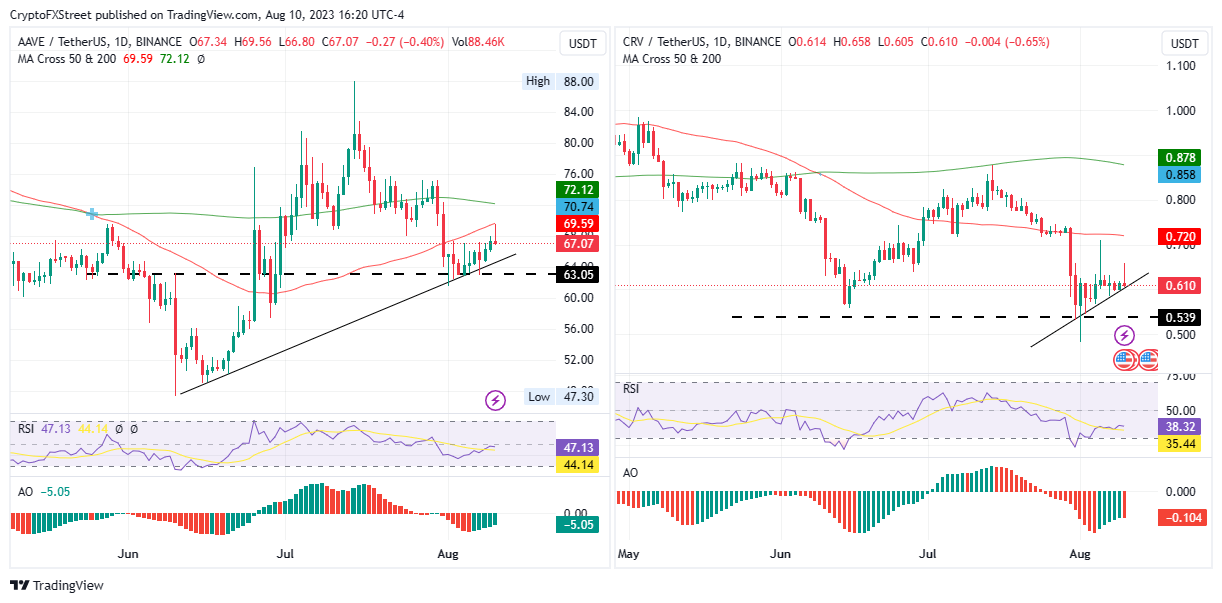
AAVE/USDT 1-day chart, CRV/USDT 1-day chart
With momentum fading, a decisive break below both ascending trendlines could spell doom for the altcoins, triggering a cascade of losses. For AAVE, the critical level to watch is the $63.05 support, while for CRV, it is at $0.539.
Unlike the CRV token, however, AAVE appears to be poised for a breakout after testing the 50-day Moving Average at $69.59. This is often interpreted as a position for aggressive entry, with the expected buying momentum forecasted to send AAVE price further north.
Bitcoin, altcoins, stablecoins FAQs
What is Bitcoin?
Bitcoin is the largest cryptocurrency by market capitalization, a virtual currency designed to serve as money. This form of payment cannot be controlled by any one person, group, or entity, which eliminates the need for third-party participation during financial transactions.
What are altcoins?
Altcoins are any cryptocurrency apart from Bitcoin, but some also regard Ethereum as a non-altcoin because it is from these two cryptocurrencies that forking happens. If this is true, then Litecoin is the first altcoin, forked from the Bitcoin protocol and, therefore, an “improved” version of it.
What are stablecoins?
Stablecoins are cryptocurrencies designed to have a stable price, with their value backed by a reserve of the asset it represents. To achieve this, the value of any one stablecoin is pegged to a commodity or financial instrument, such as the US Dollar (USD), with its supply regulated by an algorithm or demand. The main goal of stablecoins is to provide an on/off-ramp for investors willing to trade and invest in cryptocurrencies. Stablecoins also allow investors to store value since cryptocurrencies, in general, are subject to volatility.
What is Bitcoin Dominance?
Bitcoin dominance is the ratio of Bitcoin's market capitalization to the total market capitalization of all cryptocurrencies combined. It provides a clear picture of Bitcoin’s interest among investors. A high BTC dominance typically happens before and during a bull run, in which investors resort to investing in relatively stable and high market capitalization cryptocurrency like Bitcoin. A drop in BTC dominance usually means that investors are moving their capital and/or profits to altcoins in a quest for higher returns, which usually triggers an explosion of altcoin rallies.
Author

Lockridge Okoth
FXStreet
Lockridge is a believer in the transformative power of crypto and the blockchain industry.