|

XAU/USD outlook: Gold rises over 2% on Monday, generates initial signal of an end of corrective phase

XAU/USD

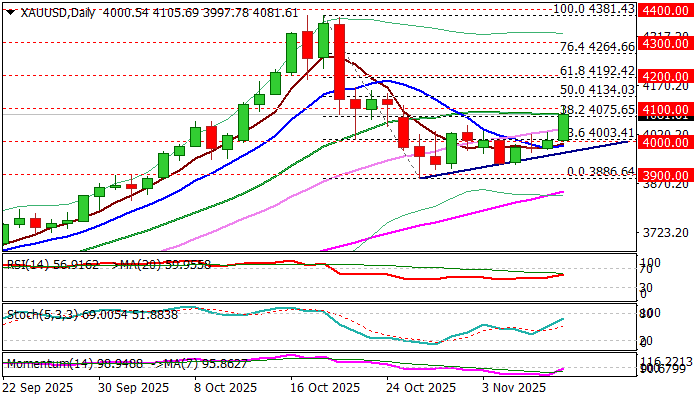
Gold rose over 2% at the start of the week and ticked above $4100 level, improving the near-term picture and sidelining the downside risk.

Fresh rise in demand was sparked by recent weak US economic data that increased pressure on dollar and revived expectations for Fed rate cut in December, while markets remain highly concerned about the depth of negative impact on the economy from the historically longest government shutdown.

Today’s break above initial pivot at $4046 (former congestion top) and $4075 (Fibo 38.2% of $4381/$3886 correction /20 DMA), as well as brief probe above $4100 (psychological), generated strong bullish signal.

Daily studies improved following completion bullish failure swing pattern but still require more work at the upside (sustained break above $4100 and potential extension through Fibo 50% at $4134) to validate signal, as north-heading 14-d momentum needs to emerge from oversold territory.

Meanwhile, the price eased from new two-week high, as strongly overbought hourly studies sparked a partial profit-taking.

Dips should be limited and provide better levels to re-enter bullish market, with $4050 zone (50% retracement of today’s rally/former range top) to contain extended downticks and keep revived bulls in play for further advance.

Firm break through $4100 to open targets at $4134 (50% of $4381/$3886) and $4192/$4200 (Fibo 61.8%/psychological) in extension.

Res: 4100; 4134; 4150; 4192.
Sup: 4050; 4038; 4020; 4000.
Chart

Author

Slobodan Drvenica

Slobodan Drvenica

Windsor Brokers

Industry veteran with over 22 years’ experience, Slobodan Drvenica joined Windsor Brokers in 1995 when he was an active trader for more than 10 years, managing the trading desk and own account departments.


More from Slobodan Drvenica
Share:

Editor's Picks

AUD/USD flirts with 0.7000, lowest since early August amid bullish USD

AUD/USD hits a fresh low since early August during the Asian session on Friday and looks vulnerable near 0.7000 after breaking below the 200-day SMA overnight. Against the backdrop of the hawkish Fed, a two-day rally in oil prices revives inflation fears and continues to push US bond yields to multi-year highs. Adding to this, geopolitical risks lift the US Dollar to a two-month high, overshadowing RBA rate hike bets and weighing on the pair.

USD/JPY pulls back from three-week high after failing near 159.00

USD/JPY edges lower during the Asian session on Friday, stalling its recent strong move to a three-week high of 159.00 as Japanese Yen bears turn cautious amid intervention fears. Meanwhile, the US Dollar retains a strong bullish undertone as the Fed's hawkish outlook and oil-driven inflation fears continue to push US bond yields to multi-year peaks. Furthermore, the BoJ's dovish rate hike last week might cap JPY and support spot prices.

Gold treads water below $4,300

Gold grabs some buying attention and advances marginally at the end of the week, partially retracing the weekly decline, although it is still navigating below the key $4,300 mark per troy ounce. The fresh selling bias on the Greenback and the modest decline in US Treasury yields appear to support the humble advance in the precious metal.

Crypto Today: Bitcoin and Ethereum edge lower, XRP extends recovery as macro headwinds weigh

The broader cryptocurrency market is consolidating on Friday, with Bitcoin paring losses slightly above $84,000. Ethereum declines in tandem with BTC. Ripple (XRP), meanwhile, paints a different picture.


Fed vs BoJ: Both hiked. The market only believes one of them – and the chart shows which
The Federal Reserve (Fed) and the Bank of Japan (BoJ) have just done something remarkably similar. Both central banks raised interest rates by 25 basis points (bps) last week, both are confronting inflation risks, and both signal that future decisions will depend on incoming economic data.
Fed vs BoJ: Both hiked. The market only believes one of them – and the chart shows which

The Fed and the BoJ have just done something remarkably similar. Both central banks raised interest rates by 25 bps last week, both are confronting inflation risks, and both signal that future decisions will depend on incoming economic data.













