|

WTI oil outlook: WTI oil in free fall, hits the lowest since 1999

WTI OIL

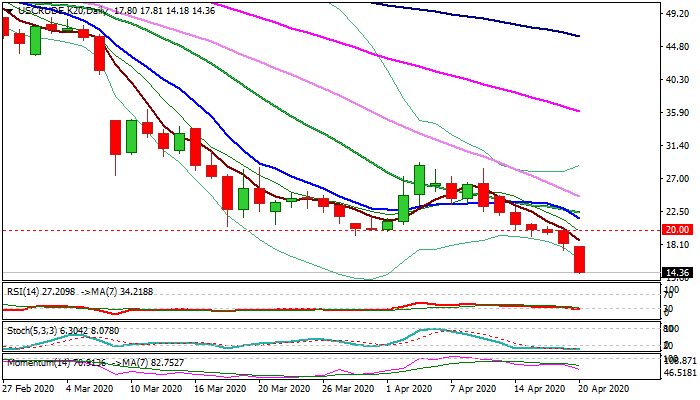
WTI oil future contract for May accelerated lower in early Monday's trading and hit the lowest since 1999 on over 16% fall during Asian / early European trading. The sentiment remains very weak and traders continue panic selling as demand weakens on daily basis and fears that US storage will fill soon. Weak global consumption over pandemic lockdown flooded markets with oil, with the latest decision of OPEC+ group to reduce daily production by 9.7 million bpd that will be effective from the beginning of May, having no positive impact on crashing oil prices. The contract fell to the lowest in 21 year at $14.20 zone in European trading on Monday, with next target at $10, coming in focus. Earlier comments that oil price can fall as low as $10 per barrel that would strongly hit all sectors in oil industry and likely be fatal for many oil refiners, are just step ahead of becoming reality. We predicted that oil price will be in a free-fall after break of critical $20 support zone and now witnessing the action. Some brief upticks can be expected meantime, more as positioning than any serious recovery attempts, however, oil is expected to face strong headwinds from $10 zone, where some basing attempts could be anticipated. Broken $20 zone marks the first significant resistance and only break here would provide temporary relief.

Res: 15.21; 16.66; 17.68; 18.88
Sup: 14.00; 13.14; 11.70; 10.00
US Crude

Author

Slobodan Drvenica

Slobodan Drvenica

Windsor Brokers

Industry veteran with over 22 years’ experience, Slobodan Drvenica joined Windsor Brokers in 1995 when he was an active trader for more than 10 years, managing the trading desk and own account departments.


More from Slobodan Drvenica
Share:

Editor's Picks

GBP/USD stays below 1.3400 after soft UK CPI data

GBP/USD struggles to gain traction and stays below 1.3400 in the second half of the day on Wednesday. The UK annual Consumer Price Index (CPI) inflation cooled to 2.6% in June against the market forecast of 2.7%, making it difficult for the British Pound gather recovery momentum. Meanwhile, investors keep a close eye on headlines coming out of the Middle East.

EUR/USD stabilizes near 1.1400 as markets focus on geopolitics

EUR/USD trades in a narrow channel at around 1.1400 on Wednesday. In the absence of high-impact data releases, escalating geopolitical tensions in the Middle East caps the pair's upside. On Thursday, the European Central Bank (ECB) will announce monetary policy decisions.

Gold extends rally as Middle East concerns intensify

Gold extends gains for the fourth consecutive day, standing comfortably above $4,100, unfazed by the risk-off market amid rising tensions in Iran and higher Oil prices. The pair has rallied nearly 2.5% so far this week and is on track for its best weekly performance in more than three months.

Australia unemployment rate set to steady at 4.4% in June, signaling strong job market

Australia will publish the June monthly employment report on Thursday at 01:30 GMT, and market participants expect a modest increase in job creation in the land Down Under. The Australian Bureau of Statistics is expected to announce that the country added 15K new jobs in the month, while the Unemployment Rate is forecast at 4.4%, unchanged from May.

Hyperliquid, Robinhood could lead crypto’s next bull market as DeFi and TradFi converge

The next crypto bull market could be driven by the growing convergence between blockchain-based financial infrastructure and traditional finance, according to Bitwise CIO Matt Hougan. In a report published late Tuesday, Hougan argued that crypto may be showing early signs of a market bottom, with Bitcoin gaining 9% since July 1 even as the NASDAQ 100 declined 6%.

US Dollar mid-year outlook: Exceptional currency, exceptional risks?
The US Dollar enters the second half of 2026 in a markedly different position from a year ago. The King currency has recovered, reflecting persistent US inflation, changing expectations for Fed policy, geopolitical tensions and renewed demand for defensive assets.