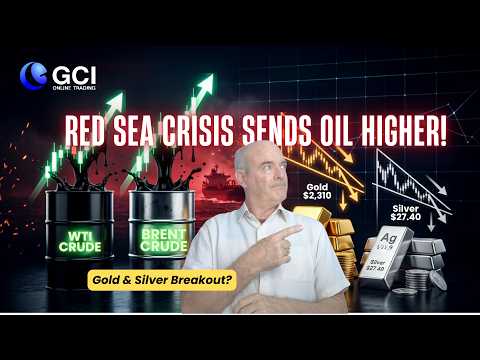
WTI and Brent Crude higher on red sea aggression, XAU/USD and XAG/USD in falling wedges [Video]
![WTI and Brent Crude higher on red sea aggression, XAU/USD and XAG/USD in falling wedges [Video]](https://editorial.fxsstatic.com/images/i/West-Texas-Intermediate_1.png)
As we all know, the Iran war is severely restricting the flow of Crude Oil through the Strait of Hormuz.
Saudi Arabia started to send more tankers out via the Red Sea, but now, we have a completely different set of problems in the Bab al-Mandab Strait, which is driving crude even higher.
In today’s Market Outlook, let’s take a look at Forex trading on EURNZD, NZDUSD, AUDUSD, AUDNZD, AUDCAD, Silver, XAGUSD, Gold, XAUUSD, WTI, and Brent Crude Oil.
So, the question for traders is, “when can we go short on WTI and Brent CFDs and watch price action fall to normal levels?”
There is no easy answer to this question, but the current US administration is under enormous pressure to end the war, but that may mean nothing in the short term.
This has caused more geopolitical uncertainty, and investors tested the $4,000 level of support on gold, with price heading up past $4,100 this week.
Silver followed gold, as it has been doing for months.
On the technical side, price action has broken through the upper trend line that we have been following for months.
On the weekly charts, we see falling wedges, which are almost always bullish patterns.
But keep in mind, these are weekly charts, so this may take a long time to play out.
This morning we saw Australian Employment Figures way higher than analysts’ expectations, and look what happened.
If we follow the rules of the News Catalyst Fade, we want to trade with the trend or within the range.
We note that in almost every case, the news drove price action WITH the trade buy; we can still look for reversals on other time frames.
We will keep an eye on AUDUSD, for example, where price is at a key level of resistance.
Also on AUDNZD, we see price at a key level with an overbought stochastic oscillator.
And, on AUDCAD, we see a strong ranging market with price at an upper trend line and an overbought stochastic oscillator.
Please feel free to check all other AUD pairs.
We see that NZD has been the strongest currency this month, but we also see that this may be changing.
For example, on NZDUSD, we see a pullback through the lower trend line, but we also see a falling wedge and an oversold stochastic oscillator.
Inflation in New Zealand is not under control, so we will keep an eye on all NZD pairs.
On EURNZD, we see the pullback as well, but with price action forming a rising wedge, and we will keep an eye on this as well.
And tomorrow’s ECB Interest Rate decision, so keep an eye on these and all EUR pairs.
That’s all for now.
CFDs and FX are leveraged products, and your capital may be at risk.
Author

Brad Alexander
FX Large Limited
Brad became fascinated with the Currency Markets from a young age and researched fundamental analysis.

















