Will the Fed cut by 25 bps or 50 bps?
-
Fed is expected to cut rates, but is it too late to the game?
-
Intense speculation about size of cut as markers lean towards 50 bps.
-
New dot plot will also be crucial in Wednesday’s decision at 18:00 GMT.

Fed to join rate-cut club
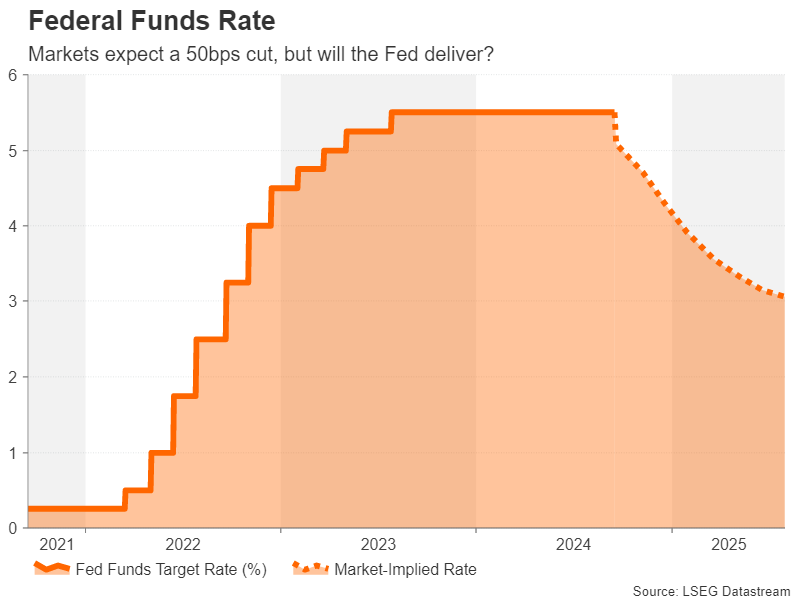
The timing of the Fed’s first interest rate cut of the cycle has been the dominant market theme all year, but since the summer, the narrative has changed to the size of the cut, not when. Nevertheless, after much frenzied speculation, the moment of truth has arrived, and the Fed is almost certain to begin its long-awaited easing cycle on Wednesday.
Until a few days ago, investors had all but priced out the probability of a 50-basis-point rate cut, as the July payrolls report that sparked fears of a possible US recession was not followed up by similarly weak data. But that hasn’t stopped some market participants to worry that the Fed has left it too late to start trimming borrowing costs and that a hard landing may now be inevitable.
What recession?
So how likely is a recession? The US economy clearly appears to be slowing, particularly the labour market. But there’s few signs in the hard data that currently point to a significant risk of an outright recession (although it’s worth remembering that jobs numbers tend to be lagging indicators) and inflation isn’t exactly falling off a cliff either.
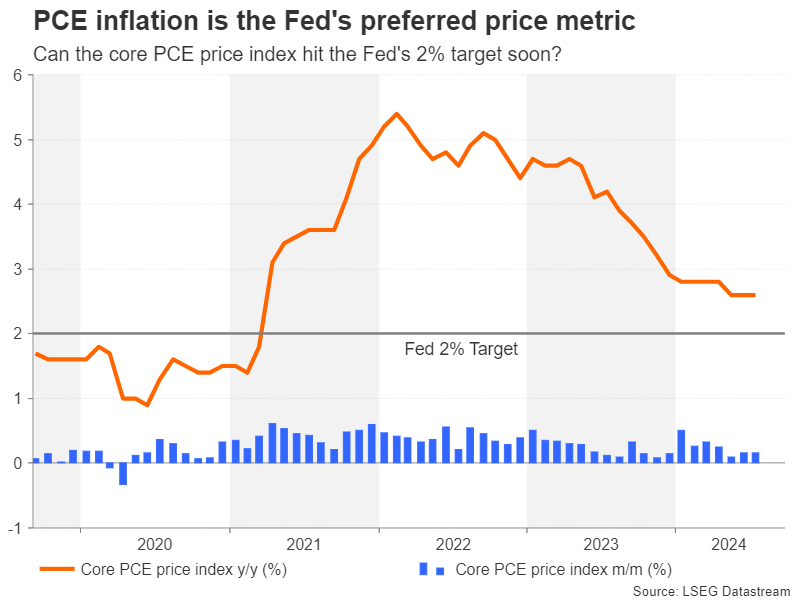
The Atlanta Fed GDPNow model’s latest estimate is growth of 2.5% in the third quarter and the core PCE measure of inflation has been stuck at 2.6% for the past three months. These are hardly red flags that would prompt policymakers to slash rates by 50 basis points. Yet, markets remain jittery and even former New York Fed President Bill Dudley has joined calls for the central bank to cut rates by half a point this week, arguing that policy is too restrictive.
Fed is flip-flopping
The Fed may have started to take on board some of the criticism. Both the Financial Times and Wall Street Journal published articles last week suggesting that the Fed is debating whether to cut rates by 25 bps or 50 bps, despite no strong hints from officials that they saw the decision as such a dilemma before going into the blackout period.
This dramatically flipped expectations for Wednesday’s announcement back towards a 50-bps reduction. Not only that, but investors have also priced in rate cuts of almost 250 bps over the next 12 months, 120 of which are expected by year-end. Unsurprisingly, the US dollar has taken a dive in FX markets while shares on Wall Street just had their best week since last October.
A communications challenge
The problem is that there’s a danger traders have misinterpreted the Fed’s motives in ‘prepping’ the markets for the possibility of a 50-bps cut. By creating the impression that the September decision is going to be a close call, policymakers may have simply wanted to send a strong signal that they’re ready to adjust rates aggressively should it be warranted. Moreover, by setting a dovish backdrop for the meeting and additionally using the dot plot to flag multiple rate cuts in the months ahead, any reduction, whether it’s 50 bps or only 25 bps, would be perceived as a ‘dovish cut’.
But a potential challenge for the Fed, or more specifically for Chair Jerome Powell, to cutting rates by 50 bps is how to communicate a larger cut. Powell and his colleagues have gone out of their way to brush off concerns that the American economy is about to hit the rocks. So how would they go about justifying the reasoning behind a 50-bps move without setting off alarm bells that they see trouble ahead?
Frontloading may be the way to go
One argument is that if they increasingly view the risks to the labour market as being tilted to the downside, frontloading the rate cuts now would give them an insurance policy against a sharp slowdown and they could always pause if the worst case scenario doesn’t materialise. But again, even if Powell can convince investors why it was necessary to act aggressively without triggering any recession panic, it would still be an admission that the Fed kept rates too high for too long.
Thus, whatever the decision, it’s hard to see Powell’s press conference, scheduled 30 minutes after the announcement, to pass without any episodes in financial markets. With the odds for a 50-bps cut now standing at around 60%, the dollar could reverse sharply higher if the Fed disappoints.
Is the Dollar set for a rebound?
The upside risk is particularly high for dollar/yen, which has been on the slide since July and is therefore looking a little oversold. The lower highs of 147.20 and 149.39 are potential targets for the bulls. The latter also happens to be close to the 50-day moving average, while the 200-day moving average is flatlining in the 151.00 region.
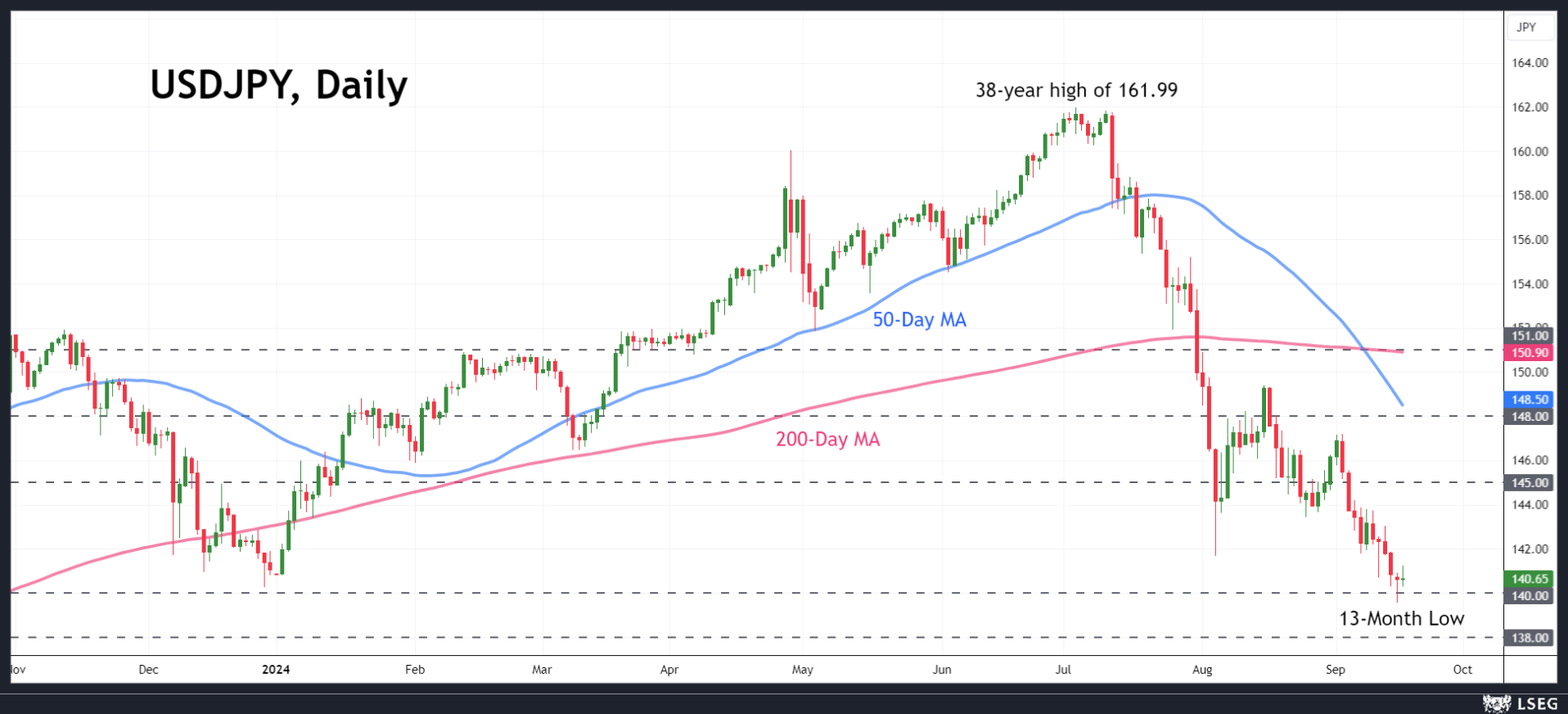
However, if the Fed does go ahead with a 50-bps cut or pleases markets with a very dovish dot plot, the dollar could soon be headed for 138.00 yen before testing the 135.00 mark.
Ahead of the Fed decision, investors will be watching the retail sales numbers for August, out on Tuesday at 13:30 GMT.
Author
Mr Boyadjian graduated from the London School of Economics in 1999 with a BSc in Business Mathematics and Statistics. Following graduation, he joined PricewaterhouseCoopers in the Business Recoveries team, where he was responsibl

















