Will the delta variant become a growth catalyst for vaccine concept stocks?

The outbreak of the Delta virus variant in many countries around the world once again caused the market to turn its attention to vaccine concept stocks. According to Bloomberg, the Moderna vaccine “produced a neutralizing titer for all tested variants, including the latest Delta variant.” On the other hand, in the UK, test reports show that a combination of one dose of Pfizer and one of AstraZeneca seems to provide better protection against the virus compared to two doses of the same vaccine. According to the report, the AstraZeneca-Pfizer combination has the best effect, followed by the Pfizer-AstraZeneca combination, and both have a better effect than two AstraZeneca vaccinations. The results of this report are exciting, because this will help to increase flexibility and support countries that need to further promote vaccines and that are experiencing supply difficulties.
At present, at least 3.01 billion doses of coronavirus vaccines have been administered globally. Among them, Bloomberg’s vaccine tracker also shows that China has the fastest vaccination rate, and it is expected that in the next month, 75% of the country’s people will have received two doses of vaccine. If the next test report confirms the effectiveness of different vaccine combinations, then this may bring another wave of gains for vaccine concept stocks. In addition, the researchers also tested the effectiveness of the mixed dose inoculation interval, ranging from 4-weeks and 8-weeks to 12-weeks. From the current available data, the 8-week vaccination interval is more effective than the 4-week vaccination interval, and the effect of the 12-week vaccination interval will be revealed next month.
The longer the vaccination interval, the better the effect, however, it may also mean that it will take longer for countries to reach herd immunity (and the economy to return to normal levels). During the period from the first dose to the second dose of vaccine and the formation of effective immunity, the active cooperation of the government and the people and the observance of epidemic prevention measures is needed to avoid infection before the formation of antibodies.
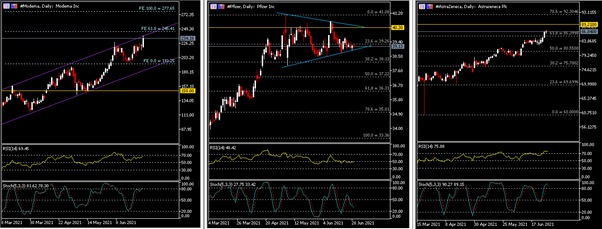
Boosted by recent positive factors, #Moderna (left) and #AstraZeneca (right) performed exceptionally well. Overnight, the former closed up about 7% to $234.18, while $238.36 was a new high since June 7 this year; the latter has continued its upward pattern after rebounding from the low of US $60.00 on March 19 this year. It is currently closed above $85.40 (61.8% Fibonacci retracement level). For #Moderna, the recent resistance is the top line of the ascending channel and the 61.8% Fibonacci extension level ($245.40). The break of the resistance will mean that the stock price is expected to continue to test the 277.65 resistance. On the other hand, the near-term support is $193.25 and the bottom line of the ascending channel. Both the Relative Strength Index (RSI) and Stochastics indicator show that the #Moderna stock price is in the overbought zone.
As for #AstraZeneca, its recent resistances are $89.21 (the high seen on July 30 last year), $92.30 (the 78.6% Fibonacci retracement level) and the historical high of $101.10 seen in July last year. In addition, #Pfizer (middle) is relatively weak compared to the other two vaccine stocks, and is currently trading in a narrow range in the wedge-shaped area. As of yesterday’s close, the stock price is at the 23.6% Fibonacci retracement level ($39.25) and the wedge-shaped bottom line area. If the bears break through this area, then its stock price may continue the downward pattern and test the $38.15 support, or the 38.2% Fibonacci retracement level. However, if the stock price stabilizes at $39.25, the near- term resistance is $40.30 and the wedge-shaped top line resistance. Similar to #Moderna, the Relative Strength Index (RSI) and Stochastics show that the #AstraZeneca stock price is in the overbought zone; #Pfizer stock price momentum meanwhile appears to be relatively weak, and its Stochastics has formed a death cross and is still running downwards.

















