Wider US international trade deficit will weigh on Q3 GDP growth


Summary
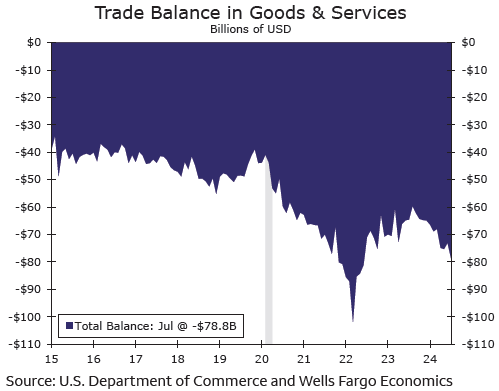
U.S. imports jumped in July, which caused the international trade deficit to widen to the largest position in a year-and-a-half and positions net exports to once again subtract more than half-a-percentage-point off of third-quarter real GDP growth.
Brace for another drag from trade in Q3
The U.S. international trade deficit widened $5.8 billion to $78.8 billion in July (chart). The larger deficit was presaged by advance data released last week that showed goods imports jumping over the month, while goods exports were essentially flat. Today's data confirm that import demand remains firm despite the dollar's slide over the past few months; total imports were up 8.4% over the past year in July. Exports have strengthened as well, although not to the same degree as imports. Total exports were up 5.0% on a year-ago basis in July. The comparative strength in imports has led the trade balance to decline to its lowest level since the summer of 2022.
Goods exports were weak in July primarily due to a substantial decline in automotive vehicles and parts (-11.2%) outflows (chart). The choppiness in auto trade reflects the ongoing normalization in a sector that has faced several acute supply and labor challenges since the pandemic. Consumer goods exports (-3.6%) slipped as well, but the decline was offset by a solid increase in capital goods exports, which has been underpinned by strength in semiconductors and civilian aircraft.
Author
Wells Fargo Research Team
Wells Fargo