Why long bonds have repriced the cost of money

The 30-year Treasury is 12 basis points below its highest level since before the financial crisis. Not its highest since 2023, or since the tightening cycle, but since June 12, 2007, the last time the longest bond in the world's deepest market yielded what it yields on Thursday.
Getting there took two attempts and most of the year. The 30-year bottomed at 4.64% on February 27, ran to 5.18% by May 19 and was turned back, fell to 4.86% by June 24, and has climbed almost without interruption since. Roughly 40 of those basis points arrived after the end of June. On Thursday it trades near 5.23%, having given back part of Wednesday's relief within a single session of Treasury announcing it would buy more of them.
The consensus explanation is tariffs, energy and fiscal deficits, which is to say inflation. The data says something close to the opposite.
Almost none of it is inflation
Split the 30-year into its two components and the argument answers itself. Between February 27 and August 17, the nominal yield rose 67 basis points. The inflation-indexed yield over the same tenor rose 63. Inflation compensation, the difference between the two, rose 4.
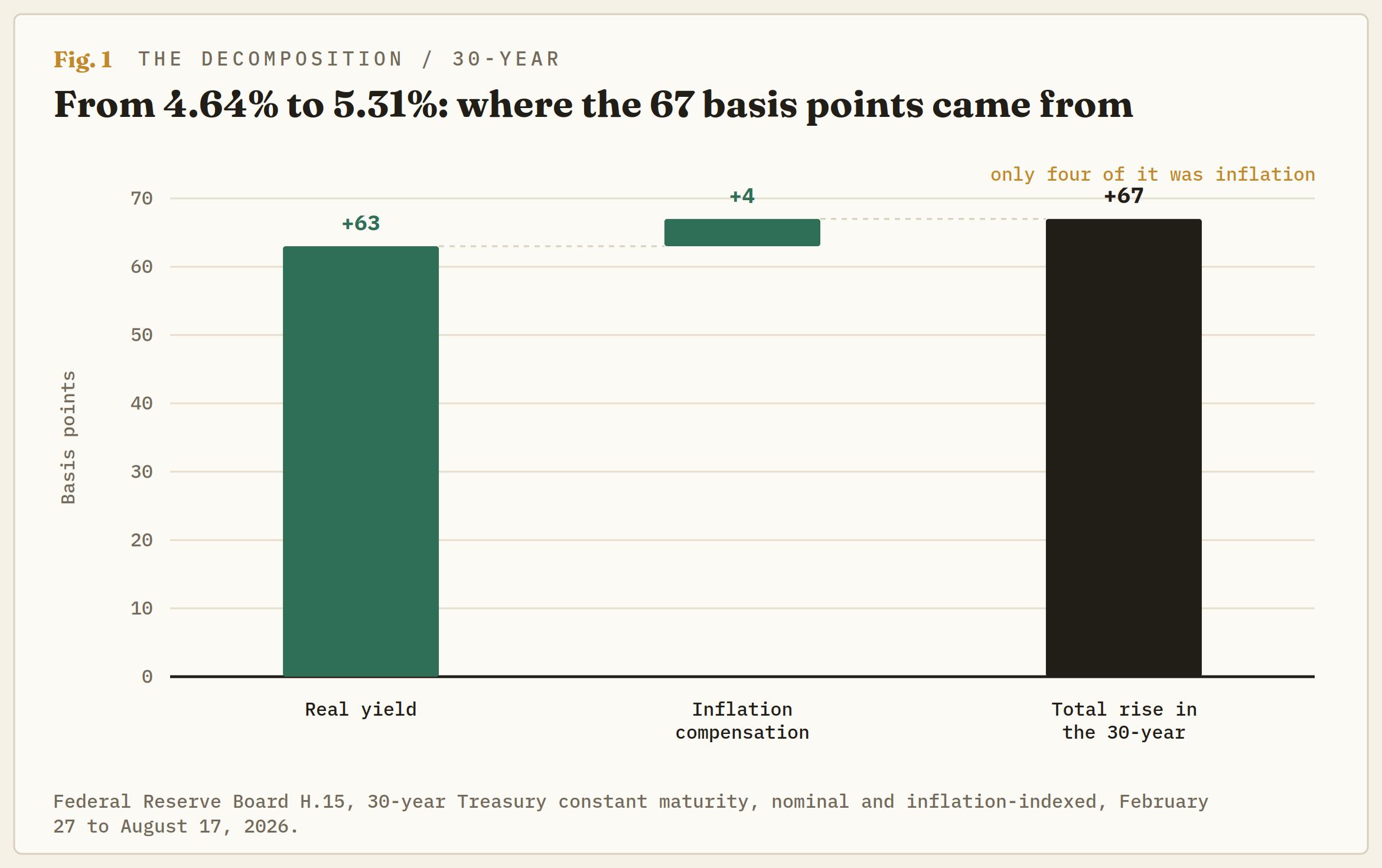
That is 94% of a six-month selloff in the longest bond, and all of it is the real rate. The market has not repriced what money will be worth in thirty years. It has repriced what money costs.
That distinction is not academic, because the two readings imply opposite trades and opposite policy. If the long end were pricing inflation, the remedy is a central bank willing to tighten, and the curve would flatten the moment it did. If the long end is pricing the real return required to hold thirty-year duration, no policy rate fixes it, because the required return is a function of who is willing to own the paper and at what price. The first is a problem the Federal Reserve (Fed) can solve. The second is a problem it can only accommodate.
The Committee has noticed. Its July record logs Treasury yields rising 25-30 basis points over the intermeeting period, attributes the move to real rates rather than inflation compensation, and observes that financial conditions had tightened, with some adding that they may not have tightened enough.
Three tenors, three different decades
The word steepening undersells this, because it describes a spread rather than a position. Measure each tenor against its own cycle peak and the picture is starker.
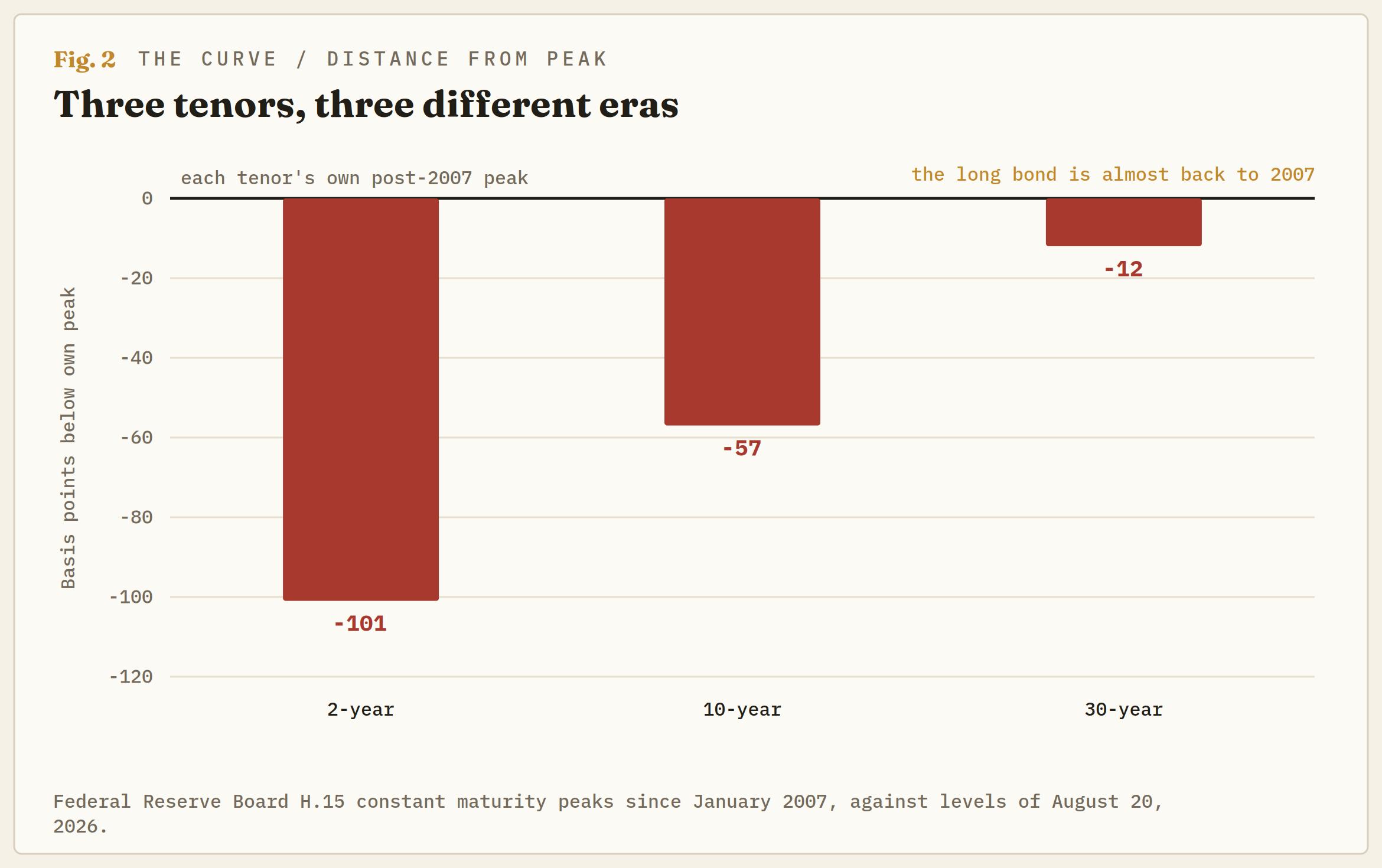
The two-year sits 101 basis points below its own post-2007 high. The ten-year is 57 below its own. The 30-year is 12 below its own. The ordering is monotonic and the gaps are enormous. The front of the curve trades in the middle of its recent range while the back sits at a two-decade ceiling.
That is not one market steepening. It is two markets that have stopped agreeing about what they are pricing. The two-year is a bet on the next eighteen months of policy, and it has spent August falling, down 6 basis points since August 3 while the 30-year added 5 over the same stretch. The classic name for this is a bear steepener. The classic cause is inflation expectations. The breakeven series says that is not what is happening, which leaves supply and the identity of the buyer.
Who is not buying
Treasury International Capital (TIC) reporting for June gives the cleanest available answer. Foreign holdings of Treasuries fell $72.1 billion in the month, Japan accounting for $26.4 billion and China $25.9 billion.
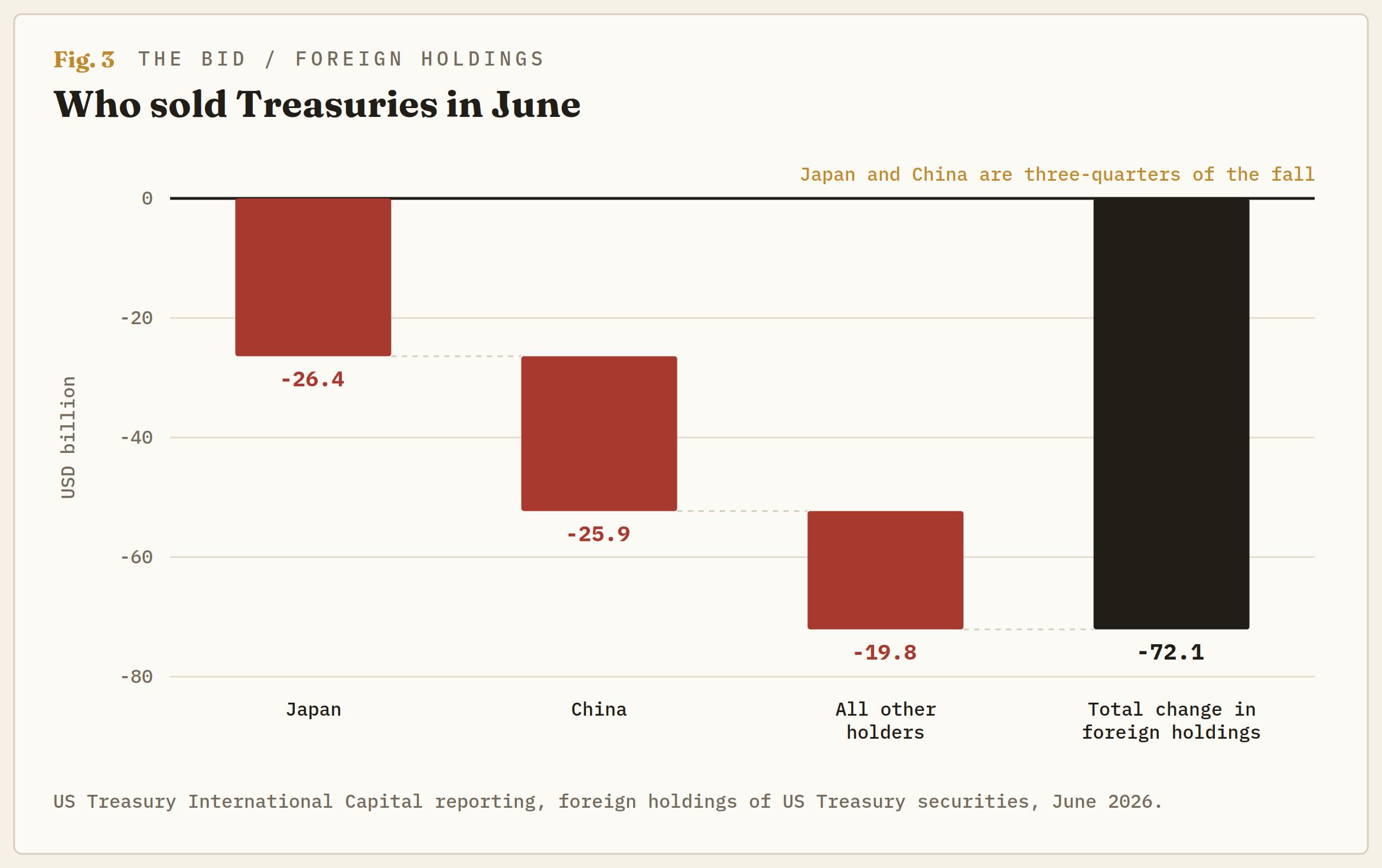
The two largest foreign holders were roughly three-quarters of the decline between them, and their reasons do not overlap. Japan is selling dollars to defend the Yen, which is a mechanical consequence of its own currency policy rather than a view on American credit. China is doing something closer to what it has been doing for a decade. Neither is price-sensitive the way a pension fund is, which matters because neither comes back when the yield gets attractive.
The evidence that this is not a one-month artefact arrived in Wednesday's 20-year auction. Indirect bidders, the closest available proxy for that same foreign demand, took 62.9% of the sale. In June, the identical tenor gave them 71.2%. Last week's 30-year sale put them at 66.8%. Direct bidders filled the gap and dealers absorbed above their norm. The auction book and the custody data tell the same story eight weeks apart, which is as close to confirmation as this market offers.
The replacement buyer is domestic, and a domestic buyer prices thirty-year duration off the real return it needs rather than a reserve-management mandate. That is how a change in the marginal holder shows up as a higher real yield, and why the decomposition looks as it does.
The rest of the world is doing it too
This is not an American story, which is the strongest evidence against the American explanations. Long ends have sold off across every major sovereign market this summer. Japanese thirty-year yields are close to their historic highs and the ten-year is at levels not seen in three decades. British thirty-year gilts have been pressing toward 6%. German thirty-year Bunds and French long-dated debt are both at levels last seen more than a decade ago.
Each of those markets has a domestic story attached to it, and the stories are mutually incompatible: a central bank exiting yield control, a fiscal credibility problem, a political one. When five markets with five different explanations move the same way at the same time, the explanations are probably not doing the work. What they have in common is that the global stock of long-dated government debt is growing while the pool of buyers indifferent to price is shrinking.
What resolves this
The level to watch is not a spread but a ceiling. The 30-year has failed twice this year at the top of its range and it is now 12 basis points from a mark set in June 2007. A sustained break puts the long bond in territory with no modern reference points and forces a repricing of every asset that discounts cash flows against it, which is most of them.
The fork is narrow. If the front end keeps falling while the long end holds near this ceiling, the curve does the tightening the Fed has declined to do, and it does it without anyone voting. If the front end turns and joins the long end, the market has stopped believing the policy rate is anywhere near where it needs to be, and September 16 becomes considerably more interesting than a hold.
The observable that separates them is the indirect share at the next long-dated auctions, not the yield itself. Yields tell you the price. The allotment tells you who was willing to own it, and that number has fallen at every long-end sale since June. Until it turns, the sensible read is that the long end is not forecasting inflation. It is repricing the cost of borrowing for thirty years in a world with more debt and fewer indifferent lenders, and there is no meeting at which that gets voted down.
Author

Joshua Gibson
FXStreet
Joshua joins the FXStreet team as an Economics and Finance double major from Vancouver Island University with twelve years' experience as an independent trader focusing on technical analysis.

















