Why high yields put pressure on stocks


Despite the Federal Reserve cutting interest rates by 100 basis points since September, long-term yields have moved higher, with the 10-year Treasury yield hovering around 4.8% and nearing the critical 5% threshold. This divergence between Fed policy and bond market behavior underscores a resilient US economy along with growing concerns about fiscal risks under the second Trump presidency and risks of persistent inflation.
But why do higher yields weigh on equities, and what should long-term investors do in this environment?
Rising yields affect stocks in several key ways
Higher borrowing costs: Elevated yields increase the cost of capital for companies, squeezing profit margins and limiting expansion. US mortgage rates are already back at around 7% and this especially hurts sectors like real estate, utilities, and small caps, which are more sensitive to rising rates due to high leverage or capital intensity. Higher bond yields can also translate into higher mortgage rates, credit card rates, and other consumer borrowing costs. This can reduce discretionary business and consumer spending, hurting revenue growth for companies in sectors like consumer discretionary.
Valuation compression: Bond yields are used as a benchmark for discounting future cash flows to derive equity valuations. Higher yields increase discount rates, leading to lower valuations for equities. Growth stocks, which tend to have earnings far out in the future, are particularly sensitive to changes in discount rates.
Increased competition from bonds: With the 10-year Treasury yield nearing 5%, dividend-paying stocks have become less attractive relative to safer fixed-income alternatives. The average dividend yield of the S&P 500 stands at just 1.29%, making it difficult for income-seeking investors to justify equity exposure when bonds offer higher, safer returns. This shift in relative attractiveness can lead to a reallocation of funds from equities to fixed income, dampening demand for stocks.
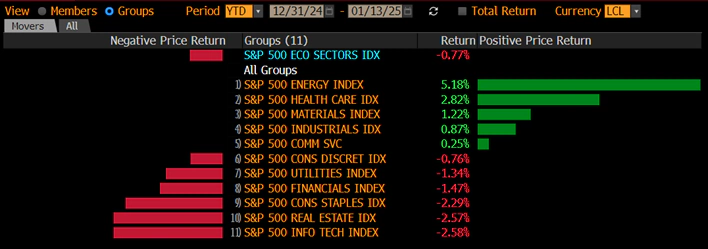
S&P 500 Sector Performance Year-to-Date (as on 13 January 2025). Source: Bloomberg
What to watch from here?
Economic data and monetary policy: The bar for more Fed rate hikes is high, but sustained economic strength in the U.S. data and fiscal risks could force the Fed’s hand if inflation re-accelerates.If growth remains strong or inflation pressures are sustained, yields can continue to edge higher and it may be prudent to be more selective in equities and stick to quality companies with pricing power where higher borrowing costs can be passed on to consumers. On the other hand, if growth slows, Fed could step in to ease financial conditions. In this case, investors could see renewed support for growth stocks, although uncertainty would remain high.
Flood of debt supply could push yields higher: Large Treasury issuances to fund deficits and fiscal spending remain a key driver of higher yields. Without strong demand for bonds, yields could rise further, especially if investor appetite weakens amid high supply.
Trump’s policies and its impact on growth and inflation: Potential massive fiscal spending and infrastructure investments could spur short-term growth but also fuel inflation. Meanwhile, tariffs are growth-negative, but there is uncertainty around if these will be one-shot or gradual.
Key technical levels: The 5% level on the 10-year yield remains critical. If yields breach and hold above 5%, one can expect renewed pressure on equities.
Positioning for a high-yield environment: A strategy for long-term investors
In today’s high-yield environment, investors face both risks and opportunities. The challenge is to strike the right balance between generating stable income and managing downside risks. Below are key strategies to position portfolios effectively:
1. Fixed income for stability and flexibility
With bond yields offering real returns above inflation, fixed income plays a crucial role. However, given the uncertain and volatile environment, investors should avoid taking on too much duration risk and focus on the short end of the curve. Short-duration bonds provide attractive yields while limiting sensitivity to further rate changes. Investment-grade corporate bonds and inflation-protected bonds can further enhance income stability, offering relatively low risk and inflation hedging.
2. Dividend stocks with upside potential
Not all dividend stocks are equally appealing in a high-yield world. Pure income-oriented dividend stocks are less attractive when bond yields are high. Instead, focus on sectors that offer a mix of income and growth, such as:
-
Energy and natural resources: These sectors benefit from higher commodity prices and offer both high yields and potential capital appreciation.
-
Financials: Financial stocks can benefit from higher interest rates through improved net interest margins, making them another viable option for dividend seekers.
Investors should focus on companies with strong fundamentals – low debt, healthy cash flows, strong management, abundant pricing power and sustainable dividends.
3. Global diversification for better value
While U.S. dividend stocks have struggled recently, international markets offer better valuations and higher yields in many cases.
4. Alternatives for inflation protection
Tangible assets such as commodities, real estate, and gold can serve as valuable hedges against inflation, especially if fiscal spending accelerates under a new administration. These assets also offer diversification benefits, reducing overall portfolio volatility. For real estate, consider REITs with strong balance sheets that can weather rising borrowing costs while continuing to generate income.
Read the original analysis: Why high yields put pressure on stocks
Author
Saxo Research Team
Saxo Bank
Saxo is an award-winning investment firm trusted by 1,200,000+ clients worldwide. Saxo provides the leading online trading platform connecting investors and traders to global financial markets.

















