Why are Durable Goods announcements so important?


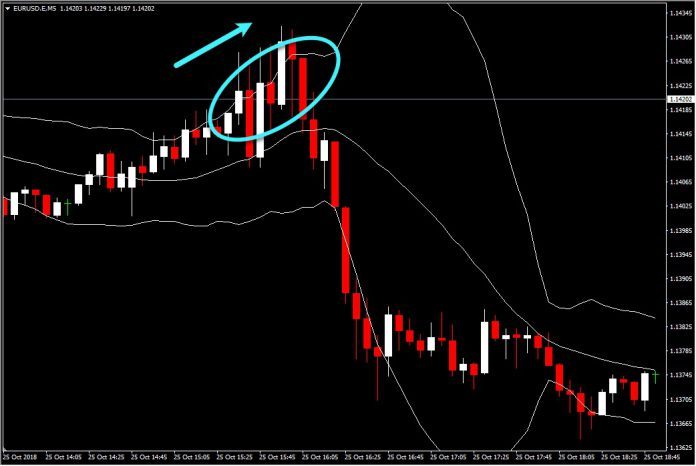
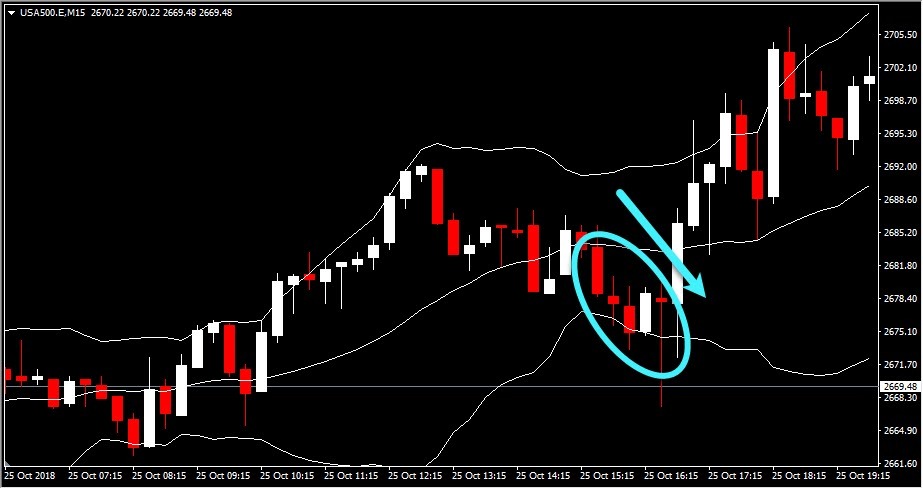
Durable goods orders are widely considered to bear much importance for the economy and the FX markets and this is why the majority of economic calendar providers include it in the list of the most important events on the day they are announced. How big is the effect? Just in the first ten minutes into the October 25 durable goods release, the Euro moved by 130 pips, while a move of 33 pips took place in the first five minutes after the announcement. At the same time, the USA500 moved 8 points within five minutes of the announcement.
The question then is why this particular indicator is of such importance. To put things in perspective, think of all the categories of goods this includes: automobiles, furniture, jewellery, electronics, and so on. These goods are, by definition, durable, because they are expected to be used for a long period of time. As such, durable goods are usually more expensive than non-durables and services, particularly for this reason.
Their high value necessitates that, in order to purchase them, consumers first need to have the available money. This, from the consumer’s perspective, would either mean that they have saved up this amount of money and they are not afraid of using it or it would mean that they have found an alternative way to fund this purchase, most likely a loan. Given that we are all consumers, it is easy to understand that we are more willing to part with a large amount of our money when the economy is growing and we are earning more in wages. In a similar manner, banks are more willing to extend credit to us when it observes that our income is steady and the economy’s prospects are bright, as this maximizes the probability of getting its money back.
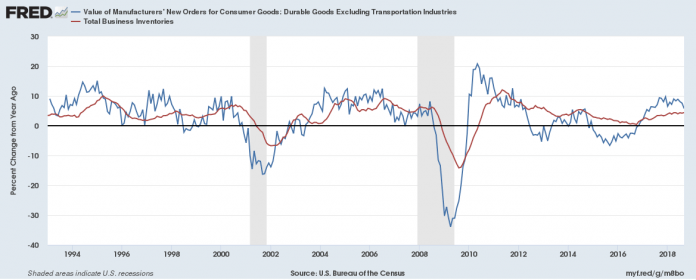
The transportation part of durable goods consumption is usually not employed given that in industries such as aviation, one large order is enough to severely distort our view of the market. Thus, while the interested investors keep an eye out for any unexpected developments in the transportation market, traders usually employ orders for durable goods excluding transportation. As the figure below suggests, durable goods orders (blue line) move in a relatively cyclical manner, along with inventory and investment cycles, but only register large and persistent decreases during recessionary periods.
Given that new orders for durable goods usually go hand in hand with inventories (red line), and the latter are a key determinant of investment, it is thus not surprising that traders keep a close eye on them. Even in terms of measurement, purchases of durable goods are usually classified as investment demand, while non-durable purchases are usually considered as part of consumption demand.
As such, as employment and retail sales data proxy for the consumption part of GDP, durable goods measure the equally important investment part of the equation. Without investment there would be very little potential for future growth, given that all growth would necessarily have to come from consumption, something which is not very viable in the long run. Given that the GDP report is only out once a month, durable goods orders are a very useful indicator when it comes to gauging the short-term developments in investment.
Author
With more than 4 years of experience at the Central Bank of Cyprus where he obtained hands-on experience with real-life economics, Dr Nektarios Michail is a supporter of a balanced approach between science and art when it comes to

















