Where Did the Fed Get These Clowns?



Fed Presidents are a real treat if you want someone to make fun of. Unfortunately, there are real-world implications.
One of the biggest doves at the Fed is St. Louis Fed President James Bullard. He says interest rates are too high. But he also says it's "premature’ to talk interest-rate cuts".
And on one hand he says don't worry the yield curve doesn't mean what it used to. On the other hand he is concerned.
Finally, Bullard says normalization is over. Let's investigate that concept.
Likely Temporary
Please consider Fed’s Bullard Says Spate of Weaker Data Likely ‘Temporary’.
“We’ve had a spate of weaker data, but I still think it is probably mostly temporary,” Bullard told reporters after a speech at the University of Wisconsin-Madison.
“I think the notion of a rebound in the second quarter is a good forecast,” he added.
Bullard, who is not a voting member of the Fed’s interest-rate committee this year, said it was “premature” to contemplate rate cuts.
Simultaneously Worried and Not Worried
You gotta like this consistency: Despite being one the first Fed officials to express concern with the flattening yield curve, Bullard said the recent inversion of some parts of the yield curve was not an important signal on its own.
On March 22 Bullard had this to say in a Wall Street Journal Interview.
MR. DERBY: So the argument, you know, we often hear is that this time is different and that, you know, there’s a lot of different sources acting in – you know, the long end of the curve had depressed yields, and so maybe the yield curve doesn’t mean what it used to mean. What do you say to people with the “this time is different” argument?
MR. BULLARD: Well – (laughs) – I myself made the “this time is different” argument in 2000 and again in 2006, and I was burned both times. And this made me think that the macro-forecasting community doesn’t connect very well with the asset-pricing community. And the asset-pricing implications of macro models are notoriously bad; I mean, they don’t match the data. And so the macro-forecasting group doesn’t like to get signals from the market that the market knows better than they do what the future of the U.S. economy is.
So what I have done is learn to respect this signal and to respect the empirical evidence that’s out there for the U.S. economy that yield curve inversion is an important signal and we need to take it seriously, even if it doesn’t match up with our models as nicely as we’d like it to. And that’s why I’m, you know, making a bigger deal out of this than I would have in 2006 or 2001.
Apparently it's different this time and not different this time. By the way, the WSJ article was March 22. The don't worry it's temporary article is from March 28.
Interest Rates Too High
Although it's premature to contemplate rate cuts, interest rates are now too high.
On February 21, CNBC reported Fed’s Bullard Says Balance Sheet Reduction ‘Coming to an End’.
“I think the message from my point of view is the normalization process in the United States is coming to an end,” the central bank official told CNBC in a “Squawk Box ” interview.
In particular, he said the December rate hike, which was the fourth of 2018, was a mistake and helped trigger a negative market reaction.
“I thought at the December meeting, myself I thought it was a step too far. I argued against that move,” Bullard said. “We did get a bad reaction in financial markets. I think the market started to think we were too hawkish, might cause a recession.”
Too Early to Reverse Mistakes
Apparently a hike was a mistake, but it's too early to reverse mistakes. You have to like that pair of ideas.
But the key point of that article is the normalization process is complete.
Normalization Over
Bullard says “I think we’re in a good place today,” he said. “We had a lot of success. People said it couldn’t be done.”
Phew. That's a relief. Count me among the nay-sayers who said it would never happen. I didn't think they would ever do it.
But they did. Normalization is over and congratulations are in order.
No doubt, inquiring minds want a picture of this tremendous success. I can help.
Normalization in Pictures
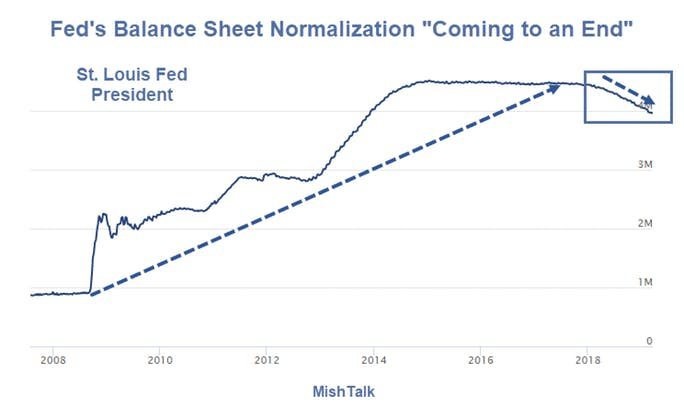
This is the new normal folks. It's a great spot and they said it couldn't be done.
One of my readers accurately commented "It's clear that the members of the FOMC are clueless in their outlook, yet they continue to micromanage the economy with unproven, newly minted monetary tools".
I recently sent my list of questions for the Fed to Jerome Powell. Prior to that, I sent them to the Wall street Journal.
Neither responded. The Journal would rather conduct bullshit interviews, and the Fed would rather give silly speeches than address some thoughtful questions.
In case you missed it, please consider Hello Jerome Powell, We Have Questions.
Author
Mike “Mish” Shedlock's
Sitka Pacific Capital Management,Llc

















