When the long end breaks, everything else listens


When the long end breaks
Markets did not crack because of a single headline. They cracked because too much risk was leaning the same way when the bond floor moved.
The spark was familiar enough. Trump reopened the tariff file, this time dragging Greenland annexation and a clutch of European capitals back into the trade war frame. That alone would usually have been absorbed as another negotiating gambit, aka TACO, another line item for the risk calendar. But this was not a geopolitics led selloff. It was a positioning accident detonated by Japan.
The real fault line ran through Tokyo. Japanese government bonds, already brittle from years of distorted demand and policy engineering, finally buckled. Long dated yields did not edge higher, they lurched. The forty year yield punching through four percent was not a data point, it was a regime signal. A market, long anesthetized by the central bank's presence, suddenly found itself without a buyer of last resort.
Three pressures converged at once. Election risk injected the specter of fiscal excess. Domestic life insurers, once the structural bid, were net sellers. And a weak twenty year auction confirmed what everyone feared but hoped to ignore. Supply was real. Demand was conditional. In that moment the market stopped debating theory and started clearing risk.
Call it Japan’s Liz Truss moment if you want. The label matters less than the mechanism. This was not a one-day panic. It was a multi-year imbalance flashing red when liquidity thinned, and confidence slipped. Once Japan’s long end snapped, the shockwave ran straight through global duration. Treasuries followed. Europe followed. Only China stood apart, insulated by capital controls and policy walls.
Equities never had a chance to ignore it. This was the wrong tape for crowded books. Gross exposure was stretched. Net exposure was elevated. The absence of a familiar Trump backtrack only made it worse. When the unwind began, it hit where it always hits first. Growth. Duration-sensitive tech. The parts of the market are priced for stability and cheap capital.
And this is the part that keeps getting missed. It is not the absolute level of yields that unsettles markets. It is the speed of the move. Markets can adapt to high yields. They struggle with yields that arrive too fast. When the long end reprices in days instead of quarters, liquidity steps aside, hedges scramble, and assets priced off stability start wobbling. Japan is not breaking markets because yields are high. It is breaking complacency because they are getting there in a hurry.
Gold told the cleaner story. As bond volatility woke up, capital ran to the asset with no issuer, no maturity, and no policy committee. New highs were not a vote of confidence in growth. They were an insurance premium being repriced in real time.
Crypto learned the same lesson it keeps relearning. It is not a hedge when geopolitics collide with rates. It is leverage wearing a different badge. When real volatility rises, speculative proxies get sold, not sheltered.
Rates themselves sent the final signal. The long end did the damage, but as equities rolled, bonds found buyers again. This was not a wholesale sell America moment. It was Japan exporting volatility through the global bond curve. Rate cut expectations barely moved. The curve steepened because the term premium woke up, not because recession was suddenly back on the table.
The dollar’s softness followed the same script. The yen jumped first, then gave some of it back, while the broader dollar stayed heavy. This was not capital running for the exits. It was capital quietly buying insurance in case the old “Sell America” tape resurfaced. And this is where that narrative still breaks down, as I argued earlier this week. Europe does not sit in US assets out of loyalty or habit. It sits there because the returns still work. Until that performance equation changes, the weaponization of capital remains more headline than action. Foreign officials can trim Treasury holdings at the margin, but private capital continues to absorb the flow without batting an eye.
Volatility, finally, is no longer asleep. Bond vol led. Equity vol followed. Skew had been whispering for days. Now the tape is speaking plainly. Technical levels matter again. Gamma matters again. Below SPX 6775 thresholds, selling feeds on itself.
The constructive note is that seasonals still lean supportive. The tape is wound, not broken. But the message from Japan is unambiguous. When the longest, quietest corner of the bond market starts shouting, every other asset class stops pretending it cannot hear.
Just as I was about to hit publish, headlines crossed that Japan’s second-largest bank is planning sizeable JGB purchases in the wake of the rout. For now, desks in Tokyo are staying tight-lipped (at least the ones I called). But if these flows are politically nudged, and that seems more likely than not, this starts to look less like discretionary balance-sheet support and more like a shadow form of yield curve control. Whether that is enough to staunch the bleeding and buy the market time to regain its footing is the open question. ( keep an eye on the yen for clues which way the market is leaning).
Gold keeps climbing while Japan’s long end burns
“What makes this move so sticky is that Japan has become the wind tunnel for global credibility risk. “
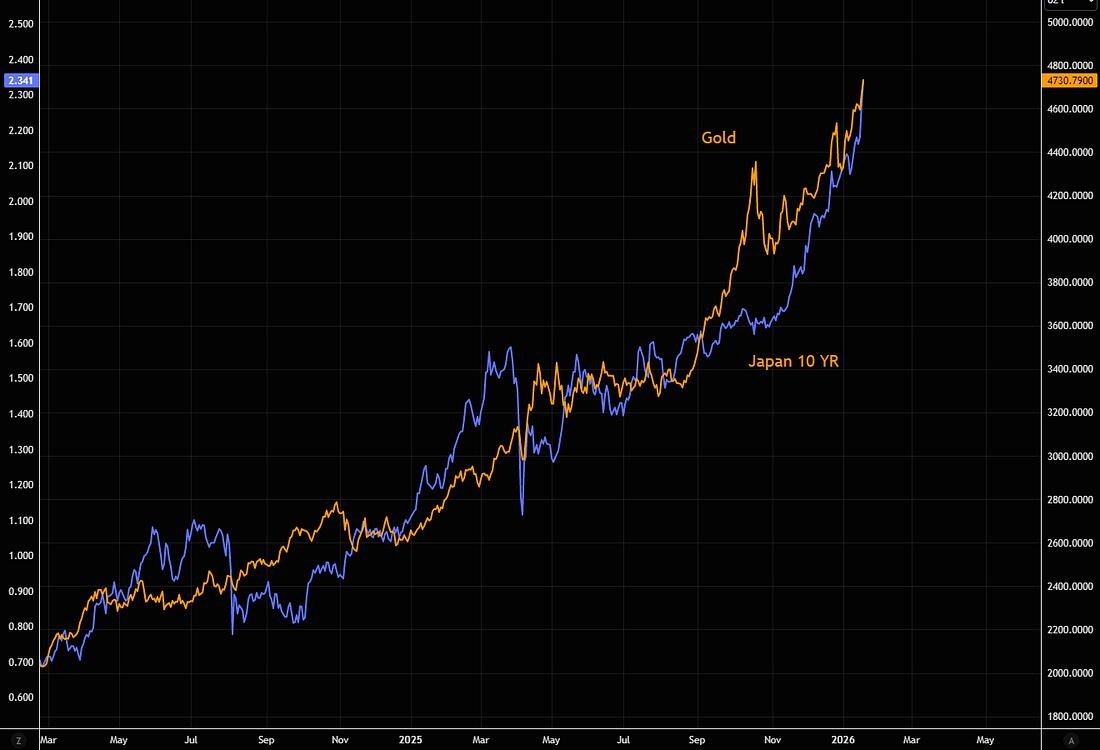
Gold is doing what it does best when the bond market loses its manners. As JGBs crater and geopolitics throws fresh kindling onto the tape, bullion is not just rising, it is marching, like a quiet convoy that keeps moving while everyone else argues at the intersection.
The market ear
The uptrend channel is still intact, still clean, still in control, but we are starting to stretch away from the 21 and 50-day moving averages, the kind of dislocation that does not kill a trend but does raise the odds of a sharp, mean-reverting shakeout that feels bigger than it really is.
What makes this move so sticky is that Japan has become the wind tunnel for global credibility risk. When Japanese rates surge, gold tends to thrive, not because Tokyo alone matters, but because Japan is the market’s oldest laboratory for financial repression, and when that experiment starts to wobble, the rest of the world hears the glass crack. Higher JGB yields are not just a local rates story. They are a transmission mechanism, exporting duration stress into global curves and pulling capital toward the one asset that does not need a central bank to validate it.
And yet, this still does not look like full blown upside panic. Gold volatility is higher, sure, but it is not doing the kind of vertical launch that normally marks a true mania phase. Momentum is hot, the tape is stretched, but the options market is not screaming. That matters because it suggests this is still a grind higher driven by hedging and allocation, not a final melt where everyone loses discipline at the same time.
Positioning is shifting in a way that makes the trend harder to fade. Specs are being pulled in, not at the old extremes, but with enough force to add fuel to the squeeze. CTAs are chasing as well, the classic late-stage accelerant that can push price beyond what looks reasonable on any static model. If you want a reality check on froth, do not look at spot gold first. Look at miners. Their momentum has been brutal, the kind of move that usually happens when the equity wrapper starts trying to front-run the metal.
The relative value angle is still supportive too. The demand story remains simple. Investors keep paying for stability over leverage, and the macro menu keeps serving fresh reasons to hedge, from policy credibility and geopolitics to tariffs, deficits, and the recurring theatre of fiscal brinkmanship.
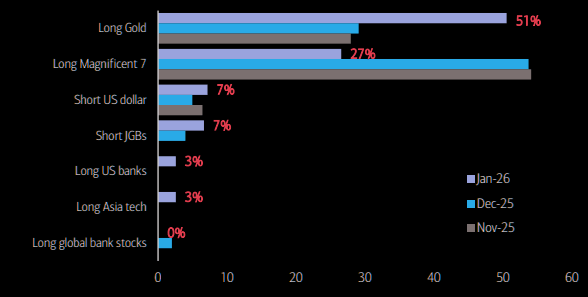
None of that means the trade is risk-free. The crowding is real. By survey measures, gold is now the standout crowded trade and is being labelled overvalued with a confidence that usually arrives late. That is the tax you pay for being right in public. When everyone starts pointing at the same lifeboat, the ride gets choppier even if the ship is still taking on water.
A very crowded trade
BOA
So the right framing is this. Gold is still the cleanest expression of a world repricing sovereign confidence, with Japan as the immediate accelerant. The trend is alive. The structure is intact. But the further we drift from the moving averages, the more you should expect the market to test conviction with a violent pullback before it rewards it again.
Author
Stephen Innes
SPI Asset Management
With more than 25 years of experience, Stephen has a deep-seated knowledge of G10 and Asian currency markets as well as precious metal and oil markets.

















