When faced with job losses and inflation, consumers retreat like turtles, hiding under the bed

Outlook
All the US data on Monday was awful. Inflation higher, activity lower. This was on top of affirmation that the tariffs will be real. We are six inches away from stagflation. This accounts for the 10-year yield tanking again and ruining the prospect of a dollar rally. Oil and most other commodities fell, too.
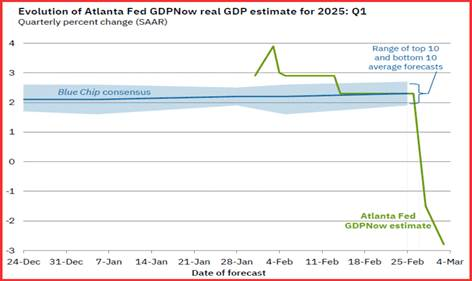
The Atlanta Fed set some pants on fire with the latest GDPNow, at a whopping -2.8% from +1.5% only last Friday. This is due, as usual, to real personal consumption expenditures falling from 1.3% to zero and real private fixed investment growth from 3.5% to 0.1%. We can’t recall a chart this awful.
Trump gives a speech tonight, accompanied by thousands of protesters (and a lot of security). He can’t say anything to fix things at this point and can only make things worse. It’s already far worse than even the most pessimistic Trump opponent had forecast.
The data and surveys point to a loss of confidence in Trump, the US as a member and leader of the free world, and the usually robust and resilient US economy. When companies are faced with high uncertainty, they cannot plan and capital spending crashes. When consumers are faced with jobs losses and inflation, they, too, pull their heads into their shells and hide under the bed.
And another possible government shutdown on March 14 will not be taken in stride as it was when the economy was booming. Context matters. It looks even worse when the economy is flailing and will inspire an even scarier slew of newspaper headlines about how the US is basically broke.
Speaking of headlines, Reuters displays a chart from something named the Policy Uncertainty Unit (https://www.policyuncertainty.com/index.html), devised by some top university professors (and new to us). It covers many countries and has some sub-indices based on specific events. Inputs are gleaned from over 2000 newspapers around the world and ten in the US, as well as things like the Fed’s surveys of professional economic forecasters.
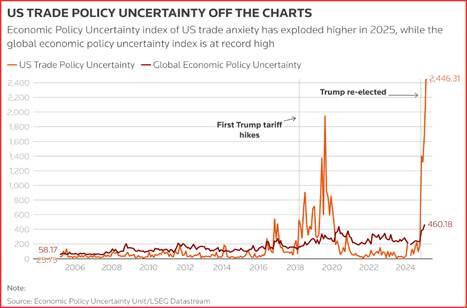
Uncertainty is the enemy of resilience and robustness. Trump is the worst thing ever to hit the US and global uncertainty indices. Any chance this is overreaction? Yes, of course. Trump can retreat, or payrolls on Friday could look good (with federal job losses far down the road or all those people get new jobs). The stock market could get a buy-on-the-dip mindset. Bloomberg reports the Goldman Sachs CEO sees only a very small chance pf recession. Blackstone sees the economy in good shape and none of its execs expect a recession.
We normally skim over regional Fed statements. For one thing, there are far too many. For another, it’s usually one voice alone in the wilderness if by chance someone says anything not anodyne. But today we get NY Fed Williams and Richmond Fed Barkin. Pay heed. One new line of thinking has three rate cuts because of the flailing economy. We say it’s too soon to judge and besides, the Fed makes policy on inflation and employment, not GDP or the stock market or uncertainty headlines.
Forecast
Let’s not kid ourselves. Trump is toxic. We can barely force ourselves to watch news TV (of any stripe) because it’s just so full of stupidity and meanness. The US economy very likely will pull out of this slough of despond—it always does—but we don’t know how long it will take. Weeks or years? The financial crisis of 2008—09 took years and impoverished millions. We don’t have a specific crisis like that just yet, but these are precisely the conditions—high uncertainty—in which a crisis can more easily form. We expect the yields to keep dropping for some days to come and the dollar to follow. Note that something can come out of left field and change everything. Like China invading Taiwan.
Tidbit: Yesterday top Treasury counselor Rattner wrote in the NYT that big businessmen do not oppose Trumps’ “move fast and break things,” even as they dislike “the unqualified cabinet appointments, the cozying up to Russia, and perhaps most of all, the tariffs” plus the war on diversity and the “continued flood of appalling actions, like his abrupt firing of several top military officers.” After all, last week the stock market hit a new high.
Confidence among businessmen is high even as confidence among the public is falling (52% disapprove of Trump according to the latest CNN poll). The author thinks the public is right. “We are in an economic tug of war between the optimism felt by investors and executives and the worrisome potentialities of Mr. Trump’s incoherent policies. My business friends may yet come to regret their support for the president.”
Rattner fails to mention that some high-profile names like Zuckerberg and Bezos switched to Trump after specific, brazen threats to themselves personally as well as their businesses.
This is an excerpt from “The Rockefeller Morning Briefing,” which is far larger (about 10 pages). The Briefing has been published every day for over 25 years and represents experienced analysis and insight. The report offers deep background and is not intended to guide FX trading. Rockefeller produces other reports (in spot and futures) for trading purposes.
To get a two-week trial of the full reports plus traders advice for only $3.95. Click here!
This is an excerpt from “The Rockefeller Morning Briefing,” which is far larger (about 10 pages). The Briefing has been published every day for over 25 years and represents experienced analysis and insight. The report offers deep background and is not intended to guide FX trading. Rockefeller produces other reports (in spot and futures) for trading purposes.
To get a two-week trial of the full reports plus traders advice for only $3.95. Click here!
Author
Barbara Rockefeller
Rockefeller Treasury Services, Inc.
Experience Before founding Rockefeller Treasury, Barbara worked at Citibank and other banks as a risk manager, new product developer (Cititrend), FX trader, advisor and loan officer. Miss Rockefeller is engaged to perform FX-relat

















