What's constraining a more robust return to work?


Summary
Demand for labor, as measured by job openings and hiring plans, has fully recovered, but employers report finding it increasingly difficult to nd the workers they need. Labor constraints are occurring - more than four million workers still remain officially classified as unemployed compared to prior to the pandemic in February of last year.
The current disconnect between unemployment and the supply of labor comes down to a slew of factors – not all mutually exclusive – that have made it hard for employers to hire. Health concerns, childcare issues, and greater financial wherewithal thanks to enhanced unemployment benefits may be slowing the return to work. The mammoth challenge of restarting the economy and businesses stepping up hiring seemingly all at once has generated additional frictions.
These forces should abate over the coming months. However, other impediments are likely to weigh on the labor supply for longer, including some mismatch between skills and industries and accelerated retirements.
Ultimately, we expect the pickup in activity will cause many workers who have left the labor force during the pandemic to return in the near- to medium term. In the meantime, increased demand for labor amid strapped supply is likely to add to building wage pressures.
Multiple factors constraining a robust return to work
By most indications, demand for labor is strong. The economy is reopening and consumer spending is surging amid pent-up demand for services and unusually high household savings. Job openings have climbed to record highs, while the share of small businesses planning to expand employment has fully recovered.
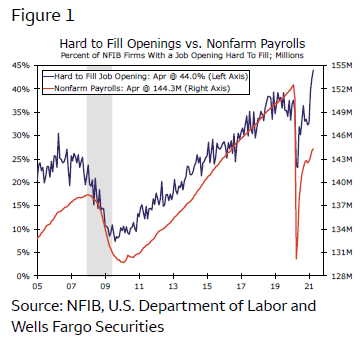
The outcry for labor comes as there are 8.2 million fewer jobs in the economy since February 2020. Yet employers report finding it increasingly difficult to find the workers they need. Labor shortages were mentioned across the Federal Reserve districts in the latest April Fed Beige Book and across a number of industries in comments from the latest ISM surveys. A record 44% of small business owners report having at least one job opening as hard to fill (Figure 1). Lack of labor was pointed to as one of the reasons behind April's surprisingly weak jobs report, but what is behind this imbalance between the supply and demand for workers?
Recent data make it clear that staffing up after a pandemic will not be a quick, seamlessprocess. Nearly three million workers are not in the labor force at present due to COVID,and we believe there are a number of factors – not all mutually exclusive – constraining amore robust return to work. In this report, we highlight a few of the key situations workersmay be grappling with and discuss the broader implications for the labor force recovery.
Author
Wells Fargo Research Team
Wells Fargo

















