What markets are getting wrong about the Bank of England

The Bank of England is poised to cut rates at its 8 May meeting, and markets are pricing a faster pace of easing thereafter. We're less convinced the Bank will deviate from its once-per-quarter cutting rhythm, but we do think it could cut rates to a lower level than investors are currently expecting.
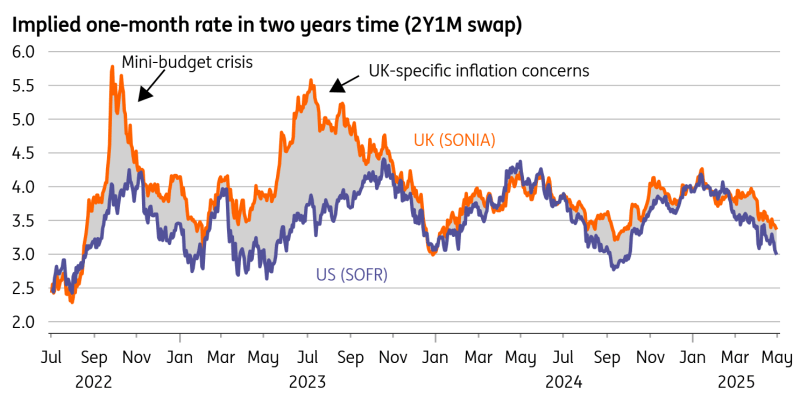
Markets expect the BoE to pick up the pace of rate cuts this summer
Will the Bank of England be forced to pick up the pace of rate cuts? Markets certainly think so. Having so far cut rates once per quarter, investors are pricing three cuts at the next four meetings. That's heavily linked to what's now priced into the Federal Reserve curve in the US. Investors also expect rates to bottom out at 3.4%, so a little more than 100bp lower than where we stand today.
Both of those points are debatable. We don’t think the Bank will move quite as quickly in the short term, but we also see scope for rates to go lower into 2026. Let’s take each of those points in turn.
On speed, it’s certainly true that the Bank is poised to cut rates at its 8 May meeting. Elevated uncertainty and subsequent weakness in survey data suggest another 25bp rate cut is a no-brainer. We expect an 8-1 vote in favour, with arch-dove Swati Dhingra voting for a larger 50bp move, just as she did in February.
Investors now expect more rate cuts from the Bank of England
Source: Macrobond, ING
But for the Bank to speed things up thereafter – and cut rates in either June or September, in addition to August – a couple of things need to happen.
First, we’d need to see clearer signs that the UK economic outlook is materially deteriorating. And there isn’t much sign of that right now, beyond some weaker survey readings.
Tariffs are unlikely to deliver a major, direct hit. Britain simply isn’t that exposed to US goods demand. A US recession would be more problematic, given that it would drag down the UK’s more significant trade in services. For now, our base case is a pronounced slowdown rather than outright recession.
Domestically, recent employer tax hikes have so far been less damaging than first feared. Weekly data on redundancies remains very low. So while the jobs market is getting cooler, we’re not seeing any of the classic warning signs you’d normally start to see in a recession.
The economy is also getting a decent tailwind from government spending. And we’re also closely watching UK-EU discussions, which could culminate in closer regulatory alignment and less friction at the border. The government is hoping tangible improvements in the trading arrangement will convince the Office for Budget Responsibility to boost its growth forecasts and unlock more fiscal “headroom”.
We don’t think the impact will be particularly significant in practice, but some positive headlines on UK-EU relations might lift BoE rate expectations over the next few weeks. Both sides meet on 19 May.
Services inflation is still proving stubborn
On inflation, the story hasn’t changed all that much since the Bank’s March meeting. Yes, oil and natural gas prices are lower, which will prompt a modest downgrade in the BoE’s inflation forecast. We see headline inflation peaking around 3.5% later this year (2.6% currently). And at the margin, that should mitigate some of the Bank’s concerns about higher energy costs feeding into services, like it did after the 2022 gas price shock.
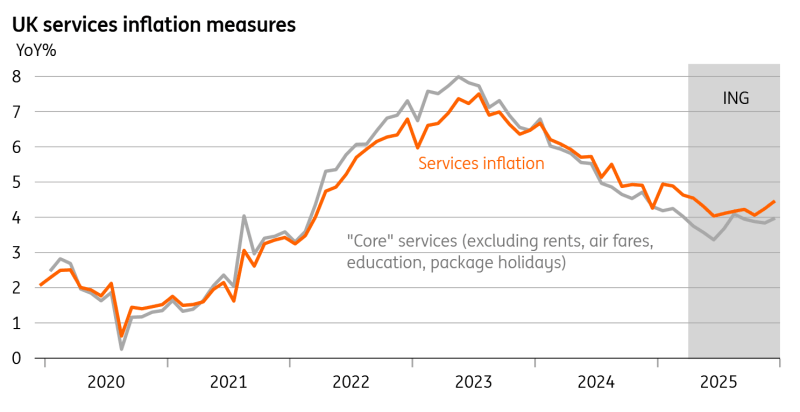
But services inflation is still an issue. At 4.7%, it is 0.2pp below where the Bank had predicted in its February forecasts, but it has been bouncing around 5% for some time now. And that’s much too high.
Services inflation looks better once volatile items and rents are stripped out
Source: Macrobond, ING
That should change, as we’ll come onto, but the risk is that April’s services inflation data isn’t that helpful. This is a big month because it’s when a load of annual price hikes kick in. These look set to be fairly chunky, despite many in theory being linked to past rates of headline inflation, which has been much lower this winter than in the one before.
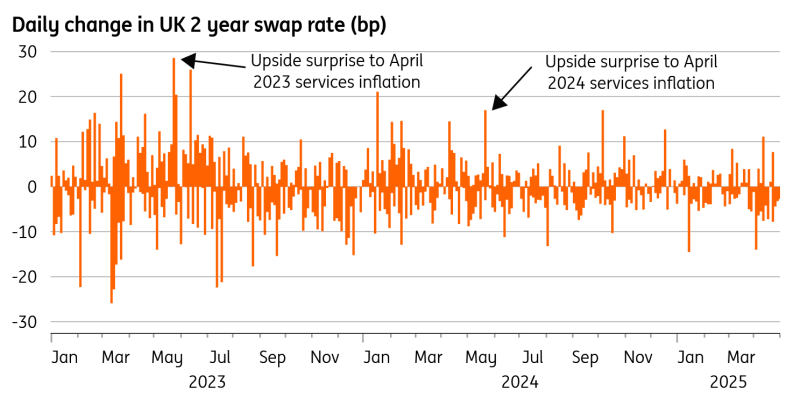
Our base case is that April’s services inflation stays at 4.7%, though we accept it could come in higher than that. Some of the biggest one-day moves in UK swap rates over the past two years were driven by upside surprises in April services inflation.
April inflation releases have a habit of driving big market reactions
Source: Macrobond, ING
The Bank could ultimately take rates lower than markets expect
That data won’t be available at the May meeting, and the Bank won’t want to commit to anything before it sees it. We therefore don’t expect any major changes in the BoE’s language this month. It’s unlikely to change its forward guidance, which simply points to “gradual and careful” further easing.
Beyond this month, however, things could start to change. Services inflation should start to come noticeably lower later this quarter; we expect it to fall to 4.2% in June. Our measure of core services inflation, excluding rents, which is arguably a better gauge of underlying service-sector price growth, is already down at 4%.
That should enable the Bank to become more relaxed about inflation by the Autumn. At the end of last year, our view was that this would enable the Bank to speed up the pace of cuts, just as markets are starting to price. The messaging from officials so far this year has made us less convinced of that, and instead, we think the path of least resistance is for the Bank to keep cutting rates once per quarter.
That process could, however, continue for longer than markets are now pricing. We think Bank Rate will fall to 3.25% by mid-2026 and possibly even a little lower than that.
Read the original analysis: What markets are getting wrong about the Bank of England
Author
James Smith
ING Economic and Financial Analysis
James is a Developed Market economist, with primary responsibility for coverage of the UK economy and the Bank of England. As part of the wider team in London, he also spends time looking at the US economy, the Fed, Brexit and Trump's policies.