What a drag it is getting old: Implications for economic growth


Summary
The working-age population in Latin America grew markedly in the last decades of the20th century and the first decade of the current century. However, the demographic growth rate has downshifted in recent years, and the IMF looks for further slowing incoming years.
Real GDP growth in Latin America can be volatile due, at least in part, to the region's relative reliance on commodity production. Looking through the noise, the trend rate of economic growth in the region appears to have slowed in recent years.
Not every country in the region will experience significant deceleration in the number of individuals of working age. However, the countries with the strongest demographic outlooks tend to be among the region's poorest. Even if these nations enjoy robust rate of economic growth in coming decades, their small economic size will limit their effect on regional output.
The largest economies in the region will collectively experience much slower rates of demographic growth, which will exert headwinds on Latin America's rate of economic growth in coming years.
Because strong rates of investment spending tend to support productivity growth, the region could offset the demographic headwinds on economic growth via acceleration in capital accumulation. But, there is little reason to expect that savings and investment in the region will strengthen considerably, at least not in the foreseeable future.
Latin America likely will continue to register lackluster rates of economic growth in the coming years. With a projected increase in the region's working-age population through the mid-2030s, the demographic outlook in Latin America is not as dire as it is in Europe or China. But, the region likely will not experience robust rates of economic growth in coming decades if its national saving and investment rates remain depressed.
Working-age population in Latin America should continue to grow
In the fifth report in our series on the demographic outlook in different regions of world and the associated implications for economic growth, we turn our attention to Latin America. For ease of analysis, we follow the nomenclature of the International Monetary Fund (IMF) and aggregate 33countries into "Latin America and the Caribbean." Not only does this aggregation include all nations in South America, Central America, and the Caribbean, but it also includes Mexico. Hereafter, we will simply refer to this region as "Latin America." Among the major regions of the world we have analyzed thus far in this series, Latin America is the smallest in terms of economic size. The region accounts for less than 10% of global GDP.
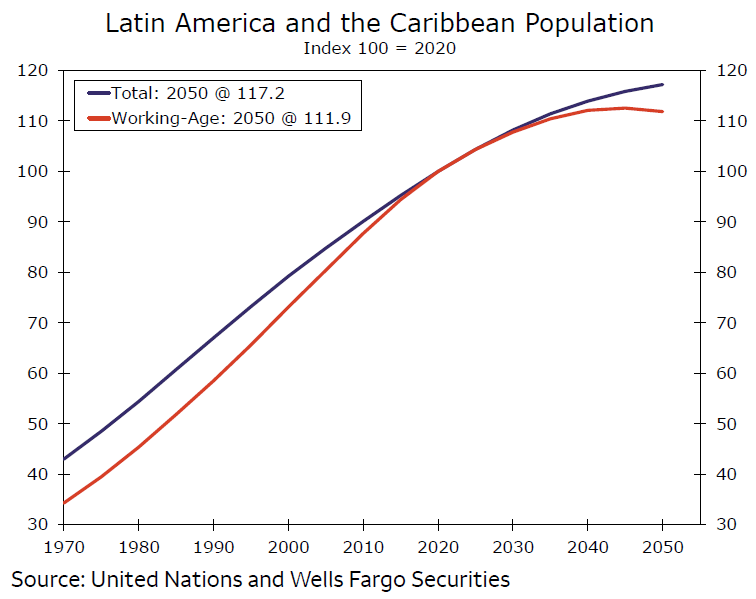
The overall population in Latin America has more than doubled since 1970, and the United Nations (U.N.) projects that on balance it will grow 17% more by 2050 (Figure 1). Although Latin America will not experience as much population growth as Africa, where the population is expected to nearly double by mid-century (see Part II), the region does not resemble China (Part III) or Europe (Part IV) either. The U.N. looks for population declines in both China and Europe by 2050. The marked rise in the overall population in Latin America over the past 50 years was driven by the region's high birthrate that led to a trebling of the working-age population (i.e., individuals between the ages of 15 and 64) over that period.
Author
Wells Fargo Research Team
Wells Fargo