Weekly roundup: Stock market recovery persists, but is the Dollar permanently damaged?
- Stocks markets in a well-established recovery.
- Momentum and growth stocks are leading the recovery, which is why US stocks are rising sharply and the FTSE 100 is lagging.
- The dollar could take longer to recover, as it struggles with the burden of a political risk premium more so than equities.
- Markets are acting like this is the peak for US trade policy uncertainty.

Stocks are on track for another weekly gain, and the recovery continues once more on Friday. Stock markets globally are a sea of green. The S&P 500 is currently higher by nearly 4% in the past 5 days, the Nasdaq is higher by more than 5%. European indices are also pulling higher, the Eurostoxx index is up by 3.6% and the Dax is higher by more than 4%. The FTSE 100 is up 1.8% so far in the last 5 sessions, and it continues to lag its European counterparts on Friday, eking out a mere 0.2% gain. However, even the performance of the FTSE 100 is impressive, since it is heavily influenced by energy companies and the price of oil is lower by more than 9% in the past month.
Tech stocks boost the US stock market recovery
So, what is driving the recovery in the stock markets? The chief factors that are boosting US stocks this week include liquidity, growth stocks and momentum. Low volatility, quality stocks and dividend players are contributing to US stocks markets’ gains, but not by as much as liquidity and growth. This recovery rally is a reverse of what we saw during the peak of the sell off earlier this month: liquid stocks like tech led the brutal sell off, now they are driving the recovery. The top performing sectors on the S&P 500 this week include leisure, electronics, copper, gaming, and consumer finance. All of these sectors fare well when volatility is moderate, and the growth outlook is rosy. On the downside, gold is one of the weaker sectors, along with insurers and healthcare, two extremely defensive sectors that tend to outperform when volatility and uncertainty is high.
Stock markets are riding a wave of hope that US tariffs will be scaled back, and the White House will provide certainty around future economic policy. They are also benefitting from strong earnings reports. Google reported earnings that smashed expectations last night and its stock is higher by more than 5% in pre-market trading. These are powerful drivers for further US stock market gains at the end of this week.
FX market more wary about USD tariff risks compared to stocks
While the S&P 500 has erased the bulk of its losses from this month, and is down 2% month to date, the FX market is not so sure. The sharp decline in the dollar index in April has retraced less than a quarter of its decline. The dollar is still the weakest currency in the G10 FX space for April and is down 6% vs. the CHF and 5.5% vs. the euro. The yen is higher by 4.8% vs. the USD in April.
Why is the dollar not recovering like US stocks? Although the dollar is advancing on Friday on the back of signs of an easing in US/ China trade tensions, it is not advancing at the same pace as stocks for a few reasons. Demand for euros remains strong, and speculative positioning has risen sharply since February. It could persist this week after a recovery for the German IFO in April and encouraging signs that the ECB will cut rates in order to protect European economic growth. However, speculative demand for euros may continue to grow as they are still not at the peak from September, so there could be further upside for the euro in the coming months.
Added to this, many US companies are global enterprises, who are less exposed to the US economic policy, especially compared to a currency, whose value is entirely based on the stability of the country’s economic and political institutions. These have been tested by President Trump. Although stocks can recover on the back of a fall in market risk, the FX market may take longer to recover. The world is hugely exposed to the US dollar, this episode with Trump’s unorthodox economic policy may have caused a small structural shift out of the dollar and the ramifications could be felt for some time.
Treasuries are still the world’s safe havens
The same logic applies to US bonds. Treasuries have been tested as the world’s best safe haven this month. 30-year, 10-year and 2-year Treasuries underperformed European bonds and UK bonds this month. This is a complete turnaround from earlier this year, when US bonds were outperforming European bonds, and US yields were falling relative to European yields. This is a clear sign that Treasuries now have a political risk premium attached to them, however, this could be eroded if the White House can reestablish conventional economic policy making. As you can see below, Treasuries have outperformed Gilts in the last 5 years, and performed with the same level of volatility as German bunds, which suggests that the recent month of turbulence for Treasuries may be short lived.
Chart 1: Bond yields for UK, US and Germany, normalized to show how they move together
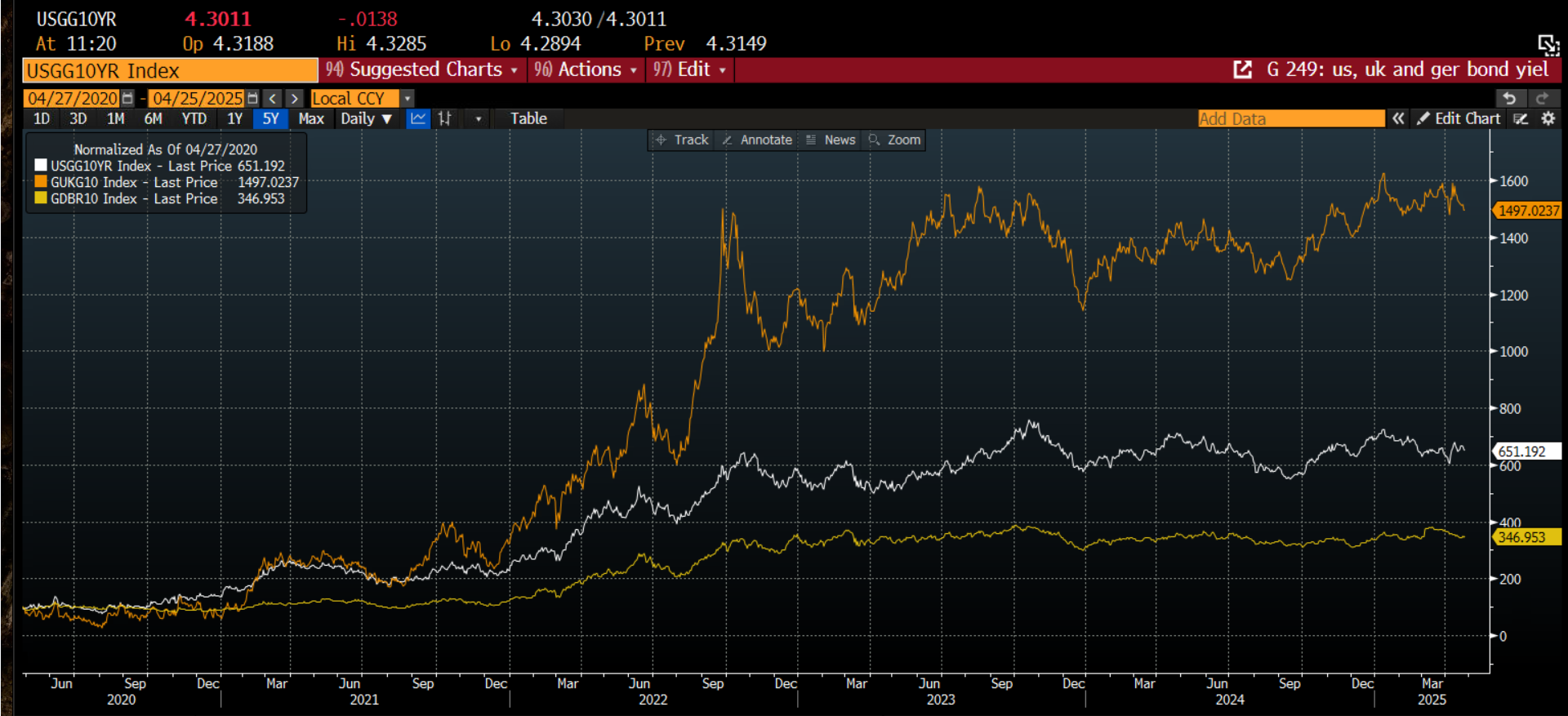
Source: XTB and Bloomberg
As we wait to see if the US/ China trade talks will begin, the dollar seems to be the asset that has been most impacted by US tariff policies. Stocks are in a well-established recovery and now that Treasury Secretary Scott Bessant has taken the reigns of economic policy at the White House, this may persist. Treasury yields are also starting to normalize.
This is the last full trading week of April, which has been an historic month for markets. Will this be the most volatile markets get this year? Or could there be further surprises to come?
Author

Kathleen Brooks
XTB UK
Kathleen has nearly 15 years’ experience working with some of the leading retail trading and investment companies in the City of London.