Week Ahead on Wall Street (SPX QQQ): Bitcoin bubbles over but equites survive and prosper
- Bitcoin tumbles again as China intensifies crackdown
- Equity markets fall modestly on Friday as big tech retreats but data remains supportive
- Fed now flips from behind the curve to thinking about being ahead

A tumultuous week but not on Wall Street. Crypto, in particular Bitcoin, was the narrative spreading across trading screens this week and the crypto leader suffered a staggering fall on Wednesday. Bitcoin plummeted through several key support levels, most notably the 200-day moving average, before eventually finding some support around the $30,000 mark. Elon Musk attempted to calm fears over Tesla’s holding by using the diamond hands emoji to imply the electric vehicle company had not sold any of its holdings.
The situation worsened on Wednesday as increased regulatory concerns mounted. In particular, China stepped up its opposition to the cryptocurrency and has reiterated that stance on Friday sending Bitcoin tumbling once again, down 10% at the time of writing. China said on Friday that it needed to “crackdown on Bitcoin mining and trading behavior, and resolutely prevent the transmission of individual risks to the social field.”
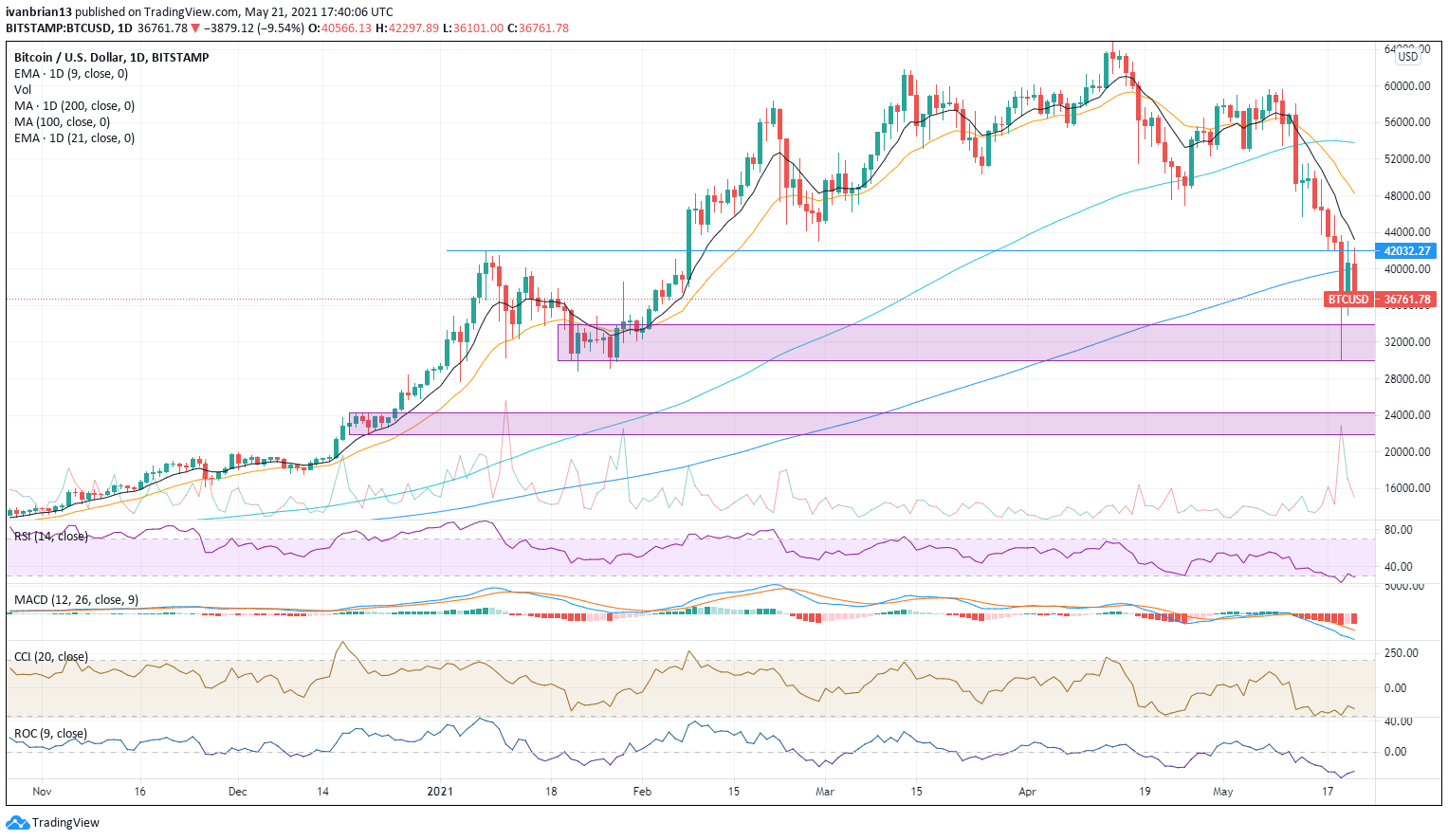
Self-praise is no praise they say so the fact that key levels identified above worked is good enough of a reward.
Naturally, crypto-related stocks such as MARA, COIN, RIOT, and others all fell sharply. Back on the equity front and the fed minutes provided some surprises on Wednesday. The thought of thinking about tapering did actually enter the Fed narrative and the market duly implied that the Fed was not going to let inflation run away with itself and marked up the prices of big tech names accordingly. Some strong support zones we have been identifying in our modestly named FAANGTastic technical analysis worked out well for big tech as all rallied from previous weeks' sell-offs.
Yields retreated from equity investors' consciousness and besides the German Bund nearly going positive on Tuesday, US yields remained stable around 1.65% all week, removing one crutch from equity bears.
Earnings season was pretty much done last week but a few laggards in the retail space joined the show and duly matched the expectations of beating expectations, you get it right? Home Depot, Lowes, Walmart, Target, Macy's, and Foot Locker all beat on the top and bottom lines and helped equities to think about thinking about making new highs!
Fund flows continued to be strong but finally equity ETF (Exchange Traded Funds) flows snapped a 14-week winning streak with the first week of net outflows from equity funds from the last 15 weeks. To show just how much flow is underpinning the equity market the latest REfinitiv Lipper Alpha data shows the twenty-second consecutive week of inflows to non-US Equity ETF’s. Some evidence of rotation was evident with Financials (XLF) and Russel 2000 (IWM) receiving net inflows while the SPY lost over $6 billion and the Nasdaq (QQQ) over $1 billion.
S&P 500 (SPY) and Nasdaq technical levels
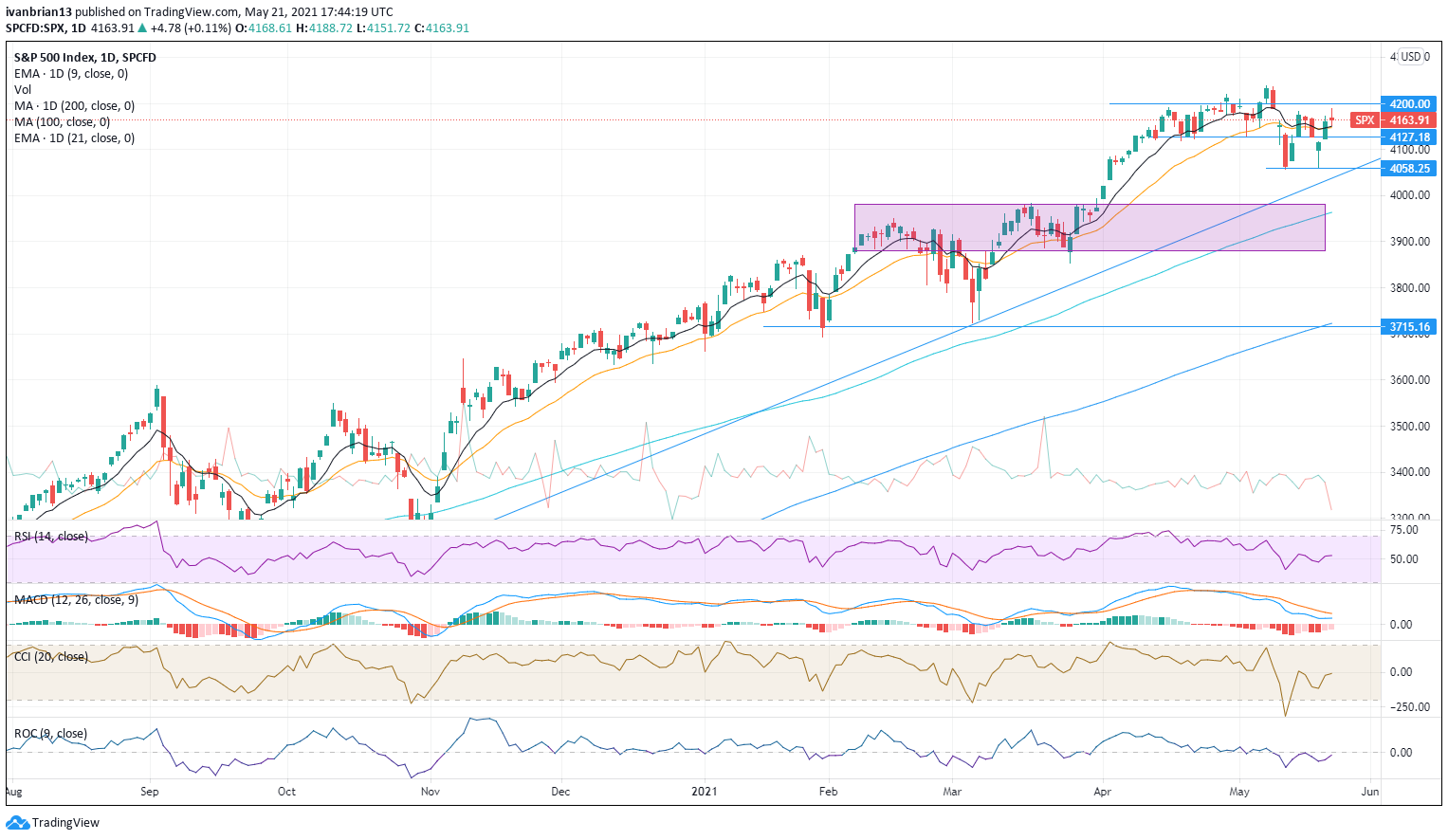
The Nasdaq shows some similar characteristics failing to break last week's lows and bouncing perfectly from trendline support at 12,994. This was also a strong support zone as highlighted. There should not be too much stopping a move to 13,750 barring next week's relatively benign-looking data releases. The Moving Average Convergence Divergence is about to give a crossover buy signal which would be a nice confirmation of the bounce from the trendline and support zone.
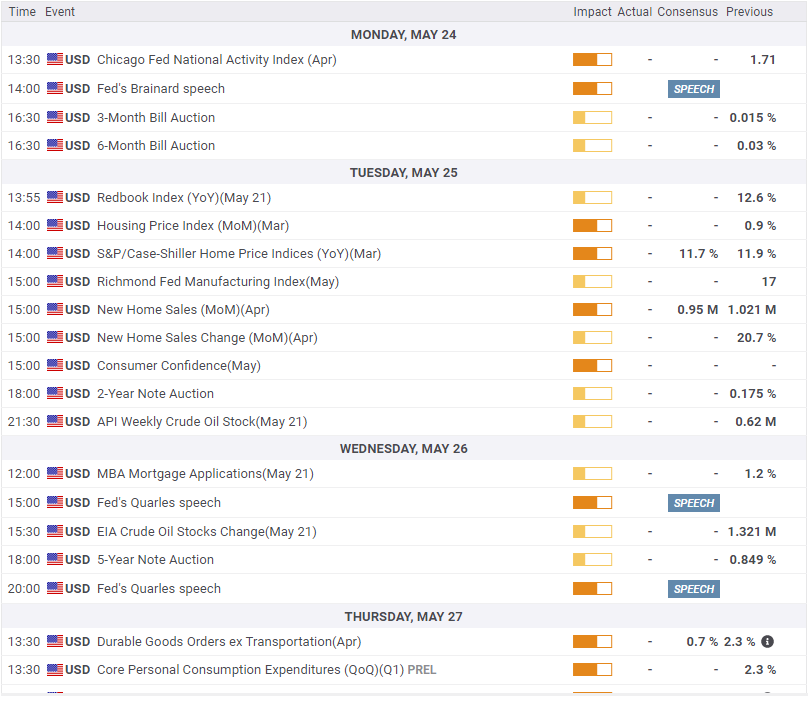
Week Ahead Data
Earnings
|
2021-05-25 |
Before Market Open |
Viasat |
VSAT |
|
2021-05-25 |
Before Market Open |
Cracker Barrel Old |
CBRL |
|
2021-05-25 |
After Market Close |
Agilent Technologies |
A |
|
2021-05-25 |
After Market Close |
Intuit |
INTU |
|
2021-05-25 |
After Market Close |
Nordstrom |
JWN |
|
2021-05-25 |
After Market Close |
Toll Brothers |
TOL |
|
2021-05-25 |
Before Market Open |
AutoZone |
AZO |
|
2021-05-26 |
After Market Close |
Williams-Sonoma |
WSM |
|
2021-05-26 |
Before Market Open |
Capri Holdings |
CPRI |
|
2021-05-26 |
After Market Close |
Snowflake |
SNOW |
|
2021-05-26 |
After Market Close |
American Eagle Outfitters |
AEO |
|
2021-05-26 |
Before Market Open |
Dick's Sporting Goods |
DKS |
|
2021-05-26 |
After Market Close |
Workday |
WDAY |
|
2021-05-26 |
After Market Close |
Okta |
OKTA |
|
2021-05-26 |
Before Market Open |
Bank of Montreal |
BMO |
|
2021-05-26 |
Before Market Open |
Columbus McKinnon |
CMCO |
|
2021-05-26 |
After Market Close |
NVIDIA |
NVDA |
|
2021-05-26 |
Before Market Open |
Abercrombie & Fitch |
ANF |
|
2021-05-27 |
Before Market Open |
Movado Group |
MOV |
|
2021-05-27 |
After Market Close |
Guess? |
GES |
|
2021-05-27 |
Before Market Open |
CorVel |
CRVL |
|
2021-05-27 |
Before Market Open |
Burlington Stores |
BURL |
|
2021-05-27 |
Before Market Open |
Dollar Tree |
DLTR |
|
2021-05-27 |
After Market Close |
Ollie's Bargain Outlet |
OLLI |
|
2021-05-27 |
After Market Close |
VMware |
VMW |
|
2021-05-27 |
Before Market Open |
Medtronic |
MDT |
|
2021-05-27 |
Before Market Open |
Best Buy Co |
BBY |
|
2021-05-27 |
After Market Close |
Costco Wholesale |
COST |
|
2021-05-27 |
After Market Close |
Autodesk |
ADSK |
|
2021-05-27 |
Before Market Open |
Canadian Imperial Bank |
CM |
|
2021-05-27 |
After Market Close |
Salesforce.com |
CRM |
|
2021-05-27 |
After Market Close |
HP |
HPQ |
|
2021-05-27 |
After Market Close |
Gap |
GPS |
|
2021-05-27 |
Before Market Open |
Genesco |
GCO |
|
2021-05-27 |
Before Market Open |
Sanderson Farms |
SAFM |
|
2021-05-27 |
Before Market Open |
Dollar General |
DG |
|
2021-05-27 |
Before Market Open |
The Toronto-Dominion Bank |
TD |
|
2021-05-27 |
After Market Close |
Box |
BOX |
|
2021-05-27 |
After Market Close |
Dell Technologies |
DELL |
|
2021-05-28 |
Before Market Open |
Caleres |
CAL |
|
2021-05-28 |
Before Market Open |
Big Lots |
BIG |
Source: Benzinga
Economic releases
Author

Ivan Brian
FXStreet
Ivan Brian started his career with AIB Bank in corporate finance and then worked for seven years at Baxter. He started as a macro analyst before becoming Head of Research and then CFO.
















