US Dollar Weekly Forecast: December is calling, but CPI gets the final word
- The US Dollar clinched its fourth consecutive week of gains.
- Fed rate hike repricing and rising crude Oil prices propped up the Greenback.
- Investors’ focus should now gyrate to inflation data due next week.

The week that was
The US Dollar (USD) kept its bullish bias well in place for yet another week, extending its march north while revisiting an area last seen 18 months ago.
The continuation of the leg higher in the buck has been underpinned by steady bets on further tightening by the Federal Reserve (Fed) in Q4, alongside radio silence on the Middle East conflict. The latter, of course, was fanning the flames for higher prices of crude Oil, which in turn fed into the inflation-extra tightening narrative.
However, there was an unexpected additional driver of the Greenback’s marked uptrend in the last few days, and it was the resurgence of fiscal concerns in France. The direct consequence of this scenario was the plummeting of the Euro (EUR) to 17-month lows vs. the US Dollar.
Back to the US money market, this time there was no support from Treasury yields as they moved on a downward path across the curve, easing from recent peaks.
Meanwhile, the bias among Fed rate setters remained unchanged, with all advocating for a tighter monetary policy stance in the near-to-medium-term horizon.
Against this backdrop, the US Dollar Index (DXY) has managed to climb past the 102.50 level, also leaving behind its 200-week SMA.
Inflation has never left the stage
The market participants have quickly forgotten the numbers from the September Nonfarm Payrolls (+29K) and turned their attention back to inflationary pressure with crude Oil prices still on the rise.
Prior to the release of the jobs data, no one was anticipating another rate hike at the Fed’s October meeting, and that sentiment remained unchanged following the labour market report.
Nonetheless, there is still widespread expectation that the Fed will increase rates by a quarter percentage point in December, aligning with investors’ forecasts of just over 25 basis points of tightening by the end of the year.
Analysts seem to project a slight decline in yearly inflation for September, although a more significant drop could rekindle speculation that the Fed might maintain its current stance during the last two meetings of 2026.
US consumer prices are currently running significantly above the Fed’s 2.0% target, and it appears that markets will require more than just a few months of apparent disinflationary pressure before considering a steady approach from the Fed, let alone the possibility of rate cuts.
More hikes are coming, but the Fed is divided on timing
The FOMC Minutes and this week’s public comments from Fed officials delivered a broadly hawkish message: inflation remains too high, demand is resilient, and policy is not yet restrictive enough. While most policymakers saw another increase as likely to be appropriate by year-end, officials stressed that the pace would remain flexible and data-dependent.
Indeed, the Minutes from the September 15–16 meeting showed unanimous support for the 25-basis-point rate increase, with most participants judging that another hike would probably be appropriate before the end of the year. Almost all officials saw inflation risks tilted to the upside, while the labour market was close to full employment. The stronger staff outlook and resilient domestic demand gave policymakers room to keep focusing on price stability.
The Minutes also highlighted the risk that AI investment could push aggregate demand ahead of supply over the medium term. Despite higher long-term Treasury yields, many participants said financial conditions remained supportive of growth. That combination, firm activity, broad price pressure, and upside risks from energy and AI, reinforced the view that the Fed still has more work to do.
This week’s speakers largely backed that assessment. Christopher Waller (Board of Governors) said further hikes were needed but did not have to come at consecutive meetings, while Jeffrey Schmid (Kansas City) said the Fed still needed to address the short rate despite higher long-term yields. Alberto Musalem (St. Louis) was more explicit, saying additional monetary-policy firming would be required to bring inflation back to 2% and limit second-round effects.
The overall message is hawkish but measured. The Fed appears increasingly comfortable with the need for further tightening, yet officials are not committing to a fixed timetable. The next moves will depend on whether inflation continues to broaden, whether demand remains strong and how much restraint is already being delivered through higher market yields.
USD longs rebuild as positioning finds a floor
USD non-commercial bullish positioning improved in the week ending September 29, according to the Commodity Futures Trading Commission (CFTC) data. Indeed, net longs increased to nearly 11.9K contracts, reversing the previous week’s decline. Additionally, the four-week change also improved to -5,144 from -8,352, suggesting that the recent deterioration in USD positioning is beginning to stabilise.
Furthermore, open interest increased for the second week in a row, this time to just over 48.3K contracts. With net longs and participation rising together, the move suggests a modest return of fresh USD buying rather than short covering. However, the relatively limited increase in net positioning suggests that conviction remains cautious.
Extra data showed Speculative Exposure rose to 24.6%, while its percentile increased to 45.5. The Net Position Percentile also improved to 48.2, leaving both measures close to neutral historical levels. Therefore, USD positioning is no longer as fragile as it was a week earlier, but it is far from historically elevated.
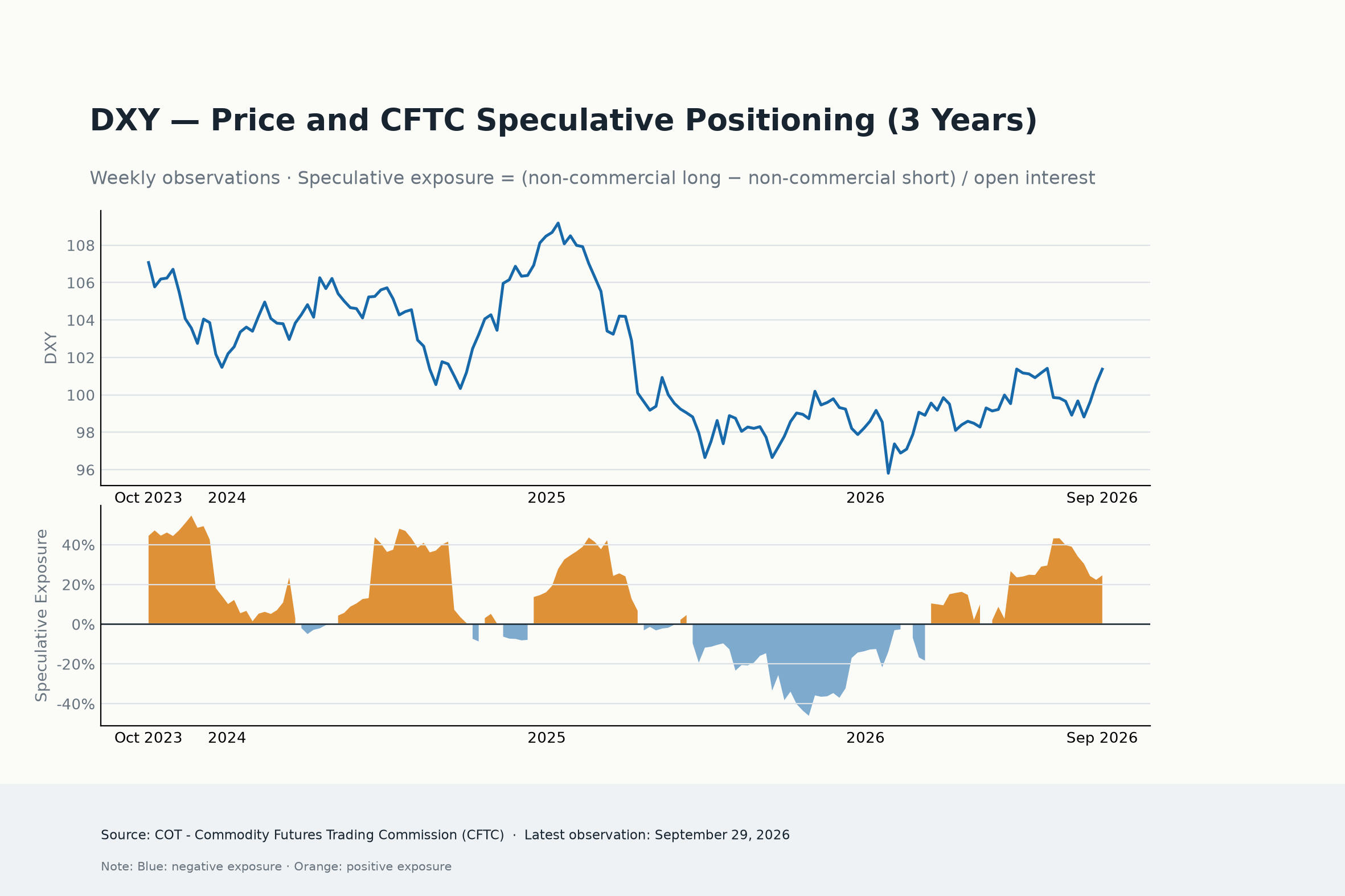
Overall, the latest data point to a tentative rebuilding of bullish USD exposure. The positive weekly change, increasing open interest and improving four-week trend are encouraging, although the modest percentile readings suggest traders are testing the waters rather than aggressively rebuilding long positions.
What’s next for the US Dollar
Next week is set to be significant in terms of data, with domestic inflation returning to the forefront of discussions, alongside insights from consumer spending and a speech by Chair Warsh scheduled for the end of the week.
As always, comments from Fed officials will be important to monitor.
The Dollar's rally still has room to run
From a near-term perspective, the outlook for the US Dollar remains constructive.
The Fed’s hawkish stance, persistent inflation concerns and lingering geopolitical uncertainty are likely to keep the Greenback well-supported.
A better-than-expected CPI report could underpin expectations for another rate hike in December, which may push DXY above the 102.50 mark to post further gains.
Softer inflation readings, however, particularly if accompanied by signs of consumers cutting back on spending, might weigh on the tightening narrative and trigger some profit-taking after the Greenback’s extended run. But for the moment, the mix of diverging policy, renewed speculative demand and a more cautious global backdrop suggests that dips in the USD are more likely to attract buyers than signal a sustained reversal.
Author

Pablo Piovano
FXStreet
Born and bred in Argentina, Pablo has been carrying on with his passion for FX markets and trading since his first college years.
















