The Euro is not the sick man of Europe. France's bond market is

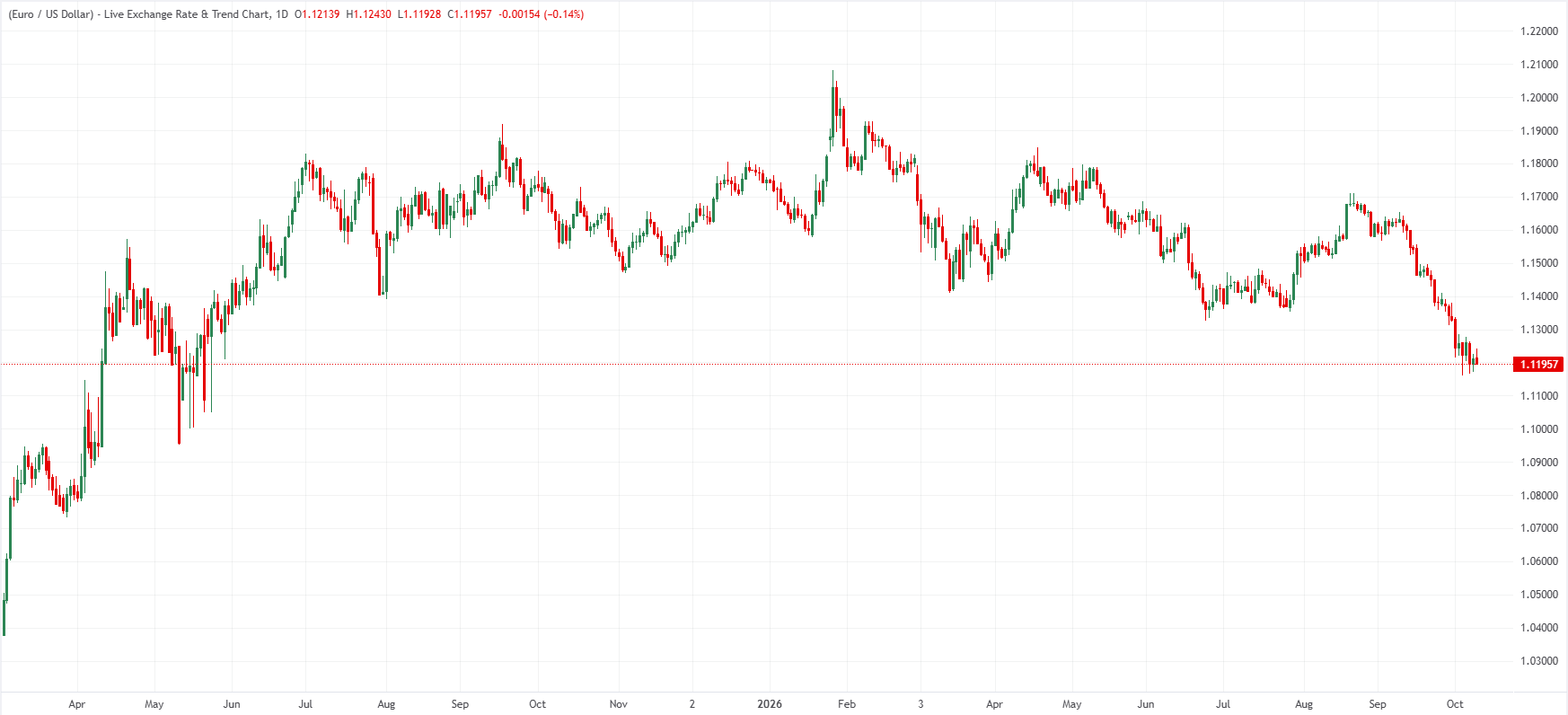
EUR/USD remains under pressure, near the 17-month low of 1.1161 reached on Monday. The pair has lost more than 7% since its yearly peak, as concerns over France's public finances increasingly weigh on the single currency. But behind the weakness of the Euro (EUR), the problem does not necessarily lie with the European economy as a whole. Instead, it is increasingly concentrated in a market that investors once regarded as one of the pillars of financial stability in the Eurozone: French sovereign debt.
France's 10-year government bond yield approached the psychologically important 5.00% threshold on October 2, to levels not seen since 2002. More concerning, the yield spread over German government bonds recently exceeded 150 basis points, reaching levels last observed during the 2011-2012 European sovereign debt crisis.
This development marks a significant shift in how investors perceive European sovereign risk. For years, debt market tensions were largely associated with peripheral economies, particularly Greece and Italy. Today, the Eurozone's second-largest economy finds itself at the center of market concerns.
For currency markets, the question is no longer simply whether France can stabilize its public finances. It is whether the French bond market crisis could become a problem for the entire Eurozone and force the European Central Bank (ECB) to reconsider its monetary policy path.
France's bond market is sending a warning the Euro can no longer ignore
The rise in French bond yields partly reflects a broader global bond sell-off. Higher energy prices, persistent inflationary pressures and expectations that interest rates will remain elevated have pushed borrowing costs higher across several major economies.
But France stands out because of the size of the risk premium investors now demand to hold its debt. The spread between French and German 10-year government bond yields, commonly known as the OAT-Bund spread, has become a particularly important indicator. Unlike the French yield alone, it provides a clearer measure of investor concerns specifically related to France's fiscal outlook.
In early October, the spread briefly exceeded 150 basis points, compared with significantly lower levels just a few months earlier. German government bonds have meanwhile benefited from increased safe-haven demand, widening the divergence between the two markets.
The situation is particularly striking because France now faces higher borrowing costs than Italy and Greece, two countries historically associated with episodes of European sovereign debt stress.
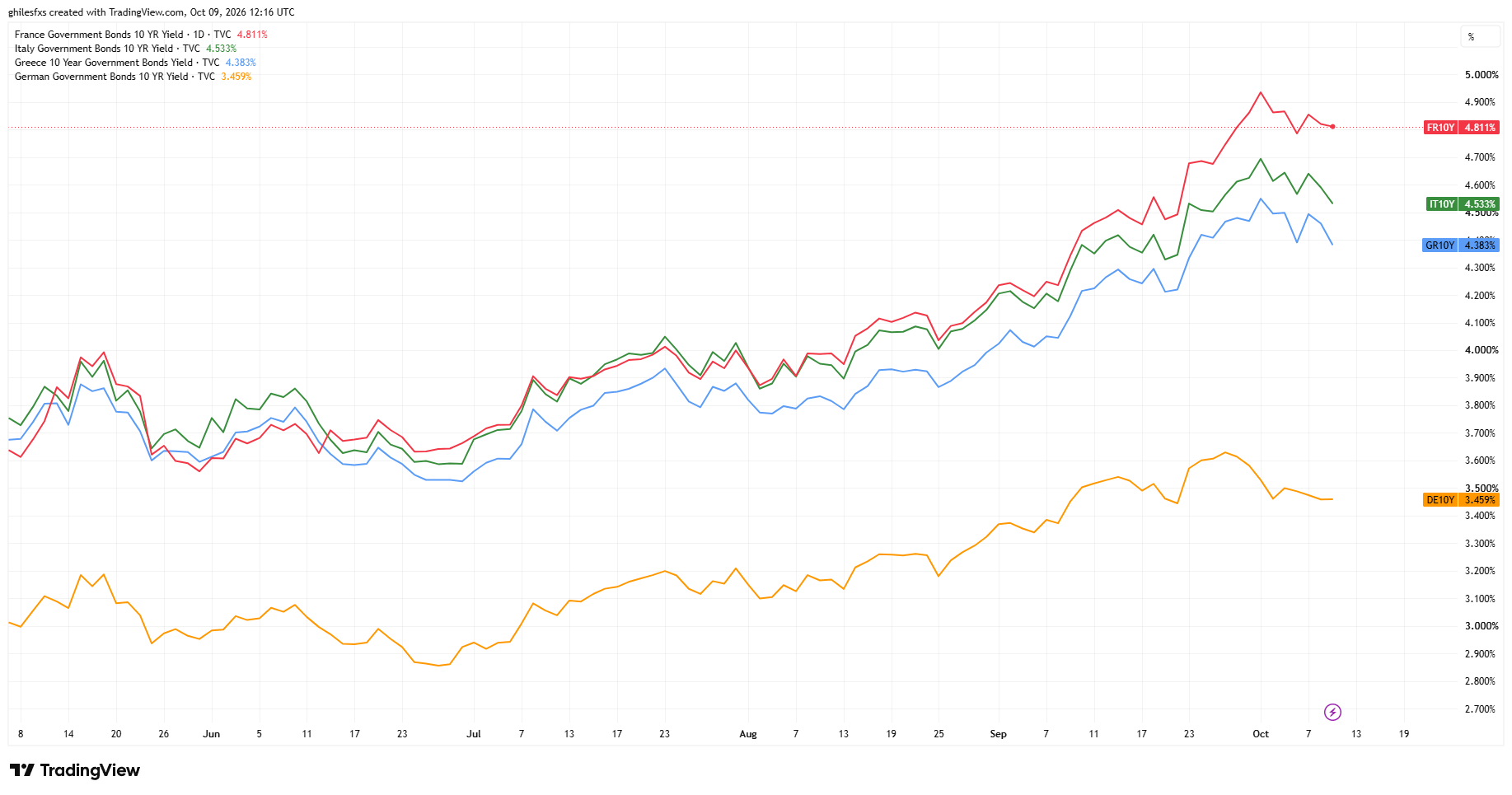
This reversal challenges the traditional hierarchy of sovereign risk within the monetary union. As Deutsche Bank Analyst Jim Reid noted in comments reported by Europe Sun: "The big question is whether this is the start of a new euro sovereign crisis or whether markets have already overshot."
For now, France continues to access financial markets. A recent €12 billion government bond auction attracted demand exceeding twice the amount offered. The problem is therefore less about financing availability than its cost. In other words, investors are not refusing to finance France. They are simply demanding increasingly higher returns to compensate for the perceived risk.
France's fiscal problem is becoming a credibility problem
The deterioration in France's bond market reflects deeper concerns about the government's ability to put public finances on a sustainable path. French public debt is approaching 120% of Gross Domestic Product (GDP), while the budget deficit remains above 5% of economic output. The government also faces borrowing requirements of approximately €340 billion in 2027, at a time when the cost of issuing new debt is rising sharply.
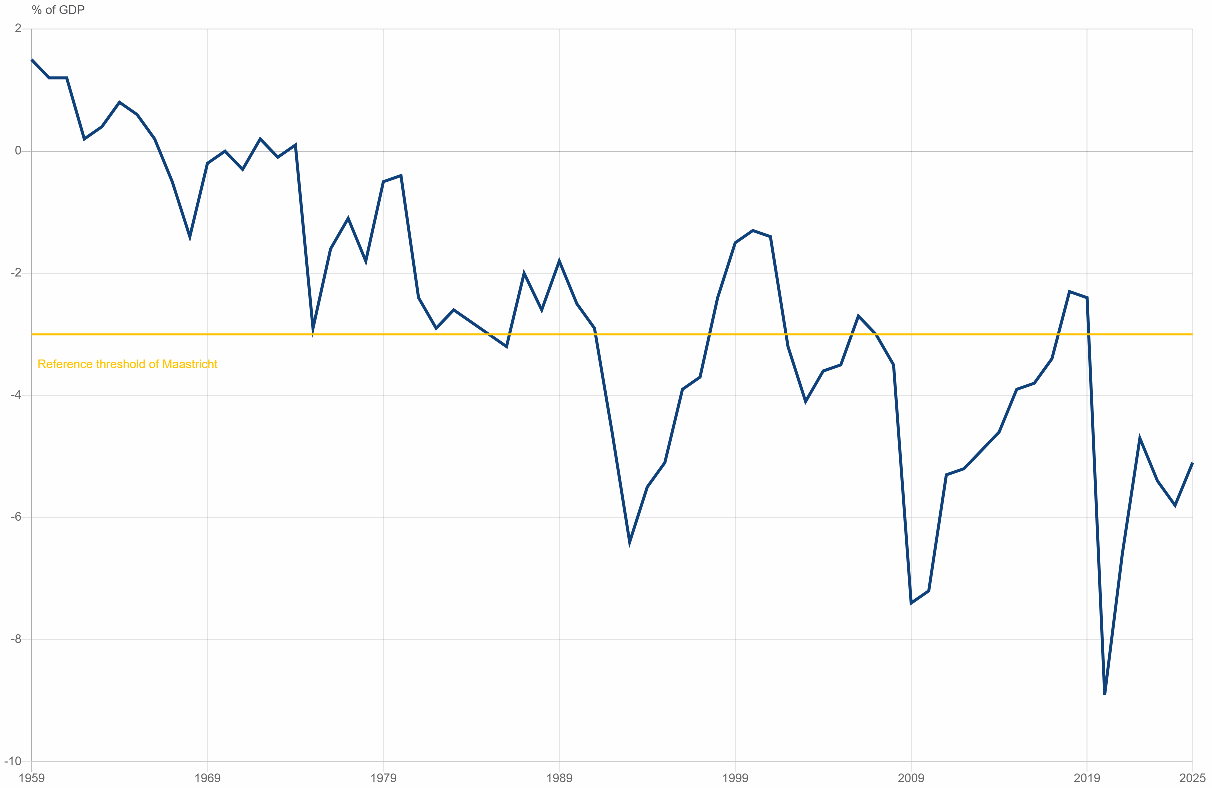
The proposed 2027 budget aims to reduce the fiscal deficit to around 5% of GDP, from approximately 5.4% this year. However, this trajectory has failed to convince investors that France can stabilize its debt burden anytime soon.
More importantly, the budget's political future remains uncertain. Prime Minister Sébastien Lecornu must secure approval from a deeply divided Parliament, with the 2027 presidential election approaching. Leading political figures, including Marine Le Pen and Jean-Luc Mélenchon, are advocating sharply different fiscal policies, without so far providing lasting reassurance to financial markets. Investors fear that electoral considerations could outweigh the need for meaningful deficit reduction.
The problem, however, extends beyond political disagreements. With public debt already elevated, a sustained increase in bond yields could gradually push the government's interest bill higher. As older bonds mature, France must refinance them at significantly higher borrowing costs.
This creates the risk of a self-reinforcing cycle: higher borrowing costs worsen the fiscal outlook, prompting investors to demand an even larger risk premium, which in turn increases financing costs further. France is not necessarily entering a sovereign solvency crisis. But it is facing a crisis of fiscal credibility whose consequences are beginning to extend beyond its borders.
The Euro doesn't fear France alone. It fears contagion
This is precisely where France's difficulties become particularly important for the Euro. In theory, rising government bond yields in a single Eurozone country should not necessarily trigger a sharp depreciation of the common currency. The risk remains concentrated in one part of the monetary union, while other economies can continue to benefit from relatively stable financial conditions.
The situation changes when investors begin to fear that one country's difficulties could spread to other sovereign debt markets. And the first signs of contagion are already emerging.
The spread between Italian and German government bond yields recently approached 130 basis points, recording its largest weekly increase since the COVID-19 crisis. Spreads in other European countries have also widened, while banking stocks have come under selling pressure.
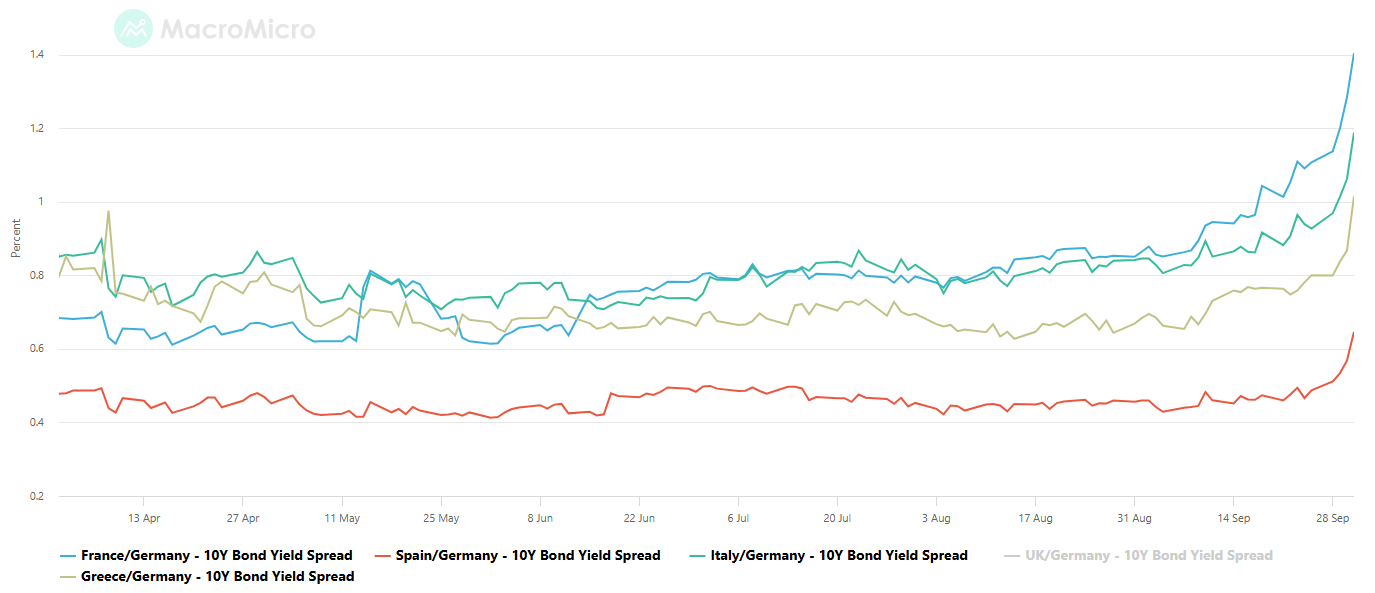
This development is particularly concerning for the Euro because it gradually transforms a national fiscal problem into a shared financial risk. In a Reuters analysis, Goldman Sachs strategists summarized this relationship: "Spreads do not matter for the currency until they are the only thing that matters."
This observation illustrates the shift in investor behavior. For several months, France's fiscal difficulties had a relatively limited impact on EUR/USD. But as rising French yields begin to coincide with broader divergence across European bond markets, investors are reassessing the risk associated with the single currency itself.
According to Bank of America FX strategists, cited by Reuters, every additional 10-basis-point widening in the French-German spread would be associated with a roughly 0.4% decline in EUR/USD. This relationship is not mechanical, but it highlights the currency's growing sensitivity to sovereign debt tensions.
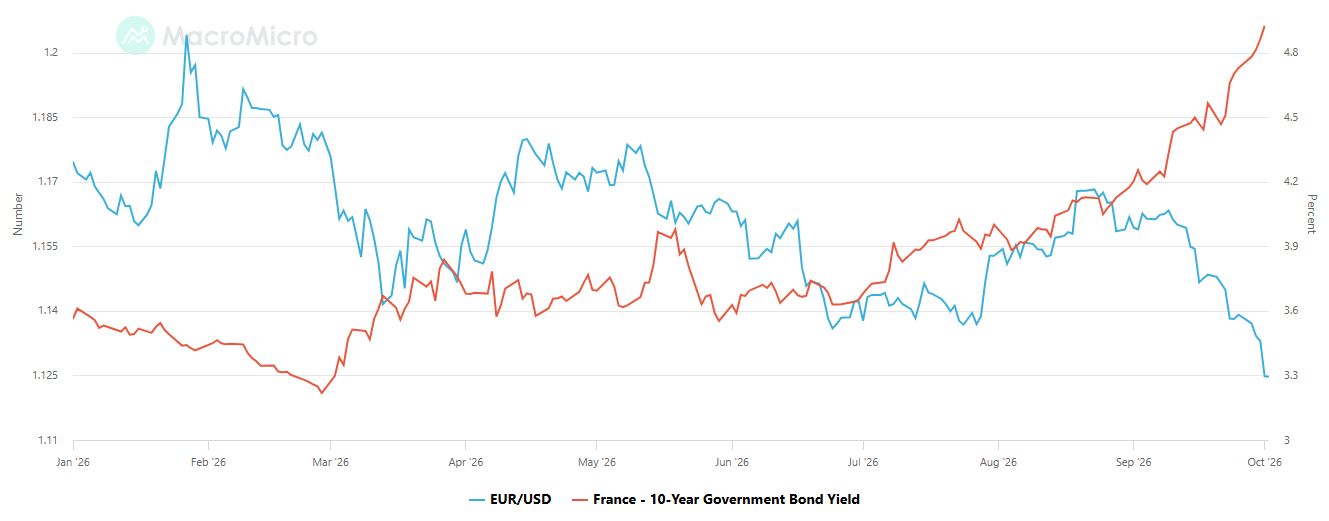
ABN AMRO also emphasizes the importance of this transmission mechanism: "The euro tends to weaken when government bond yields in a major eurozone country, or in several countries, rise sharply because of political and/or fiscal concerns". The firm adds that fears of contagion across Eurozone sovereign bond markets are also contributing to the pressure on the Euro.
The difference between a French bond market correction and a broader European crisis therefore depends largely on the extent of contagion. France under pressure can temporarily weigh on the Euro. Several sovereign debt markets coming under pressure simultaneously could raise more fundamental questions about financial stability across the Eurozone.
Higher European yields are no longer necessarily good news for the Euro
The Euro's current weakness also presents a monetary policy paradox. Normally, rising bond yields and expectations of further interest rate increases support a currency. Higher interest rates make assets denominated in that currency relatively more attractive to international investors. But this relationship generally holds when rising yields reflect stronger economic prospects or expectations of tighter monetary policy. It becomes much less favorable when yields rise because of concerns about public debt sustainability.
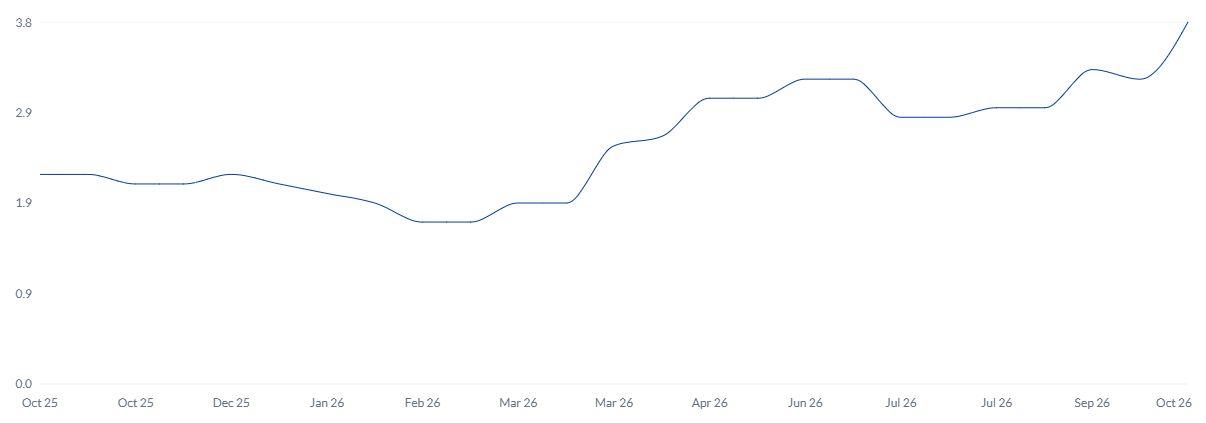
That is precisely what is happening in the Eurozone. The ECB has already raised interest rates twice this year, bringing its Deposit Facility rate to 2.50%, as it attempts to contain renewed inflationary pressures. Annual Eurozone inflation reached 3.8% in September, its highest level in three years, up from 3.2% in August. This acceleration, largely driven by energy prices, would theoretically strengthen the case for further monetary tightening.
But bond markets are already imposing tighter financial conditions. When sovereign yields rise sharply, financing costs for businesses, households and governments also increase, even without another ECB rate hike. This can slow investment, weaken economic growth and eventually reduce inflationary pressures.
For the Euro, the implications are significant as investors are beginning to consider the possibility that the ECB may raise interest rates less aggressively than previously expected, despite inflation remaining elevated.
ING identifies two channels through which French bond market stress directly affects the single currency: "The euro is being affected through two channels: a direct one, where a fiscal risk premium (so far not extreme) has been added, and an indirect one via a repricing lower in ECB rate expectations." According to ING, market pricing for ECB tightening by the March meeting declined to around 45 basis points on October 6 from 80 basis points on September 24.
The ECB faces a fragmentation dilemma it cannot easily solve
The ECB's main challenge is not simply the rise in government bond yields, but the growing divergence between member states. European monetary policy relies on a fundamental principle: decisions made in Frankfurt should be transmitted relatively evenly across financial conditions throughout the Eurozone. However, when French or Italian yields rise much faster than German yields, financing conditions begin to diverge.
This phenomenon, known as financial fragmentation, poses a particular risk for a monetary union made up of several countries with independent fiscal policies. Another increase in policy rates could deepen these divergences by placing additional pressure on the most indebted governments.
Oversea-Chinese Banking Corporation (OCBC) highlights this contradiction: "Rising fragmentation fears are tightening financial conditions through higher sovereign borrowing costs and wider risk premia. This raises the risk that the ECB becomes more cautious on further policy tightening as financial stability concerns begin to compete with inflation risks."
The ECB must therefore reconcile two objectives that could increasingly conflict. On one hand, inflation approaching 4% requires monetary policy to remain sufficiently restrictive to prevent price increases from becoming entrenched across the economy. On the other hand, an excessive increase in sovereign borrowing costs could trigger an economic slowdown and destabilize parts of the European bond market.
The dilemma becomes even more complicated because of the Euro's weakness. A depreciating currency increases the cost of imports, particularly energy and commodities priced in dollars. This risks adding to inflation precisely when bond market stress is encouraging the ECB to adopt a more cautious approach.
The ECB could therefore find itself in a particularly uncomfortable position, having to fight inflation partly fueled by a weaker Euro, while trying to avoid worsening the sovereign bond market crisis that is contributing to the currency's decline.
The Euro's next move may depend more on Paris than Frankfurt
France alone cannot be blamed for the Euro's weakness. Elevated US yields, demand for the US Dollar (USD) and monetary policy divergence between the Federal Reserve (Fed) and the ECB continue to influence EUR/USD. But the French bond market crisis introduces an additional risk factor that is gradually changing what drives the European currency.
ING estimates that the fiscal risk premium currently embedded in the Euro remains relatively modest, leaving room for further depreciation if sovereign debt tensions intensify. The bank therefore sees the possibility of EUR/USD falling toward 1.1100, or even 1.1000 in a scenario of more severe bond market stress. MUFG shares a cautious outlook, arguing that downside risks are likely to persist as long as French fiscal uncertainty and contagion concerns remain unresolved.
For investors, three fundamental developments now deserve particular attention: the trajectory of the French-German yield spread, the potential spread of tensions to other sovereign bond markets and the ECB's response to tightening financial conditions.
These factors could determine whether the Euro's current weakness represents a temporary correction or the beginning of a deeper reassessment of European sovereign risk. France is not yet facing a sovereign funding crisis. And the Euro is not necessarily on the brink of another crisis comparable to 2012. But bond markets are sending an increasingly difficult warning to ignore.
The real danger for the Euro is not simply that France is borrowing at nearly 5%. It is that investors are beginning to wonder which other European governments could face the same treatment. And as long as that question remains unanswered, the ECB may find it increasingly difficult to support the Euro through interest rate hikes alone.
Author

Ghiles Guezout
FXStreet
Ghiles Guezout is a Market Analyst with a strong background in stock market investments, trading, and cryptocurrencies. He combines fundamental and technical analysis skills to identify market opportunities.