CFTC Report: Euro and Aussie shorts expand amid diverging signals

The week in one sentence: Euro and Australian Dollar shorts deepened in the week to October 6, while Yen longs rebuilt. In addition, Coffee buying continued, and Gold exposure remained elevated despite another price decline.
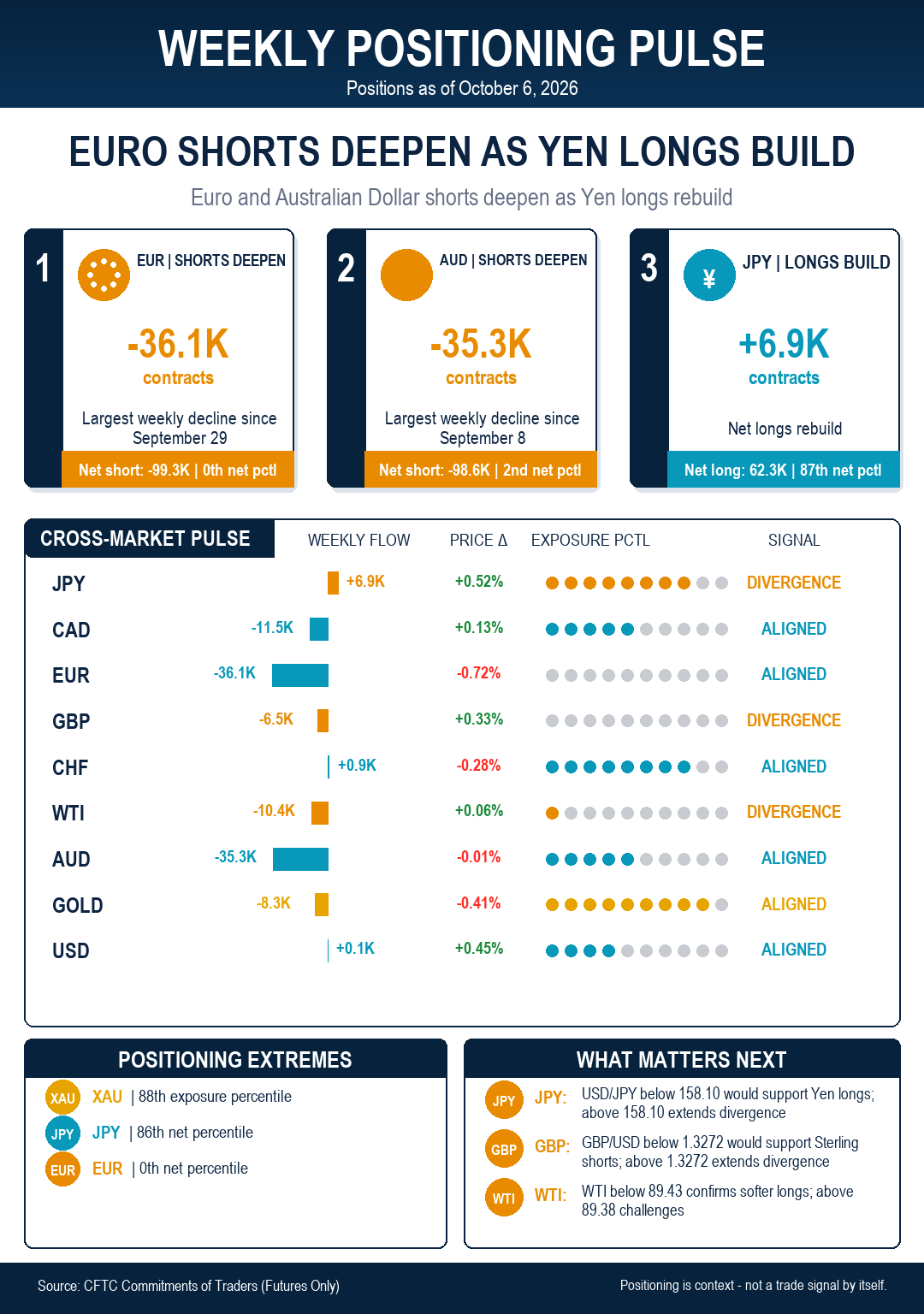
Euro net shorts deepen
Speculators turned more negative on the Euro (EUR), increasing the net exposure to around 99.3K contracts. EUR/USD navigated in the red, slipping back toward the 1.1260 region, so the market is confirming the positioning signal. Exposure is near the 1st percentile, and net positioning is near the 0th. Further price confirmation would strengthen the move; a reversal would argue that the flow is fading.
Sentiment around the Aussie remains sour
Non-commercial players increased their negative bets on the Australian Dollar (AUD), sending the net longs to nearly 98.6K contracts, the highest since late August 2025. The market confirms the positioning signal followed a modest decline in spot below the key 0.7000 yardstick. Additionally, speculative exposure is near the 47th percentile, while net positioning is near the 2nd. The trend would be strengthened by more price confirmation; a reversal would suggest that the flow is waning.
Price and positioning are still at odds
The Japanese Yen (JPY), the British Pound (GBP), and the West Texas Intermediate (WTI) all showed significant mismatches. Price and speculative flow are heading in different directions; therefore, the signal cannot be considered a clear trend call. For traders, the following move is more important than the snapshot: continuation validates the flow, but reversal exposes the mismatch.
Where the flow has confirmation
Price and positioning moved in the same direction for the Canadian Dollar (CAD), EUR, and the Swiss Franc (CHF). That gives the move a better tactical footing, but it still needs follow-through next week; a quick reversal would turn the apparent confirmation into a false start.
The crowded trade
Gold remains the most crowded trade, with positioning at the 88th percentile, while GBP sits at the opposite end of the spectrum, near the 0th percentile. This contrast highlights an uneven balance of risks: heavily crowded positions are more exposed to sharp unwinding, while those with exceptionally low participation have greater scope for renewed buying should price action turn favourable.
Positioning Map
Gold is the clearest crowded long by exposure at the 88th percentile, meaning its net position is large relative to open interest. JPY has the strongest outright net-positioning reading at the 86th percentile, while EUR sits near the 0th net percentile and is therefore unusually lightly owned. These measures capture different dimensions: exposure highlights crowding, whereas the net percentile shows how large or small the position is in absolute historical terms. The map therefore flags crowded exposure in Gold and the greatest potential room for rebuilding in EUR, without treating either extreme as a standalone reversal signal.
Author

Pablo Piovano
FXStreet
Born and bred in Argentina, Pablo has been carrying on with his passion for FX markets and trading since his first college years.
















