Wall Street opens june with a wary bid as trade winds whipsaw sentiment


The wary June bid
The S&P 500 opened June with a tentative tick higher, like a surfer catching a soft wave after outrunning a storm surge. But make no mistake—this market isn’t rallying on conviction. It’s drifting on hope, coasting through a fog of geopolitical landmines and algorithmic guesswork.
After May’s melt-up—the best since Reagan’s re-election—the tape is stalling, caught between policy posturing and the hope that cooler heads might prevail. Wall Street brushed aside escalating global trade tensions Monday, instead choosing to bet on another chapter in the "Tariff Tango" that ends in a handshake, not a slap.
But underneath the surface, the churn was palpable. China fired back at U.S. accusations of trade violations, flipping the script and blaming Washington for failing to uphold its end of the Geneva truce. The détente—barely warm, let alone cozy—now hangs by a Trump-Xi phone call. And while traders want clarity, they’ll settle for headlines that keep the bid alive.
If Trump and Xi patch things up this week, expect another squeeze higher and whispers of new highs to echo through the Street. If they don’t, brace for a whiplash ride through summer where chop replaces trend and range-bound trading becomes the new normal.
In global trade’s high-stakes ballroom, the U.S. and China don’t just dominate the floor—they are the floor.
The U.S., as the world’s biggest buyer of consumer goods, is essentially the demand engine of the planet, vacuuming up products from every factory zone on Earth. China, on the other hand, is the undisputed exporting behemoth, churning out everything from semiconductors to sneakers at a scale that dwarfs rivals. Between them, they form the gravitational core of global commerce.
Most nations, whether they like it or not, align their trade orbit around one of these two giants. Even if they grit their teeth at the geopolitics, they can’t afford to ignore the economics. These are not just trading partners—they’re gatekeepers to growth, balance sheets with nuclear warheads, and policymakers with supply chains wrapped around their fingers.
So when the U.S. and China speak, the rest of the world doesn’t just listen—it trades, repositions, and recalibrates. Because love them or loathe them, they remain the loudest—and most consequential—voices in the global room.
The Nasdaq, still high on AI fumes, closed out May with a jaw-dropping 9% gain, led by Nvidia’s relentless charge. That momentum carried over into June, with chipmakers posting nearly a 2% gain on the day. It’s a market trading like a kid hopped up on sugar—jittery but still sprinting. Nvidia has become the poster child of this run, and until it trips, the crowd will follow. The summer churn has begun.
The street is now eyeing Friday’s jobs number, with final inning whispers around ~100k and a growing crowd hedging (shorting the dollar) for a sub-70k print. The narrative has twisted like a Mobius strip—weak data is now “lagging,” unless it’s too weak to ignore. A soft print could pull the rug from under the “resilient economy” story, especially if it drags yields lower and fractures the illusion of tech’s immunity. Volatility hasn’t shown up yet, but the yield curve is still screaming—like a canary in a coal mine with a megaphone. So don’t get lulled by the pump. This market has all the makings of a classic “trap door” setup: slow grind higher, low realized vol, and then—snap.
Until then, the trade is clear: buy the secular compounders, short the yield-sensitive zombies, and keep one eye on the headlines. Because in this market, narrative isn’t just noise—it’s fuel.
The view
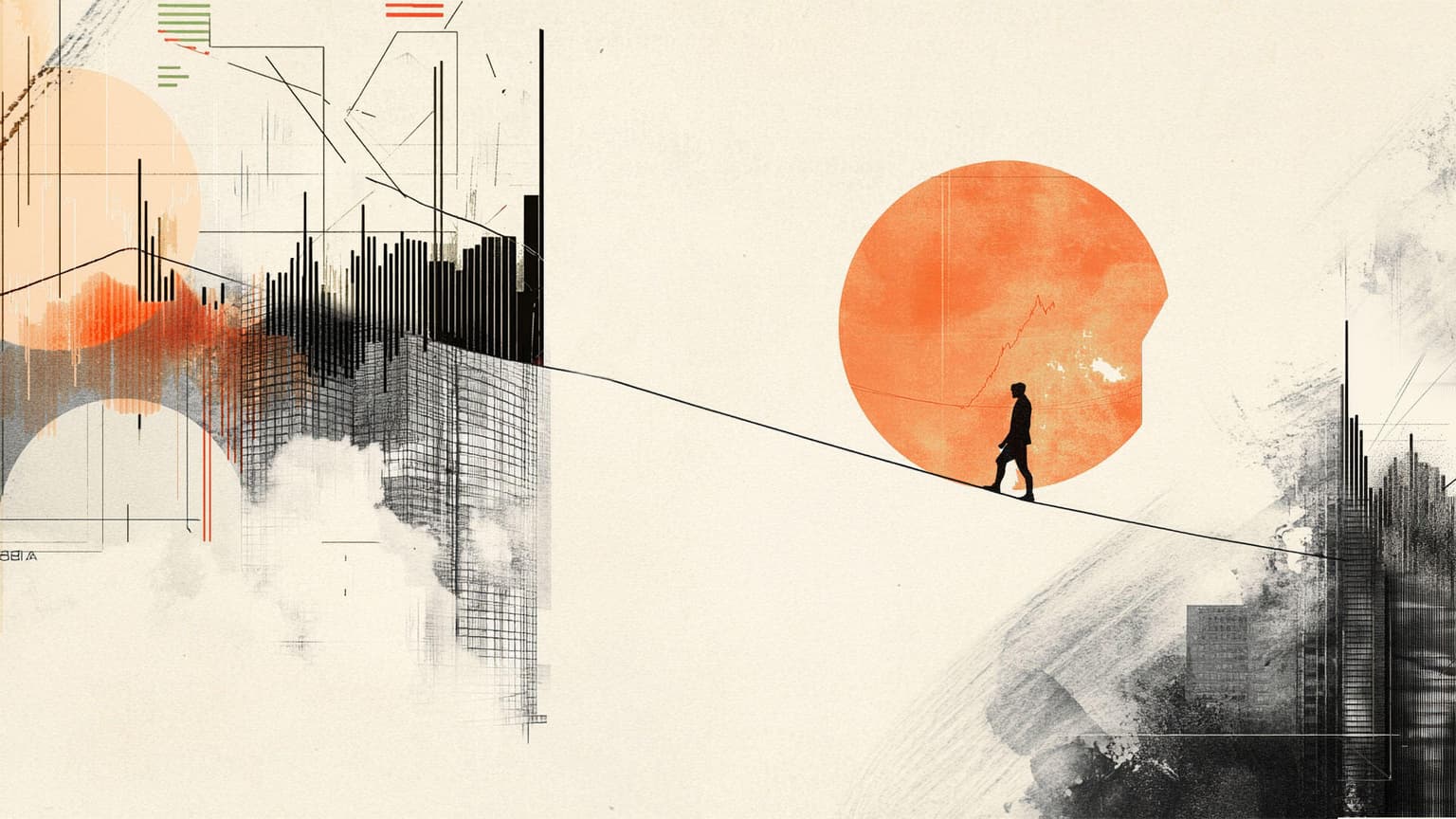
The market has entered a high-wire act—trading with no net, arms wide open, daring gravity to blink first. The left tail risk of a full-blown tariff barrage may have been priced out, but the right tail—some euphoric melt-up on AI mania or a Trump–Xi bromance—feels increasingly limited by bloated multiples and a growth narrative running on fumes. Valuations are already puffed up like a hot-air balloon tethered to soft economic undercurrents, and the higher we float, the more traders scan the basket for leaks.
The SPX, meanwhile, is caught in a coiled spring between 5700 and 6150—a range that mirrors the market’s bipolarity: hope for a dovish twist on trade or a Trump call versus the constant paranoia of macro data souring faster than milk left out in the July heat.
Markets have clipped the wings on both ends: the left tail’s tariff panic has been tranquillized, but the right tail’s moonshot is smothered under the gravity of bloated multiples and hopium-fueled growth projections.
What’s striking isn’t just the range—it’s the consensus forming around the same playbook which has gone from boutique to Broadway: long secular growth and fortress-balance-sheet megacaps, short the walking wounded in a world of 4.5% yields and terminally stalled growth. The street is now chasing that exact setup with reckless abandon. Gross exposure is soaring—charts don’t lie—and last week’s notional long buying in U.S. info tech was the biggest in a decade. That’s not a drift; that’s a stampede.
Author
Stephen Innes
SPI Asset Management
With more than 25 years of experience, Stephen has a deep-seated knowledge of G10 and Asian currency markets as well as precious metal and oil markets.