Volatile volatility is here to stay


The beginning of the end of the USD's bull run
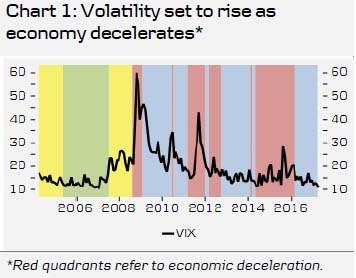
Over the past week, volatility has spiked, equities have corrected lower, the US dollar has collapsed and global yields have dropped. This is as expected as the cycle turns lower. Our quantitative business cycle model has turned increasingly negative with a synchronised move lower across Europe, the US, Japan and emerging markets. The market perception that volatility would fall after the French election as political risk in the eurozone is gone is incorrect, as focus shifts from politics to the economy. Volatility in markets is likely to become more volatile as the cycle turns lower (see Chart 1). Of course, recent news regarding President Trump's interference in the FBI investigations is disturbing and has added to the rise in volatility, but the fundamental driver, in our view, is the turn lower in the cycle. Expect volatility across asset markets to become more volatile near term.
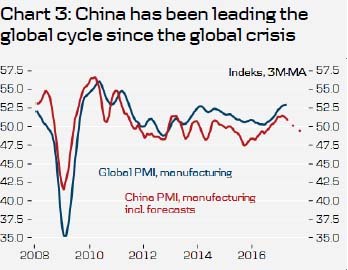
Since the great recession, China has been leading the global industrial production (IP) cycle (see Chart 3). China had several mini-cycles in the period 2013-14 but that can be explained by the authorities' stop-go policies in those years. We are that the cycle in China is now turning lower as the authorities tightening measures to reign in house prices as well a normalisation of infrastructure investments is set to drive lower growth near term. For more details, see Research: China leading indicators – the slowdown is a reality, 2 May 2017. China was the positive story in 2016 but this is set to turn in 2017.
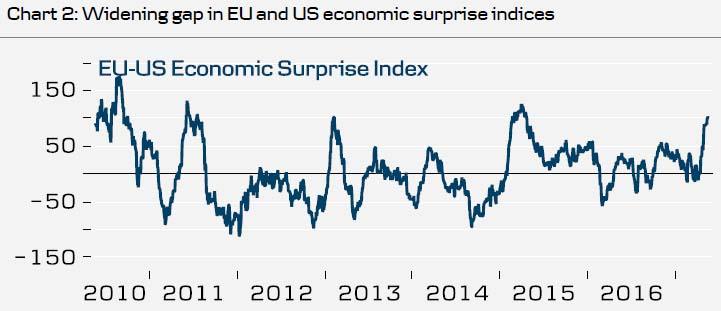
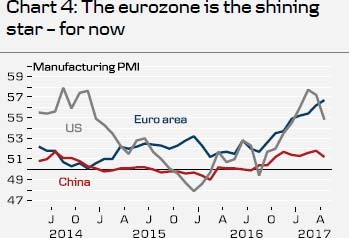
The recent strength of the EUR and fall of the USD can be explained by a repricing of both Europe and the US. The difference in the economic surprise indices between the eurozone and the US is at the highest level since spring 2015 (see Chart 2) and PMIs in the eurozone have been marching higher consistently since September 2016, while the cycle in China and the US is faltering (see Chart 4). Eventually, there will be a spill-over from the IP cycle in China and US into the eurozone as there always is, but for now, the eurozone is shining. However, EUR/USD has moved very far, very rapidly in a very short period of time and that was the reason we decided yesterday to take profit on our long EUR/USD recommendation from FX Top Trades.
Author
Danske Research Team
Danske Bank A/S
Research is part of Danske Bank Markets and operate as Danske Bank's research department. The department monitors financial markets and economic trends of relevance to Danske Bank Markets and its clients.

















