USD/JPY Weekly Forecast: An old-fashioned yield spread move
- USD/JPY reaches six-and-a-half year high at 125.10 on Monday.
- Dollar gains in March coincide with sharply higher Treasury rates.
- Widening yield spread between the US 2-year Treasury and JGB powers USD/JPY.
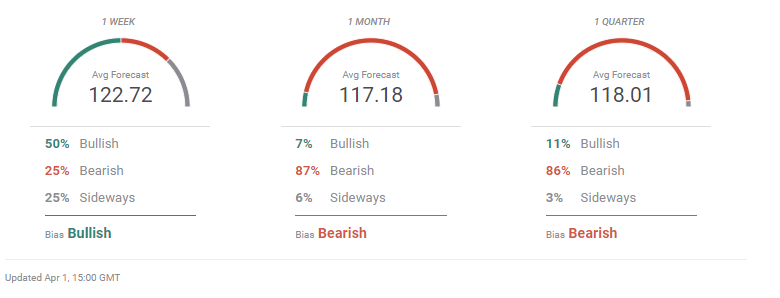
- FXStreet Forecast Poll sees near-term consolidation in USD/JPY.

The USD/JPY climbed to a seven-year high at 125.10 this week moving in near lock-step with the widening bond spread between US Treasury rates and Japanese Government Bond (JGB) yields. Overall the USD/JPY has gained almost 7% this month after its 114.81 close on March 4. The retreat from Monday’s close at 123.81 was a classic profit response to a move that achieved all of its technical goals.
-637844207096411839.png)
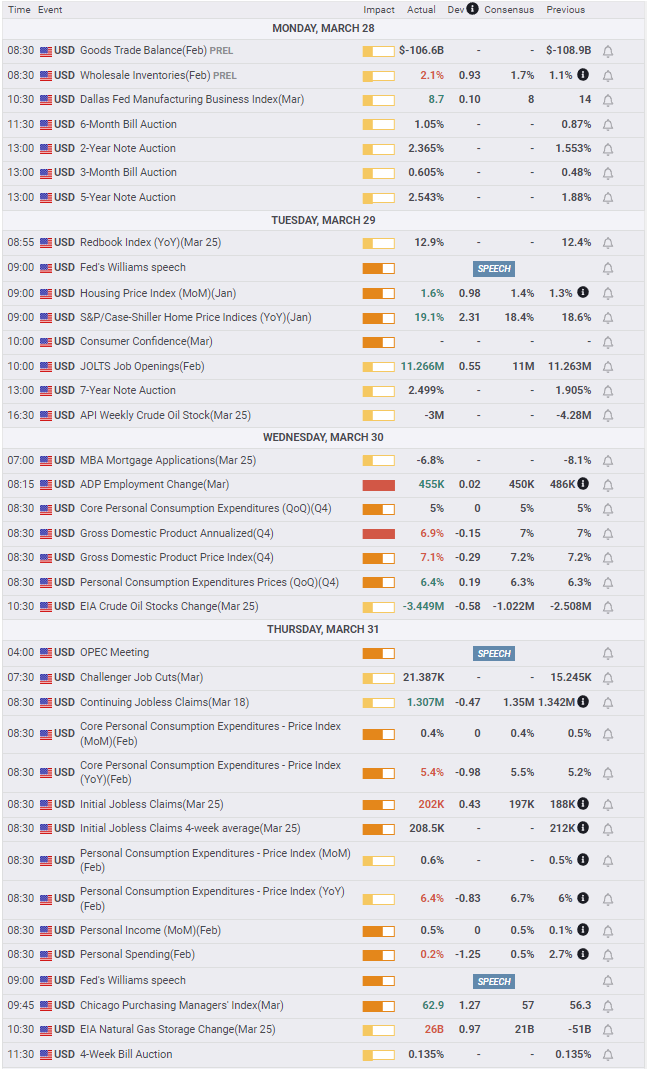
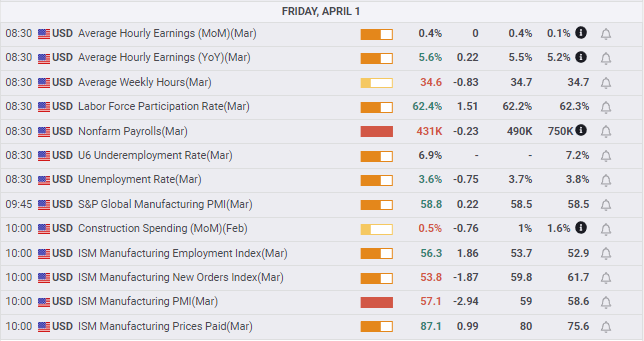
Treasury yields have been on a tear as credit markets factor in the Federal Reserve’s newly aggressive approach to inflation. Friday’s US Nonfarm Payrolls at 431,000, slightly below forecasts, and a better than expected unemployment rate at 3.6%, were more than strong enough to allay fear of an inflation-induced slowdown in economic growth. The March NFP report is the last before the May 4 FOMC meeting. The Fed is expected to increase the fed funds rate by 0.5%.
The yield spread between the US-2 year note and its JGB equivalent widened 13 basis points this week. Since the March 4 low in the USD/JPY that spread has ballooned by 95 points. On March 4 the US 2-year yield was 1.49%. On Friday it was trading at 2.44%. The 2-year JGB was offering -0.026% on March 4. At Friday’s close in Japan the yield was -0.040%.
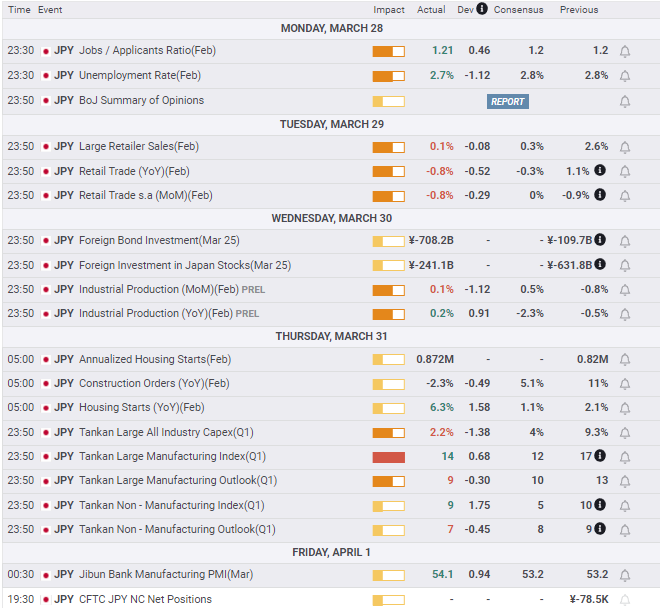
Japanese economic data for February was mixed. Retail Trade (sales) fell 0.8% for the month and year on forecasts of -0.3% and flat. Industrial Production was slower for the month at 0.1% than the 0.5% prediction but better for the year, 0.2% vs -2.3%. The Tankan Report for the first quarter saw a 2.2% rise in the All Industry Capex (capital investment) that was less than the 4% projection and the fourth quarter’s 9.3% burst. Large Manufacturing Outlook registered 9 down from 13 and the overall Index slipped to 14 from 17.
In the US payrolls and PCE inflation were the main data points. The Fed’s favorite inflation gauge, the Core PCE price Index rose to 5.4% in February, a four-decade record. With inflation in the manufacturing pipeline even higher, consumer prices are set for further increases in the months ahead. The March Purchasing Managers’ Index in manufacturing at 57.1 was down from February’s 58.6. More importantly the New Orders Index dropped to 53.8 from 61.7, for its lowest reading since May 2020, suggesting that inflation may be a drag on consumer purchases.
USD/JPY outlook
The USD/JPY vault after breaking the five-year resistance at 116.35 on March 11 was aided by the coincident sharp gains in US Treasury yields, especially in the relevant 2-year domination.
-637844207995954922.png)
A quick ascent to 121.00 and 122.00 followed by volatile trading around the latter level has provided a base at 121.60 that has proved resilient. The last time the USD/JPY was above 122.00 was in November and December 2015 making the technical guidance tenuous.
Treasury yields at the shorter end of the curve have executed one of the steepest rises in history and are closing in on the highs of the last decade. Further gains are possible but it is likely the bulk of the improvement has already taken place. The USD/JPY has probably seen the majority of the impact from the burgeoning Treasury-JGB 2-year spread.
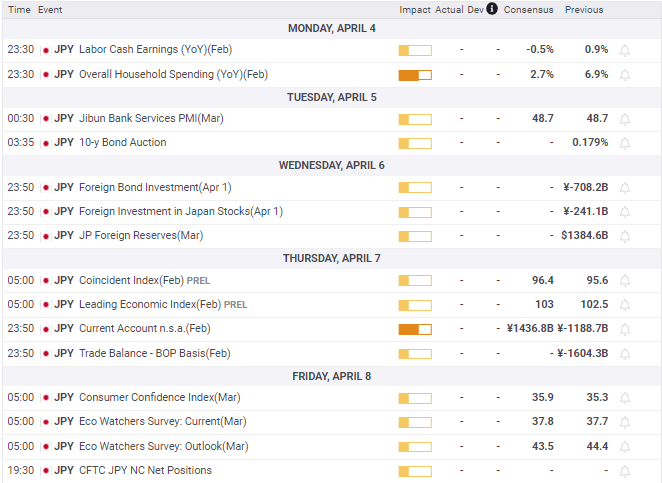
Upcoming Japanese data on earnings and household consumption for February, and Consumer Confidence for March are expected to show little improvement from their current weak levels. The Eco Watchers Survey that tracks regional economic trends is also forecast to remain moribund.
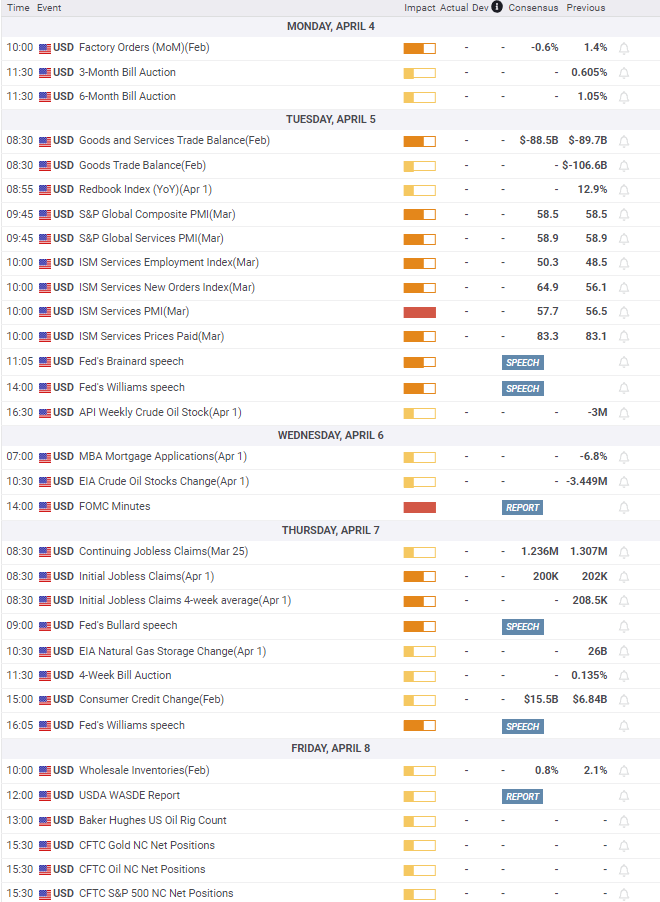
Important US economic information is limited to the March ISM Services PMI survey. The consensus expectation has improvements in all categories but the surprise drop in overall manufacturing PMI and the New Orders Index, and the equally unforseen rise in employment betokens caution.
Given the rapid ascent in USD/JPY and the probable calming of the furious Treasury yield gains, the outlook for the USD/JPY is consolidation between 121.50 and 123.50.
Japan statistics March 28–April 1
FXStreet
US statistics March 28–April 1
Japan statistics April 4–April 8
FXStreet
US statistics April 4–April 8
FXStreet
USD/JPY technical outlook
The MACD (Moving Average Convergence Divergence) price line spread over the signal narrowed substantially after the USD/JPY retreated from Monday's six-and-a-half year high but it remains at levels not visited in five years. The Relative Strength Index (RSI) also saw a pullback from Monday's five-year high that dipped just below overbought status mid-week but returned with Friday's move above 122.00. Volatility in Average True Range (ATR) has reached levels not seen since the drama of the pandemic onset in March 2020.
 tech 1-637844266533074503.png)
The USD/JPY has not traded above 125.00 for any sustained period in over 20 years. A technical base for further gains barely exists and the very rapid increase and limited support at any point above 116.00 makes the trade-based MACD and RSI advice of limited import.
 tech 2-637844266753997334.png)
The USD/JPY has soared 18% this year and though the fundamental logic underpinning the move is solid, the recent climb over 116.00 will entice profit-taking. The 38.2% Fibonacci level of the 2022 ascent lies at 115.78. The technical outlook is for consolidation of the last three week's rapid gains before a potential move higher.
 tech 3-637844266887164512.png)
Resistance: 123.00, 123.80, 124.30, 125.10
Support: 122.30, 121.70, 120.80, 119.20, 118.15, 117.30, 116.10
Moving Averages: 21-day 119.36, 50-day 116.90, 100-day 115.61, 200-day 113.36
 tech 4-637844275458475413.png)
FXStreet Forecast Poll
The FXStreet Forecast Poll predicts consolidation in the near-term followed by failure to hold 120.00
Author

Joseph Trevisani
FXStreet
Joseph Trevisani began his thirty-year career in the financial markets at Credit Suisse in New York and Singapore where he worked for 12 years as an interbank currency trader and trading desk manager.