USD/JPY under pressure as Yen rises and December rate hike expectations grow

USD/JPY begins the week around 157.48. The Japanese yen rose for three consecutive sessions last week after the Bank of Japan held its key interest rate at 1.25%, as expected.
At the same time, the BoJ sent a more important signal about future policy: according to the central bank, core inflation has finally reached the 2% target. This has strengthened expectations that the next move could be a rate hike as early as December.
The decision was approved by an 8–1 vote. Board member Hajime Takata advocated an immediate rate hike to 1.5%, noting that economic conditions have entered a new phase and require a faster move towards a neutral rate.
The yen also gained support from demand for safe-haven assets after weak reports from major technology companies. These reports again raised concerns about the scale of AI investment and triggered another stock market sell-off.
Another positive factor for the yen was the return of global asset managers to the Japanese debt market. Improving domestic demand and more favourable monetary policy expectations are increasing the appeal of higher Japanese bond yields and supporting the yen.
Technical analysis
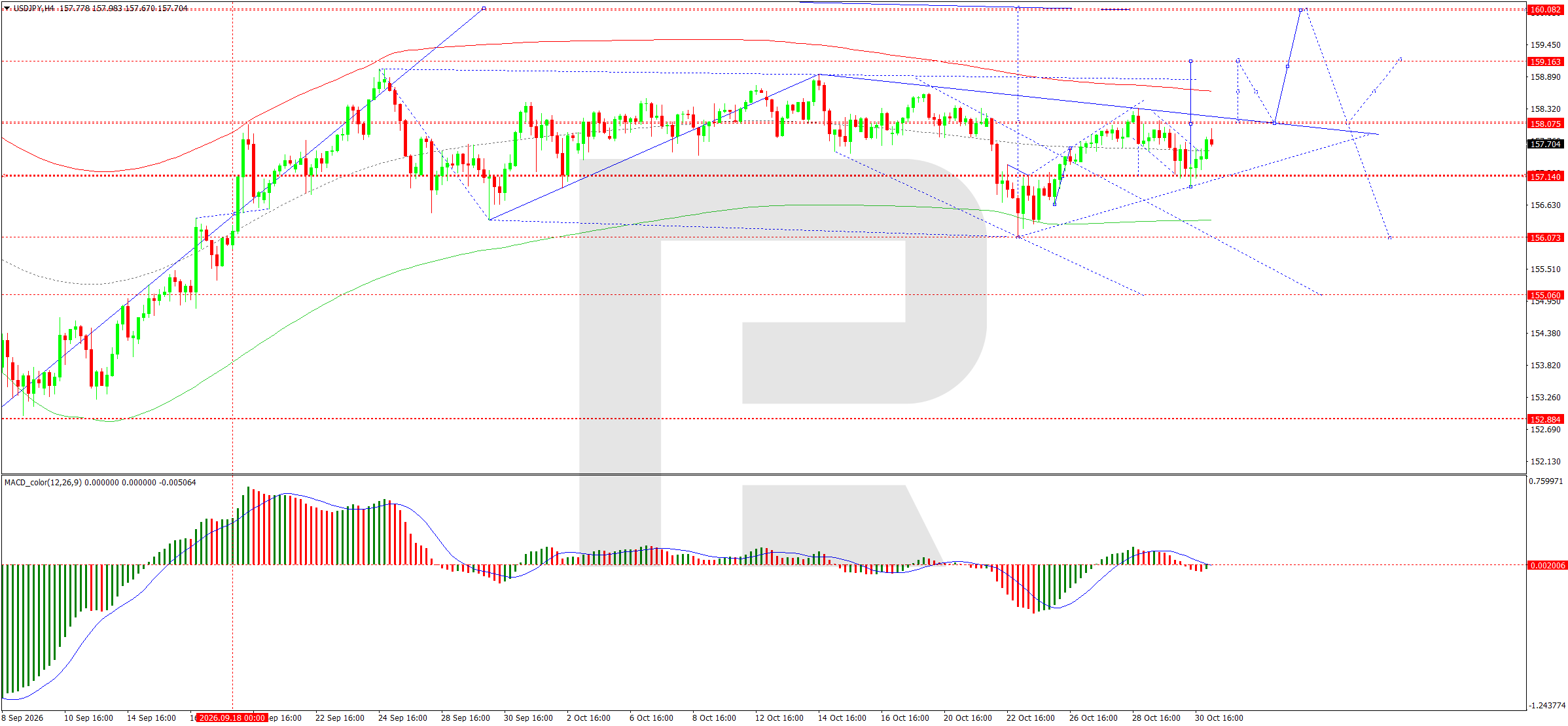
On the four-hour chart, USD/JPY continues to form an upward corrective structure after completing the decline towards 156.07. Buyers pushed the price back up to 157.98, but the downward resistance line caps further upside. Early in the day, a local correction towards 157.38 is expected, followed by a resumption of growth. The immediate target is 158.08, with a break above this level opening the way towards 159.16. The main medium-term target lies at 160.08. The MACD indicator shows weakening upward momentum: the histogram is contracting, and the signal line is gradually turning down. This allows for an initial decline before growth resumes.
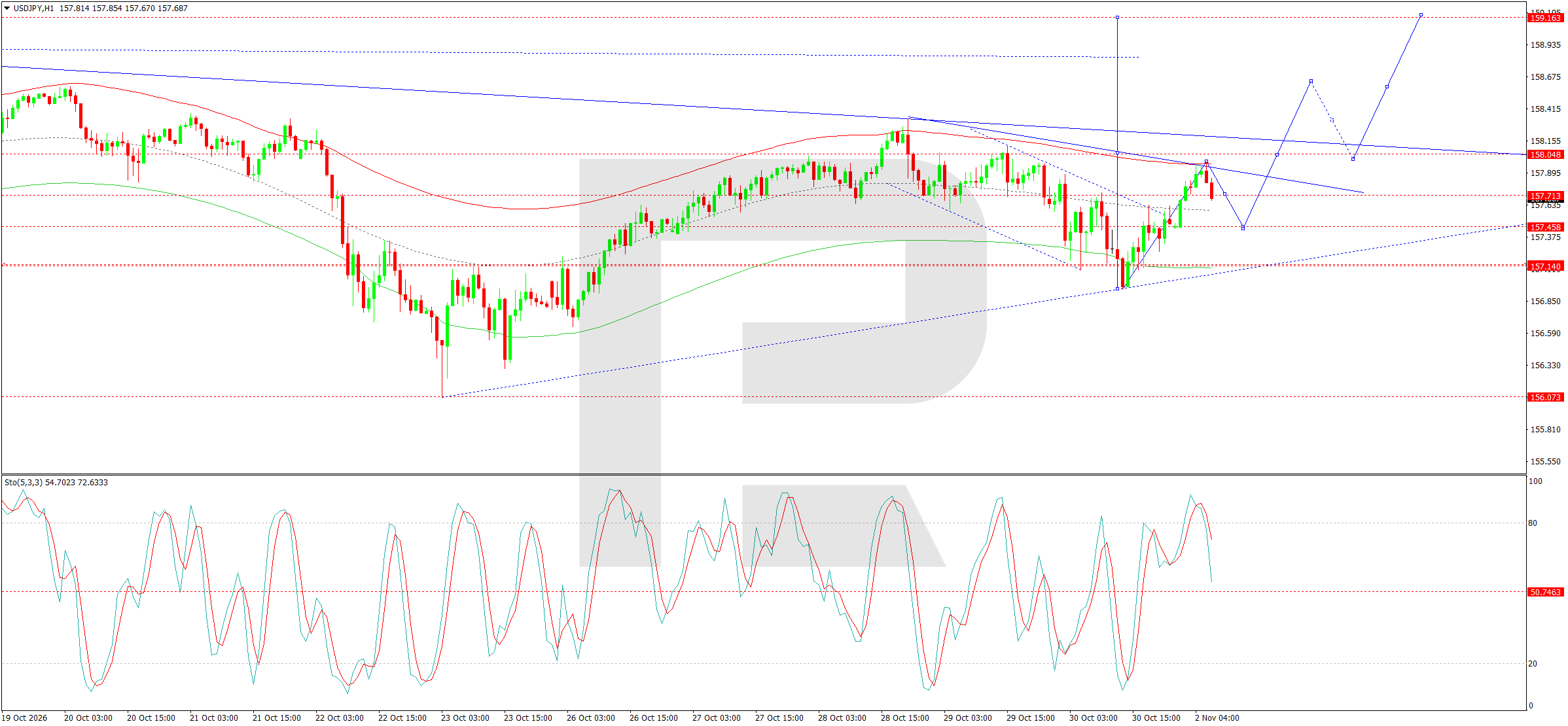
On the hourly USD/JPY chart, a local peak formed at 157.98, and a corrective move is developing from it. The current pattern envisages a decline into the 157.46–157.38 area, where the nearest support zone lies. The price holding above 157.14 would allow the correction to be viewed as an intermediate stage in the formation of a new upward wave. After the pullback ends, a recovery towards 158.08 is expected, followed by a move towards 158.63 and 159.16. The Stochastic oscillator has left the overbought zone and is pointing downwards, confirming the likelihood of a short-term correction.
The main scenario for Monday envisages the decline ending around 157.38, followed by a resumption of growth. A move above 158.08 would strengthen upside potential. A break below support at 157.14 would weaken this scenario and open the way towards 156.07.
Conclusion
USD/JPY remains under pressure as the yen benefits from the Bank of Japan’s signal that core inflation has reached its 2% target, keeping a December rate hike firmly in play. The 8–1 vote, with one member calling for an immediate increase to 1.5%, underscores the growing hawkish sentiment within the BoJ. Additional support for the yen comes from safe-haven demand amid tech-sector weakness and the return of global investors to Japanese bonds. Technically, the pair remains in a corrective phase within a broader upward structure, with support at 157.38 and 157.14, and resistance at 158.08. A break above 158.08 would open the way towards 158.63, 159.16 and eventually 160.08, while a break below 157.14 would expose 156.07. The near-term direction will hinge on whether the current correction holds or deepens.
Author

RoboForex Analysis Department
RoboForex
RoboForex Analysis Department provides timely market insights, expert technical analysis, and actionable forecasts across forex, commodities, indices, and equities.

















