The week ahead: Midterms, Payrolls and a recovery for tech

If you thought last week was dramatic, there will be more to come this week, with tech earnings, US Midterm elections and a slew of economic data on both sides of the Atlantic for markets to digest.
November recovery on the cards?
However, the start of November trading is more upbeat than the bloodbath that we saw at the end of last week. Equity futures are pointing to a stronger open for the Nasdaq 100, which could gain by nearly 1% later today, and the S&P 500 is also expected to rise by half a percent on Monday. The FTSE 100 is expected to open down a notch, as investors step back into the tech trade after last week’s blood bath.
Oil prices are lower today, and Brent crude is down by nearly 3%, which is also boosting sentiment. The oil price is reacting to reports that President Trump is rolling back on his idea to strike Iran after the Midterms and instead is willing to give diplomacy more time to work towards a resolution of the conflict. This may come too late to save the Republicans from a drubbing in this week’s Midterm elections, which we speak about in more detail below.
A week to remember for the AI trade
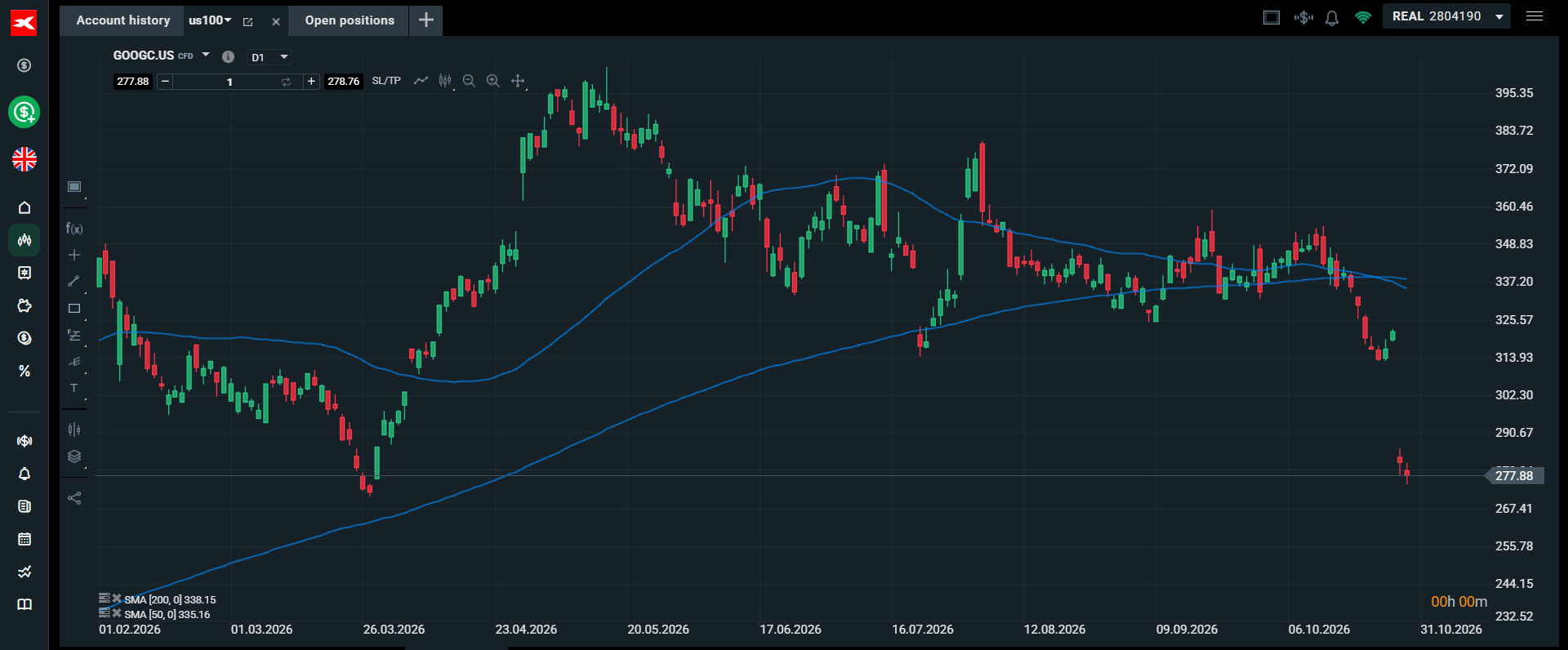
Last week was a week to remember. Investors are regrouping on Monday after the sharp sell off in some AI names last week. Tech earnings were the biggest driver of last week’s sell off, and there were some wild swings in prices as investors punished earnings misses. This is why Alphabet shares sank more than 12% on Thursday and failed to recover on Friday, and why Intel’s stock price fell nearly a third in one trading session. Both Intel and Alphabet are poised to claw back some of last week’s losses, and Intel and Alphabet are pointing to a higher open later today.
Cracks appearing in the AI narrative
However, even if there is a recovery in tech names today, cracks have started to appear in the AI narrative, and the cost of insuring some AI corporate debt against default also started to rise, although there is wide dispersion among AI names. Former obscure corners of the AI landscape, including the neocloud operators that run GPU-leasing data centres, are under intense stress. Names like CoreWeave and Nebius have seen their credit default spreads widen to distressed levels. CoreWeave’s share price is down 60% in the past year and Nebius is lower by nearly a quarter in the past 3 months, although both stocks are set to join in Monday’s recovery.
This week we will be looking for two things. Firstly, how far will the biggest victims of last week’s AI sell off recover? Secondly, is the cost of default protection also recovering after blowing out last week? The latter will determine whether this recovery is genuine.
The problem with neocloud providers
Why are neocloud businesses seen as the weakest link in the AI chain? CoreWeave and Nebius have spent huge amounts on capex to lease compute power and they have used enormous amounts of debt to do this. The problem is that GPUs and AI compute hardware has a shorter lifespan than originally thought. This means that projected revenues are nowhere near capex levels and this is leading to concerns about their financial future, especially when they have so much debt to finance. This is a continuing problem for some AI companies, and it could limit their chance of recovery.
Will the great rotation ever happen?
As US stocks sold off last week, especially large cap growth stocks, something interesting started to happen under the hood and investors were looking for opportunities elsewhere. There was a clear preference for European over US stocks and Greece and Germany managed to perform well on a broad basis last week. In contrast the US, Brazil, Japan, China and Taiwan saw their indices come under pressure.
As we move into a new week, the focus will be on whether risks continue to build in the US and other tech-heavy sectors, and if strength continues to build in other indices, such as European markets.
US indices remain resilient to AI fears
Although there was a bloodbath for some AI names last week, the sell off was not universal. The Magnificent 7 only dropped 2% on the week, and Tesla bucked the sell off, rising 7%. The S&P 500 fell 0.5%, even though the headlines suggested it was financial armageddon. There has not been a rush to downgrade the US or global economic outlook, and for now Q3 earnings season remains strong.
Strength in earnings could fuel a November recovery
Of the 60% of S&P 500 names that have reported earnings for Q3, more than 80% have reported earnings that are above estimates. It is easy to spin a bearish yarn when it comes to markets and the AI trade, but the data does not lie. Tech is one of the sectors that are leading the earnings beat, according to FactSet.
The recovery starts here
The question now is will last week’s bloodbath attract some buying interest? While there are plenty of reasons to be concerned about the AI sell off, and higher Fed interest rates are adding to the economic headwinds battering the sector, this sell off could attract some buying interest as we move into November. It is also worth noting that the final months of the year are traditionally the strongest months for stock market performance. Nvidia dropped 4% on Friday and now has its lowest price to earnings ratio since 2019. Will this entice buyers as we start a new week?
AI trade turns into the patience trade
As we move into November, investors need to navigate ongoing geopolitical tensions, rising oil prices and AI investment concerns. The AI trade is no longer a quick win for traders. Instead, if traders are willing to step back into the AI trade, especially some of the hyperscalers, then they will need patience. Last week’s earnings reports told us that the payoff from AI investments will take time, and will not be even amongst the Magnificent 7. The AI trade is now a patience trade.
Although the sell off in some AI names was brutal last week, the earnings reports did not tell us much that we did not already know. We know that the hyperscalers are spending hundreds of billions on AI capex, we always knew that Alphabet is still trying to figure out ways to monetise its search business in the era of AI agents, and that Amazon is a cash-burning machine. Essentially, these are strong, global businesses but they need time to see their investments in AI pay off. For now, Microsoft is the only major hyperscaler that has positive free cash flow, reporting $18.6bn for last quarter. Even these figures did not stop Microsoft’s stock price dropping more than 1% on Friday, and for the week it only rose by 0.8%.
Chart 1: Alphabet shares sunk last week
Few safe harbours in the storm
Amidst the tech sell off, the US 10-year Treasury yield acted as a moderate safe haven. The US 10-year yield fell 6bps to 4.93% last week. This can be looked at in two ways. Firstly, do structural issues in US debt markets make Treasuries a less attractive safe haven? Or alternatively, the fact that money was not piling into Treasuries suggests that last week’s sell off is not a sign that a financial or an AI crisis is brewing, and instead was a normal bout of volatility after some unexpected earnings.
Amidst all the AI doom-mongering, the US economic outlook remains resilient. Q3 GDP was strong, it came in at a 3.4% annual rate. Perhaps the biggest surprise was US economic confidence. The Conference Board’s consumer confidence indicator rose 7 points in October, even though the oil price is surging.
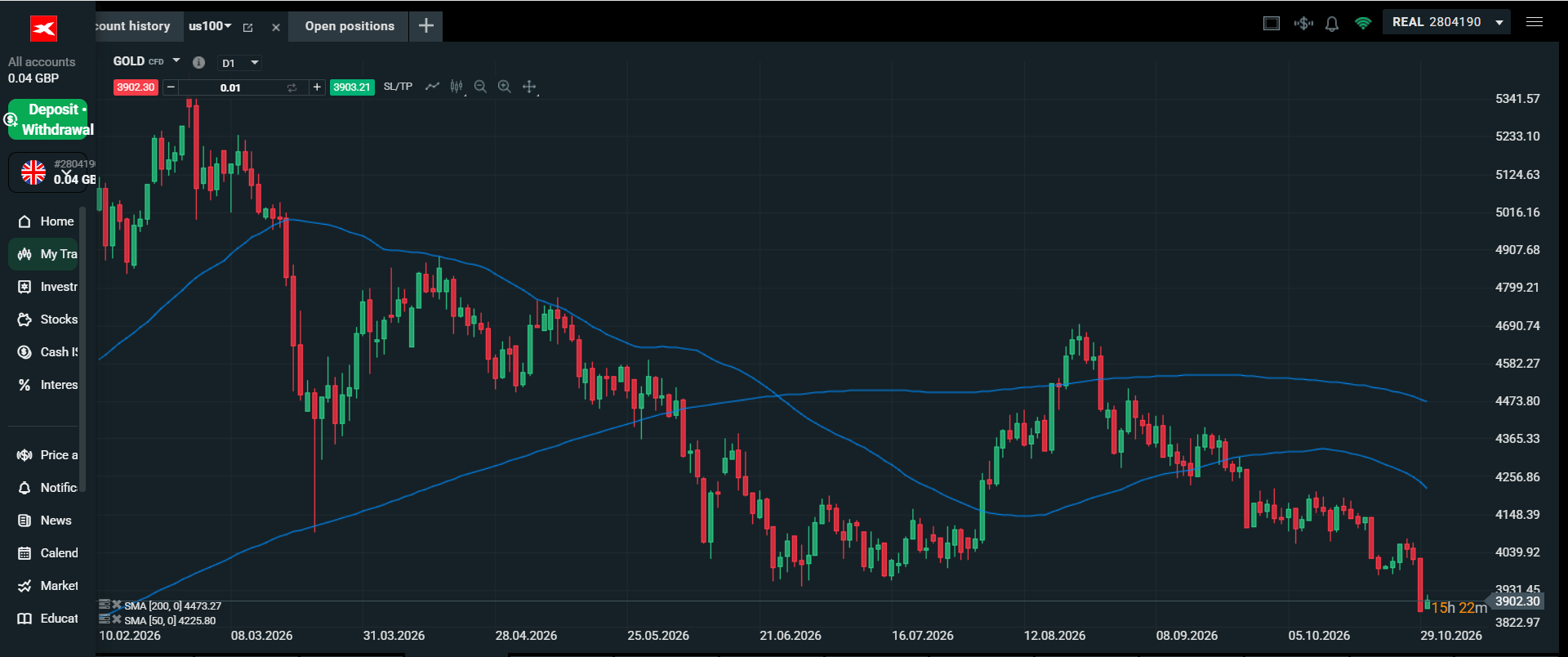
Other traditional safe havens failed to entice buyers last week. The gold price fell 3% last week, and is currently trading around $3898, its lowest level in over a year. Bitcoin also fell, on news that Binance, the world’s largest crypto exchange had been the victim of a $6bn heist.
As we start a new month, there is a big disconnect between Wall Street and Main Street, with Main Street riding high as Wall Street falters.
Chart 2: The Gold price drops to its lowest level in over a year
Europe lags the US, but stocks disconnect from economic reality
Growth in Europe is lagging the US, with France registering negative growth for Q3, adding to its list of woes. However, this did not stop a decent gain for the Cac 40 index, which registered a 2% gain last week.
Major central banks including the Fed, the ECB and the BOJ refrained from hiking rates last week, although all three are expected to hike rates next month. The UK budget left UK markets mostly unscathed. Gilt yields fell across the curve last week and the pound managed to rally by 1.5% vs the USD last month. The focus will now shift to the Prime Minister’s 10-year plan, which is expected to be announced at some point this month. The outcome of this report, especially how radical it is in bringing down welfare spending, could have a big impact on the Gilt market, which has been remarkably stable in the past month.
What to watch in the week ahead
This week is another major test for markets. More earnings news will come from Apple and Palantir. These reports come at a time when investors are sensitive to tech news and are laser focused on capex and returns.
Economic data is also in focus with global PMI reports for October, the US ISM surveys, inflation data from Europe and US payrolls also in focus. Investors and traders will be watching to see if the payrolls data shifts the dial for a Fed rate hike in December. Currently there is a 72% chance of a rate hike, according to the CME Fedwatch tool.
Below we take a look at two main events this week, which are worth watching closely.
1. US Midterms
The US Midterm elections take place this Tuesday, with results coming in late Tuesday night and into Wednesday. Currently, Polymarket is predicting a 71% chance of the Democrats gaining a clean sweep of the Senate and the House, and only a 6% chance of the Republicans holding onto both houses of Congress.
Prediction markets have been wrong before, most recently with the second round of the Brazilian election, so they are worth taking with a pinch of salt. The Midterms are important for the trajectory of US economic policy in the next two years, for example the regulatory agenda and for foreign policy. While a Democratic clean sweep could raise fears of more regulation especially for crypto and AI, if it increases the chance of a swift end to the war in the Middle East then it could boost markets and weigh on the oil price.
The picture is also nuanced for stocks. While some may think a win for left leaning Democrats is bad news for stocks, seasonal patterns can trump political fears. US indices tend to outperform in election years compared to other years, according to Morningstar. Essentially the election results on Tuesday will end months of uncertainty, and bring closure, something that investors may welcome as we move into the final months of the year. It is also worth noting that US stock indices tend to perform well in the 12 months after an election, which is another sign that investors do not like political uncertainty.
The latest reports suggest that turnout will be high. Nearly 7.5 million Texans cast ballots in their state’s early voting period, this is a record high for Midterm early voting. The outcome of the Senate race will be determined by the following races: Louisiana, Florida, Mississippi, Nebraska, South Carolina, Iowa, Michigan, Maine and Minnesota. It could be a long night for traders on Tuesday.
2. The Bank of England set to pull the trigger
After a bland budget last week, which failed to spook the bond market, the Bank of England is likely to hike rates on Thursday.
The market expects a rate hike and there is a near 100% chance priced in for later this week. There is also a 60% chance of a hike in February and more than a 50% probability of a further hike in March.
Whether or not we see further hikes after December will depend on the outlook for the oil price. If there is any chance of a resolution to the war in the Middle East then we could see energy prices fall and with that the odds of more rate hikes from the BOE and other central banks. For now, geopolitics are the main driver of rate hikes in the UK and elsewhere, and until the outlook changes, rate hikes will remain on the agenda, which could pressure bond prices but may boost the pound.
The commentary from the BOE is also worth watching later this week. While there are noted hawks at the bank who have been calling for a rate hike for months, it is worth watching the number of dissenters on Thursday. Also, the governor has been concerned about second round effects from inflation, but private sector wage growth remains subdued. If the Governor references this, it could suggest that the bar to further hikes in Q1 are higher than initially thought, which may weigh on the pound.
Author

Kathleen Brooks
XTB UK
Kathleen has nearly 15 years’ experience working with some of the leading retail trading and investment companies in the City of London.