The hidden weaknesses behind Dutch economic growth

The Dutch economy has proved remarkably resilient in recent years, powered by its high-tech and semi-public sectors. But this success may be a mixed blessing: strong GDP growth and full employment have helped obscure underlying challenges to the country's longer-term growth potential.
The Dutch teflon economy of the 2020s
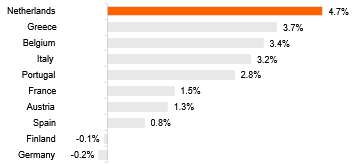
Over the past six and a half years, the Dutch economy has proved remarkably resilient. The pandemic, the war in Ukraine and 2022 energy crisis, trade tensions and the war in the Middle East have all caused disruption, but none has triggered a deep or prolonged downturn or a significant rise in unemployment. Despite some temporary dips, growth has remained relatively solid, particularly compared with other eurozone economies.
Dutch economy grew relatively strongly between 2020 and 2026
Average GDP growth* from Q1 2020 to Q1 2026 relative to Q4 2019, for the 10 largest euro-area economies excluding Ireland.
This creates the impression that the Netherlands no longer needs to worry about economic growth. ‘Things will work out anyway’ is a sentiment that increasingly surfaces in the economic debate. Historically, however, that view is not always justified. Just look at the neighbours to the east. Germany’s economic resurgence in the 2000s, sometimes described as a second Wirtschaftswunder, gave the country a sense of economic invincibility. Over the past decade, it has become clear that Germany is vulnerable to high energy prices, competition and weaker demand from China.
That is why this article examines the reasons behind strong Dutch growth this decade and where the vulnerabilities lie.
The Netherlands is benefiting strongly from its machinery manufacturing cluster
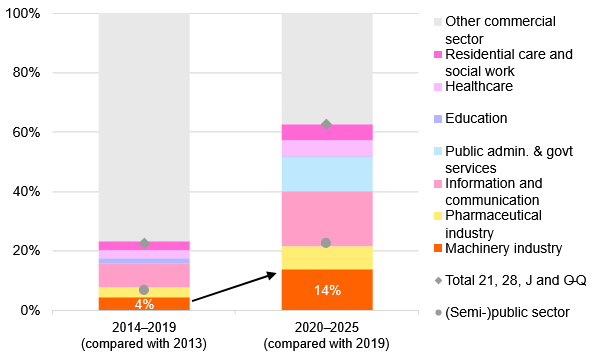
One striking feature of recent strong growth is the enormous acceleration in machinery manufacturing. Chip-making equipment manufacturer ASML plays a dominant role in this sector. Growth was already strong in the years before the pandemic, and the sector has expanded rapidly since the AI boom began.
ASML and the wider semiconductor ecosystem surrounding it have therefore become a key driver of economic growth in recent years. In Brussels, concerns about missing the AI boom are widespread. In his report on European competitiveness, Mario Draghi warned that Europe is on the cusp of an AI revolution and cannot afford to remain stuck in the technologies of yesterday. For the Netherlands, such concerns are generally misplaced. Through machinery manufacturing, among other channels, the Netherlands is benefiting fully from the boom. This single sector has accounted for 14% of growth over the past six years.
Read more about ASML’s significant contribution to Dutch GDP here.
Machinery’s share of growth has increased sharply
Industry share of growth in gross value added in the Netherlands*.
Pharmaceuticals and digital services are also performing very strongly
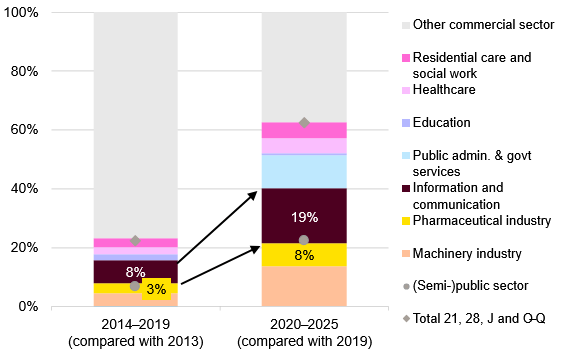
The pharmaceutical and IT sectors have also been significant drivers of growth over the past six years, contributing 8% and 19%, respectively. Digitalisation continues to strengthen the role of IT, while the pharmaceutical cluster is benefiting from trends including ageing populations and advances in medicine. Together, these modern, high-tech sectors have made a substantial contribution to the Netherlands’ recent economic success.
ICT and pharmaceuticals’ share of growth have also increased sharply
Industry share of growth in gross value added in the Netherlands*.
A larger (semi-)public sector is also a key driver of growth
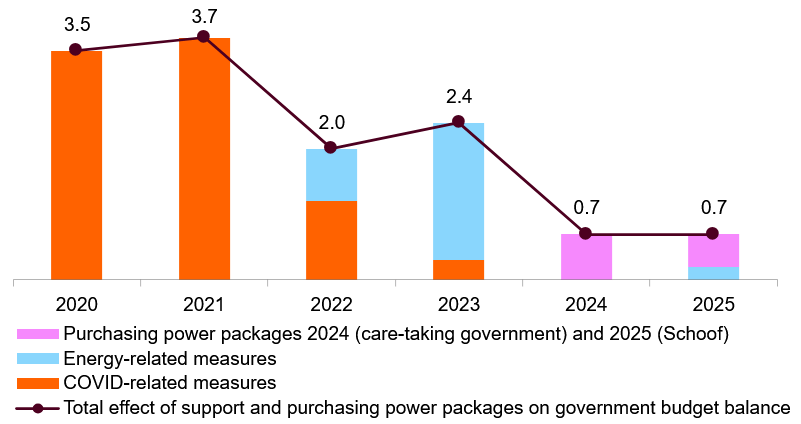
As the preceding charts show, growth in the Dutch economy has been driven not only by high-tech, but also by the government and the semi-public sector. The economic shocks of recent years have certainly left their mark, but this has largely been absorbed by a sharp rise in public spending. This has provided substantial support to economic growth at a time when uncertainty among consumers and businesses was holding it back.
Support and purchasing power measures have been substantial in recent years
Impact of support and purchasing power measures on the Dutch government deficit, % of GDP.
At the sector level, the (semi-)public sector has become a more significant driver of the Dutch economy. Healthcare has expanded strongly in recent years, alongside considerable growth in government. This marks a clear shift from the pre-pandemic period. While other European countries have seen similar trends, the expansion of the Dutch (semi-)public sector has been well above average.
The (semi-)public sector’s share of growth has also increased significantly
Industry share of growth in gross value added in the Netherlands*.
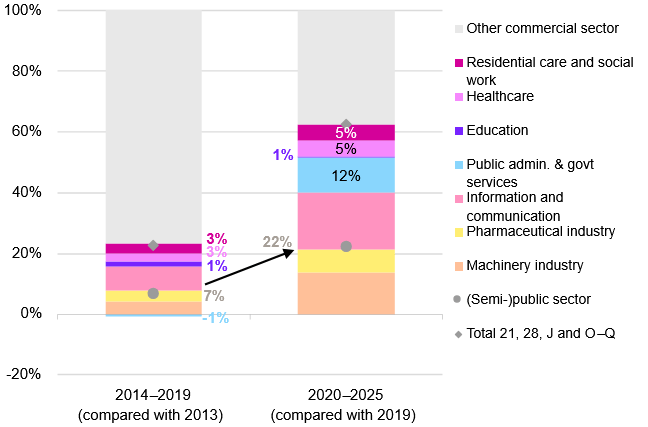
This is largely because the government has increased spending in recent years. Demand for healthcare is rising as the population ages, greater attention has been paid to public services after years of cutbacks, and additional funds have been deployed during crises to support households and businesses.
However, a larger (semi-)public sector puts greater pressure on the welfare state.
Budget-driven growth has not focused strongly on future growth potential
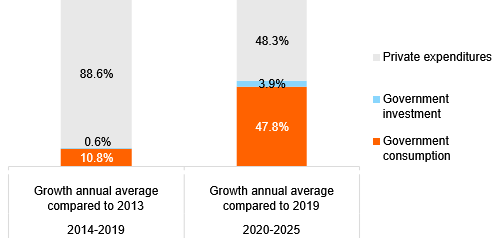
At the same time, growth has been driven mainly by government consumption, with public investment, which is crucial to future growth potential, playing a much smaller role. Substantial purchasing-power support has also helped cushion households from recent economic shocks. As a result, much of the additional spending has supported the economy in the short term rather than strengthened its long-term foundations, through measures such as energy bill relief and fuel duty cuts rather than investment in infrastructure.
Government consumption has recently contributed far more to economic growth than government investment
Share of expenditure category in expenditure growth in the Netherlands*.
The Dutch growth engine is running strongly
All in all, the Dutch economy has shown remarkable resilience in the 2020s. While many countries suffered prolonged effects from successive shocks, the Netherlands repeatedly rebounded relatively quickly. A significant share of growth came from the successful high-tech sectors and from a rapidly expanding (semi-)public sector.
A strong high-tech sector sounds promising and makes the Netherlands one of Europe’s most modern economies. To maintain that position, however, those sectors need sufficient space and other factors of production to continue growing.
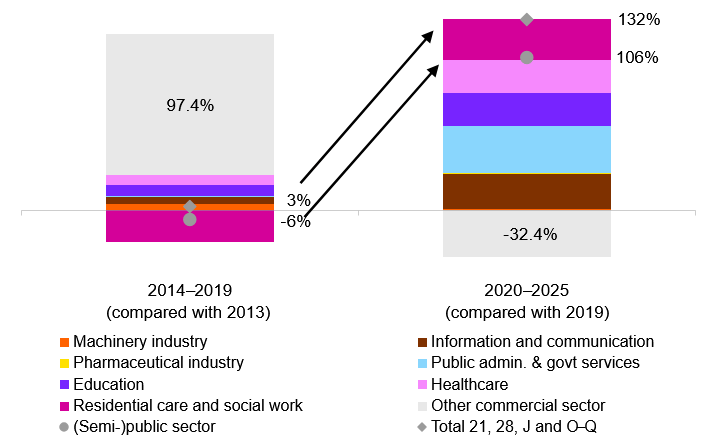
Employment growth dominated by the (semi-)public sector and ICT
Share of growth in the employed labour force* in the Netherlands by industry compared with 2013 and 2019.
The Netherlands must continue to maintain the foundations for strong growth
Yet, the strong growth of recent years is deceptive, because it distracts from the need to keep improving structural growth. The Netherlands has, after all, benefited from a strong business climate for decades. This reflects reliable institutions and policies, as well as a well-educated workforce. Its physical infrastructure – including Rotterdam, Schiphol and the road network – and digital infrastructure are also very strong. Together, these factors make the Netherlands an attractive location for economic activity, from which the country continues to benefit.
However, those foundations have recently been eroding. The factors that keep the economy strong over the longer term are being constrained by unpredictable politics, labour shortages, deteriorating infrastructure and bottlenecks such as nitrogen restrictions, grid congestion and permitting.
The right people for growth are hard to find, partly because of strong public-sector demand
The Netherlands has recently seen remarkably strong growth in labour supply, yet a historically high share of Dutch companies report being constrained by labour shortages. This share was even higher following the pandemic and remains above the highest levels recorded before 2020. The limited easing of labour market tightness is largely because, on balance, all employment growth in recent years has gone to the (semi-)public sector.
This sector is also expected to absorb much of the growth in labour supply in the coming years. Businesses will therefore continue to compete for a barely expanding pool of workers. People are also working fewer hours per week than before, making it harder for companies to get all the work done. In addition, many companies struggle to recruit specific skills: 45% of vacancies prove difficult to fill, while almost two-thirds of employers with hard-to-fill vacancies say candidates lack the required skills.
The talent shortage looks persistent and will hold back the economy
The expanded supply of labour is therefore insufficient to make the labour market significantly less tight, and labour-supply growth is expected to weaken in the coming years. Despite planned cutbacks in central government, the semi-public sector will continue to exert strong demand for labour, particularly because of rising demand for healthcare. And with population ageing and lower immigration, the scope for broader labour-supply growth appears largely exhausted. It is therefore difficult to see where the hours worked needed for substantial economic growth will come from.
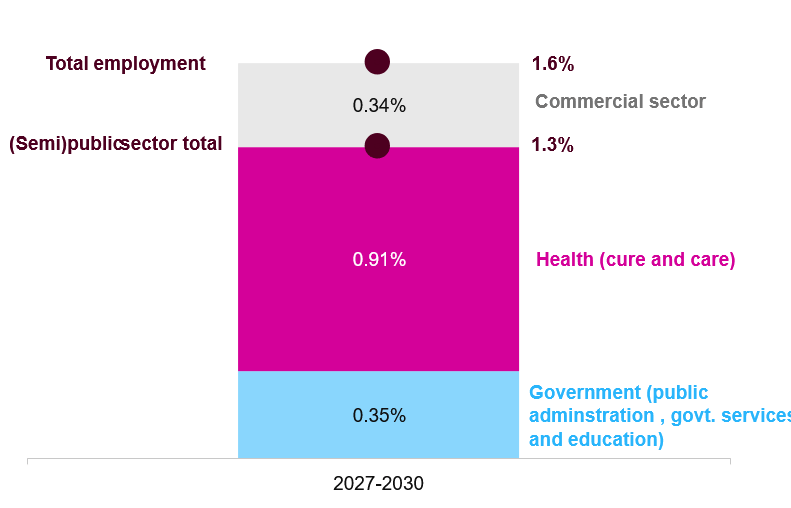
The (semi-)public sector accounts for almost 80% of the expected growth in employment
Estimated employment in hours worked in the Netherlands: average year-on-year change in 2027-30 (%) and sector contributions (percentage points).
Productivity growth is currently rapid, but the underlying conditions are a concern
Further growth in labour input therefore remains a major challenge for the Dutch market economy. The hope then is that labour productivity can increase. Labour productivity growth has in fact picked up again recently, after almost a decade of very sluggish growth.
A catch-up process began in early 2024, reversing much of the decline of the preceding years. This is because companies are improving efficiency after a period of strong wage growth and labour market tightness. The decline in the number of self-employed workers may also be a factor. At first sight, this mainly appears to be a catch-up after an exceptional period marked by the pandemic and related measures, as we discussed here previously.
Structurally, labour productivity is determined mainly by the adoption of innovations and investment in capital. Both enable more to be produced with the same number of people. Artificial intelligence (‘AI’) is an appealing innovation that is highly likely to improve productivity. The Netherlands is well positioned to benefit from AI-driven efficiency gains, as we wrote here previously.
Investment in intangible and human capital is needed
Developing and successfully deploying new technologies requires skilled people to implement them. Achieving this also requires investment in research and development. Those underlying conditions need to be maintained.
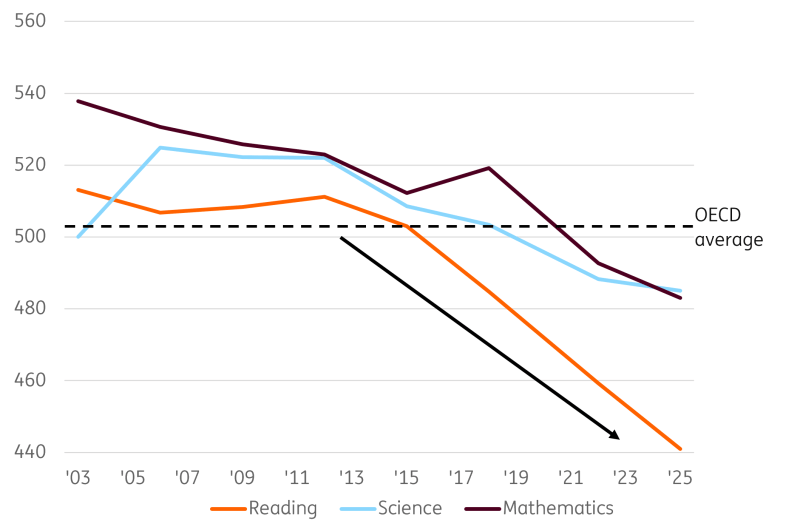
R&D investment in the Netherlands is relatively modest. In an international comparison, the Netherlands has a relatively mediocre level of R&D investment, leaving considerable ground to make up. This makes future productivity growth vulnerable. As noted earlier, labour shortages are a major constraint on economic growth. The same applies to productivity growth. These concerns are not confined to the short term: the availability of well-educated staff also looks set to remain problematic over the longer term. Declining educational performance is a warning sign that finding well-qualified staff, particularly for high-value R&D, will remain a structural problem.
Dutch educational performance is declining relative to other countries
Average PISA*-score for learning performance of 15-year-olds in the Netherlands.
Investment in physical capital as well
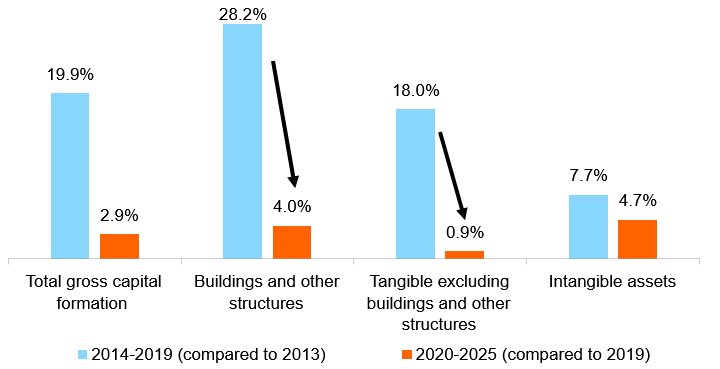
Investment in the Netherlands is also too weak beyond R&D. Recently, the limits to physical investment have become increasingly apparent because of shortages of space, nitrogen headroom, grid congestion, shifting policy and – there it is again – labour. This is also visible in the data. Investment has been weak recently, and capital accumulation, particularly in physical assets, has been much weaker in recent years than before.
Physical infrastructure, for example, faces a major maintenance backlog. This became very visible recently when the Merwede Bridge was closed to lorries. Dutch infrastructure is still of good quality, although the Netherlands has begun to slip in the international rankings. This presents a major budgetary challenge: according to the Netherlands Court of Audit, the funding shortfall for maintenance of the main road and waterway networks, among other things, already amounts to €34.5bn for 2024-38.
Productivity growth is therefore currently solid, partly because of the recovery from several weak years, but the underlying growth potential remains constrained.
Particularly weaker investment growth in tangible capital goods
Growth in gross fixed capital formation in the Netherlands, total and by asset type.
Fragmented politics remains a question mark for structural growth improvements
Ultimately, these are factors that constrain our potential. For now, nothing seems amiss, but it remains crucial to keep nurturing the economy’s growth potential. It is therefore important that the government addresses the conditions needed to deliver strong growth over the longer term. And the government does have a clear focus on structural growth, something that is confirmed even by the namesake of the Wennink report.
Consider the billions of euros earmarked in the coalition agreement for tackling the nitrogen problem and grid congestion, additional investment in housing construction, infrastructure and education, and the creation of a national investment institution to finance businesses and an agency for disruptive innovation. Although the additional amounts are by no means always sufficient to meet all the challenges, this is a step in the right direction towards improving the Dutch economy’s growth potential. Initially, proposed labour market and social security policies were also intended to increase labour supply, while investment in R&D, regional innovation clusters and scale-ups should boost productivity. These are all measures that could reduce important bottlenecks to investment and future growth.
In a fragmented political landscape, there is a risk that growth-enhancing policies will lose out when there is no immediate economic urgency. Difficult budget negotiations within the government and with the opposition show how hard it is to provide consistent policy direction. The strong GDP growth and full employment of recent years may therefore prove both a blessing and a curse. For the Dutch economy, it is important that efforts to strengthen structural growth continue despite the complex political environment. Strong growth cannot be taken for granted – just look at Germany.
Author

ING Global Economics Team
ING Economic and Financial Analysis
From Trump to trade, FX to Brexit, ING’s global economists have it covered. Go to ING.com/THINK to stay a step ahead.