USD/JPY Price Forecast: Surges past 150.00 as Takaichi's win tempers BoJ rate hike bets`
- USD/JPY surges to a two-month top in reaction to Sanae Takaichi’s win at the LDP leadership election.
- Takaichi's policies could further delay BoJ rate hikes and weigh on the JPY amid the risk-on mood.
- Rising Fed rate cut bets might keep a lid on further USD gains and act as a headwind for spot prices.

The USD/JPY pair opened with a bullish gap at the start of a new week and surged past the 150.00 psychological mark, rising to its highest level since early August in reaction to an unexpected result in Japan’s leadership contest. Sanae Takaichi won the Liberal Democratic Party (LDP) leadership election on Saturday and is now expected to be confirmed as Japan's first female Prime Minister during a parliamentary session in mid-October. Takaichi is viewed as a fiscal dove and stood out in the race as the only supporter of big spending. The outcome sets the country on course for more expansionary fiscal policy, which could further complicate the Bank of Japan's (BoJ) task and turn out to be a key factor weighing heavily on the Japanese Yen (JPY).
Traders were quick to react and started pricing out the possibility of an interest rate cut by the BoJ later this month. Moreover, the optimism lifts Japan's Nikkei 225 to a fresh record high and drives flows away from the safe-haven JPY. Meanwhile, a sharp decline in the JPY benefits the US Dollar (USD), which jumps back closer to the late September swing high and contributes to the USD/JPY pair's strong intraday rally. The upside for the USD, however, seems limited on the back of worries that a prolonged government shutdown would affect the US economic performance. Apart from this, bets for further policy easing by the US Federal Reserve (Fed) might cap the USD and the currency pair. According to the CME FedWatch tool, the possibility of a 25-basis-point interest rate cut by the US Federal Reserve in October and December stands at 95% and 83%, respectively.
In contrast, BoJ Governor Kazuo Ueda reiterated last week that the central bank will raise interest rates if the economy and prices move in line with forecasts. Moreover, markets are fully pricing in another rate increase by the BoJ early next year, which might hold back the JPY bears from placing aggressive bets and act as a headwind for the USD/JPY pair. Nevertheless, spot prices remain on track to register the biggest one-day rise since May 12 in the absence of any relevant US data. In fact, important US macro releases scheduled at the start of a new month have been delayed due to the government closure, leaving the USD at the mercy of speeches from influential FOMC members. This, along with the broader risk sentiment, might produce short-term trading opportunities around the USD/JPY pair ahead of Japan's Household Spending data on Tuesday.
USD/JPY daily chart
Technical Outlook
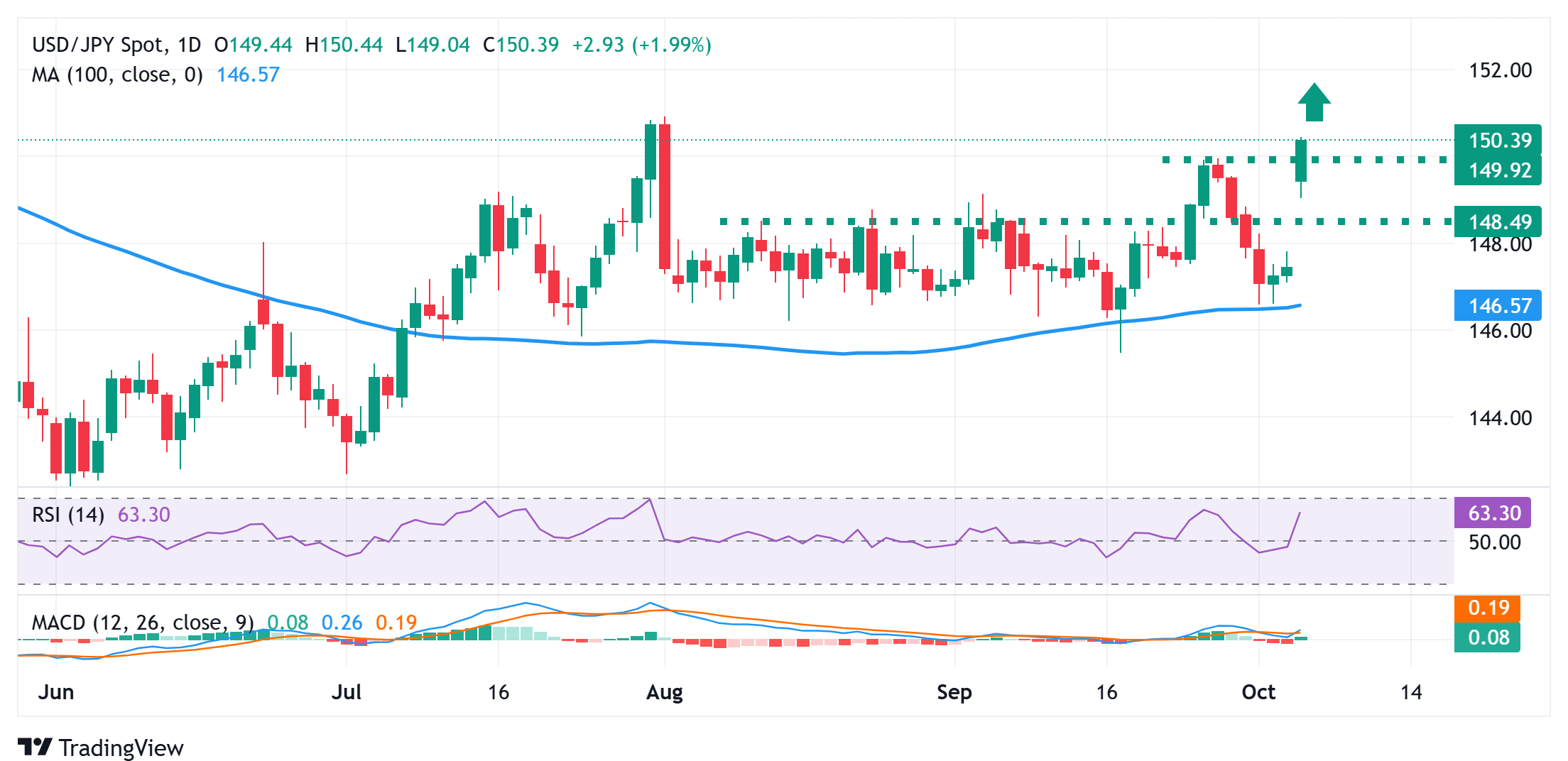
Against the backdrop of last week's bounce from the 100-day Simple Moving Average (SMA), intraday breakout and acceptance above the 150.00 round figure could be seen as a fresh trigger for the USD/JPY bulls. Moreover, oscillators on the daily chart are holding comfortably in positive territory and suggest that the path of least resistance for spot prices is to the upside. This, in turn, backs the case for a move towards testing the August swing high, around the 151.00 neighborhood, with some intermediate hurdle near the 150.65-150.70 region.
On the flip side, any corrective pullback below the 150.00 mark could be seen as a buying opportunity near the 149.40 area. This, in turn, should help limit the downside for the USD/JPY pair near the 149.00 round figure. A convincing break below the latter could drag the USD/JPY pair to the next relevant support near the 148.35 region en route to the 148.00 round figure and the 147.80 zone. Failure to defend the said support levels might shift the near-term bias in favor of bearish traders and pave the way for deeper losses.
Author

Haresh Menghani
FXStreet
Haresh Menghani is a detail-oriented professional with 10+ years of extensive experience in analysing the global financial markets.