USD/JPY Price Forecast: Bulls retain control near 159.00/July 2024 high ahead of US CPI
- USD/JPY continues to scale higher and remains supported by a combination of factors.
- BoJ uncertainty, Japan-China rift, and talks of a snap election in Japan weigh on the JPY.
- Renewed USD buying lends additional support to the major ahead of the US CPI report.

The USD/JPY pair prolongs its uptrend witnessed over the past week or so and climbs to its highest level since July 2024, around the 159.00 neighborhood on Tuesday. The Japanese Yen (JPY) continues with its relative underperformance amid talks of a snap election in Japan. This, along with the emergence of some US Dollar (USD) buying, acts as a tailwind for the currency pair as traders now look forward to the release of the US consumer inflation figures, due later during the North American session, for a fresh impetus.
Reports suggest that Japan's Prime Minister Sanae Takaichi may soon call an early election in the first half of February to take advantage of strong approval ratings and bolster her coalition government’s parliamentary majority. With Takaichi's popularity running high, a win would likely cement her authority to further boost the expansionary fiscal policy. This reignited the so-called “Takaichi trade, with Japan's Nikkei 225 Index closing above the 53,000 mark for the first time in history and undermining the JPY's safe-haven status.
Meanwhile, investors remain uncertain about the likely timing of the next interest rate hike by the Bank of Japan (BoJ). Adding to this, the deepening Japan–China diplomatic crisis turns out to be another factor exerting additional downward pressure on the JPY, which fails to gain any respite from intervention fears. Japan’s Finance Minister Satsuki Katayama said earlier today that she shared concerns over the JPY's recent one-sided decline with US Treasury Secretary Scott Bessent and that the tolerance for weakness was limited. This, in turn, fueled speculations that authorities could step in to stem further JPY weakness, though it does little to impress bulls.
The USD, on the other hand, regains some positive traction following the previous day's slide and contributes to the USD/JPY pair's positive momentum. Any meaningful USD appreciation, however, seems elusive amid concerns about the US Federal Reserve's (Fed) independence. In fact, Fed Chair Powell said that the threat of criminal charges against him is a consequence of US President Donald Trump's anger over the refusal to cut interest rates despite repeated public pressure. This might hold back the USD bulls from placing aggressive bets.
Moreover, traders are still pricing in two more interest rate cuts by the Fed later this year. Hence, the key US Consumer Price Index (CPI) will be looked upon for cues about the Fed's rate-cut path amid expectations for potentially stagnant policy in the first quarter, bolstered by Friday's US Nonfarm Payrolls (NMFP) report. This, in turn, will play a key role in influencing the near-term USD price dynamics and provide some meaningful impetus to the USD/JPY pair. Nevertheless, the fundamental backdrop backs the case for a further move higher.
USD/JPY daily chart
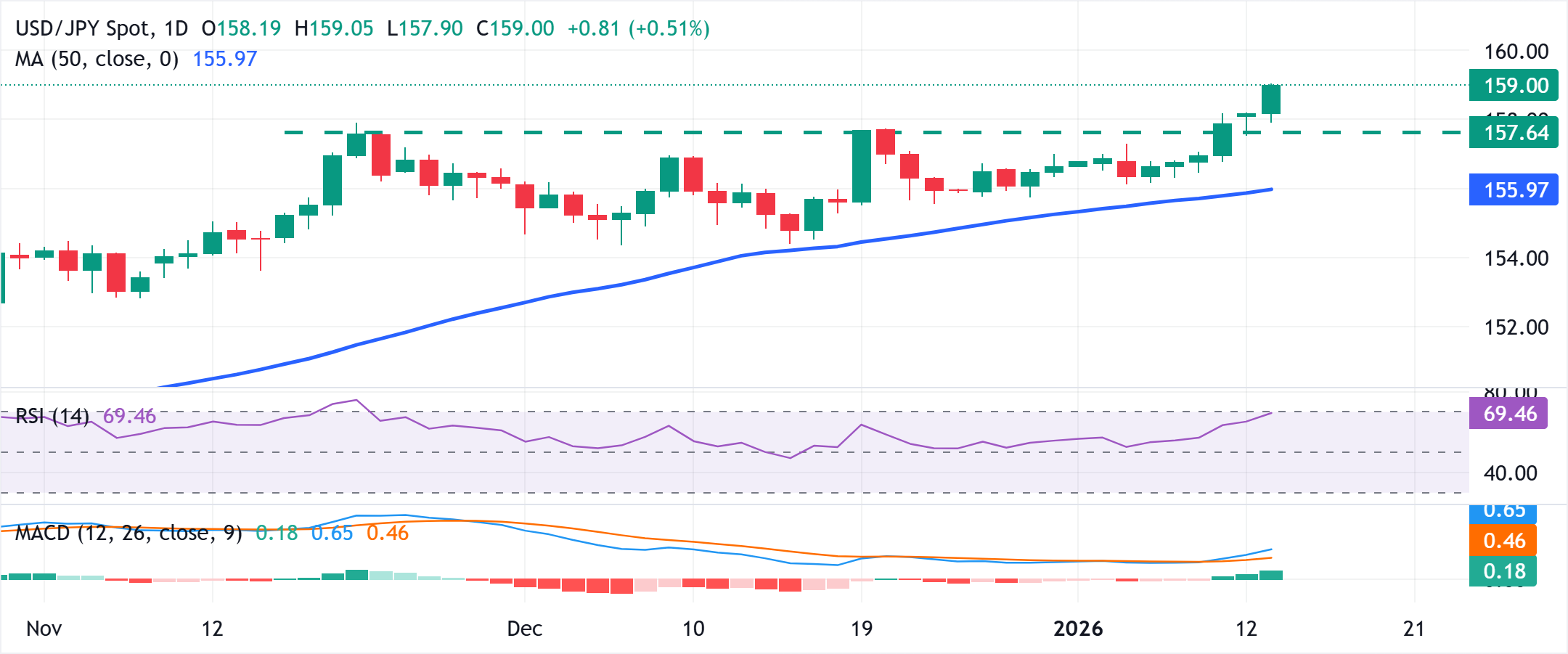
Technical Analysis:
The 50-day Simple Moving Average (SMA) rises to the 156.00 mark, reinforcing the bullish tone. The USD/JPY pair holds above this gauge, keeping buyers in control. The Moving Average Convergence Divergence (MACD) line stands above the Signal line, with a positive, widening histogram near the zero mark, suggesting strengthening upside momentum. The Relative Strength Index (RSI) at 69 approaches overbought, which could cap immediate advances.
Momentum remains supportive as the MACD’s positive expansion points to sustained buying interest, while its proximity to the zero line highlights a developing trend rather than a mature extension. Given the stretched RSI, USD/JPY could consolidate, and a pullback would test the 50-day SMA as dynamic support; a hold above that average would keep the broader bullish bias intact, whereas a failure there would open the door to a deeper corrective phase.
(The technical analysis of this story was written with the help of an AI tool.)
Author

Haresh Menghani
FXStreet
Haresh Menghani is a detail-oriented professional with 10+ years of extensive experience in analysing the global financial markets.