|

Technical analysis – USD/CAD trickles lower within range toward 1.3650

  • USD/CAD stays rangebound with a downside bias.
  • Momentum indicators’ prolonged flatlining mirrors consolidation.

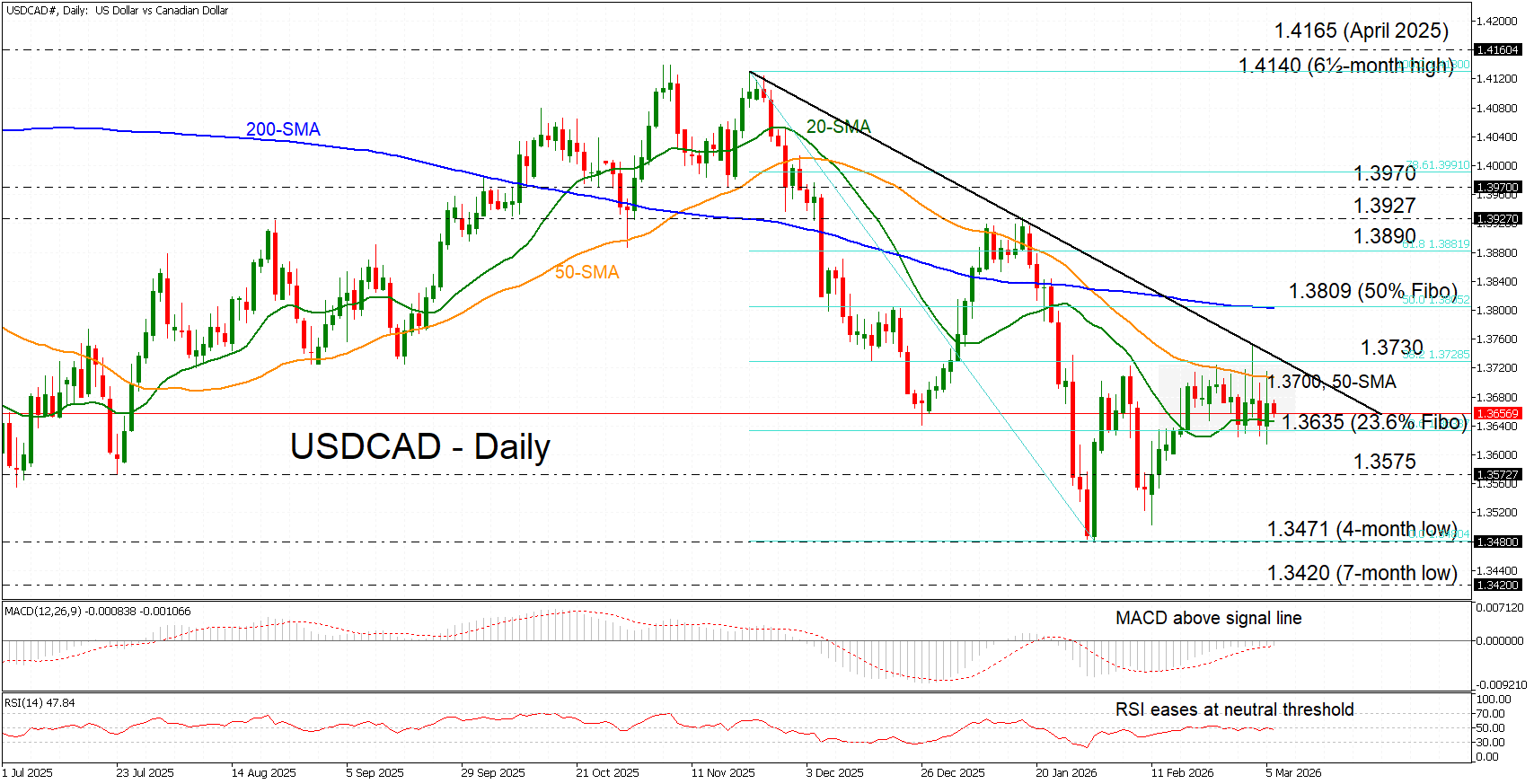
USD/CAD remains on the defensive, continuing to trade within the range established since mid‑February, with price action capped between the 20‑day and 50‑day simple moving averages (SMAs) inside the tight 1.3645-1.3700 band. The Canadian dollar is still under pressure against a firmer US dollar, though it remains relatively bid amid rising oil prices linked to the ongoing Middle East conflict.

The momentum indicators reinforce the multi‑week muted tone, with the RSI flatlining near the neutral 50 mark and the MACD compressing around its zero and red signal lines, pointing to limited upside in the near term.

Price action is currently drifting lower within its range after repeated rejections at the short‑term downtrend line. Initial support is located at the 20‑day SMA at 1.3645, sitting just above the 23.6% Fibonacci retracement of the November-January decline at 1.3635. A break below these levels would expose support at 1.3575 and then the four‑month low near 1.3471, last touched in late January.

On the upside, a decisive break above the 50‑day SMA and the 38.2% Fibonacci retracement at 1.3730 – where the short‑term downtrend line also intersects – would shift the bias higher. Such a move would open the path toward the 200‑day SMA near the 50% Fibonacci level at 1.3809, which recently formed a ‘death cross’ with the 50‑day SMA, adding further technical weight against sustained upside.

Overall, USD/CAD is losing momentum as it edges toward the lower bound of its multi‑week consolidation, with the earlier rebound from four‑month lows stalling. While the broader downtrend remains intact, downside risks may be limited if the pair continues to hold above the 20‑day SMA.
Author

Nicole Zeniou

Nicole joined Trading Point as a Market Analyst in January 2025. She holds a BA in English Literature from Kingston University, London, and an MA in Applied Linguistics (Research Methodology) from the University of Southampton with distinction.


More from Nicole Zeniou
Share:

Editor's Picks

USD/JPY retreats from nearly two-year high on hawkish BoJ Minutes

USD/JPY drifts lower during the Asian session on Friday, retreating further from its highest level since July 2024, set the previous day. Minutes from the April BoJ meeting keep further policy normalization firmly on the table amid expectations for a pickup in inflation over the coming months, due to higher energy costs. This offsets Japan's softer National CPI print and lifts the Japanese Yen amid intervention fears, exerting some pressure on the currency pair.

AUD/USD awaits 0.7000 breakdown before the next leg down amid bullish USD

AUD/USD holds above 0.7000 during the Asian session on Friday, though it remains close to the weekly low and seems poised to register modest weekly losses. The US Dollar sits near its highest level since May 2025 as the Fed's hawkish tilt overshadows optimism over the US-Iran peace deal, capping the currency pair. However, the RBA's signal that additional rate hikes were possible if inflation persists lends some support to the Aussie.

Gold refreshes weekly low as Fed's hawkish tilt underpins USD

Gold attracts sellers for the third consecutive day and weakens below $4,200, hitting a fresh weekly low during the Asian session on Friday. Despite the latest optimism over a US-Iran peace deal, the Fed's hawkish tilt helps the US Dollar to preserve its strong weekly gains to the highest level since May 2025. This, in turn, undermines the non-yielding bullion and backs the case for further losses.

Ethereum: Tokenization and network activity skyrocket in Q1 despite DeFi contraction
Following months of crashing prices and macro-driven fragility, Ethereum saw mixed performance across key metrics in the first quarter of 2026, according to Token Terminal. In its quarterly Ethereum report, the onchain analytical platform highlighted contraction across DeFi-focused metrics such as lending, trading volume and fees, while tokenization and throughput expanded.
Regime change: Inside Kevin Warsh's first move to make the Fed unreadable on purpose

The rate did not move. That was the least interesting thing about Kevin Warsh's first meeting in charge of the Fed. The FOMC held its benchmark at 3.50%-3.75% for the fourth straight meeting, exactly as priced, and then the new chair used his first press conference to dismantle the machinery the market has leaned on for a decade.

The next big AI trade may not be about chips or software

Artificial intelligence has already created some of the biggest winners in modern market history. Chipmakers have surged, data centre construction is booming, and electricity demand forecasts are changing globally.