USD/JPY Price Forecast: Bears pause for a breather near 200-hour SMA ahead of Fed’s Powell
- USD/JPY attracts strong follow-through selling amid a broadly weaker US Dollar.
- The divergent Fed-BoJ policy expectations support prospects for further losses.
- Traders now look to Fed Chair Jerome Powell’s testimony for a fresh impetus.

The USD/JPY pair extends the previous day's sharp retracement slide from the 148.00 mark, or its highest level since May 13, and attracts heavy follow-through selling on Tuesday. The downward momentum remains uninterrupted through the early European session and drags spot prices to the 145.00 psychological mark. Moreover, a broadly weaker US Dollar (USD) and the divergent Federal Reserve (Fed)-Bank of Japan (BoJ) policy expectations suggest that the path of least resistance for the pair is to the downside.
Data released on Monday showed that the growth in the US business activity slowed marginally in June and the overall rate of expansion remains well below the rates seen in late 2024. In fact, S&P Global’s Composite Output Index slipped to 52.8 from 53.0 in May, while the Manufacturing PMI held steady at 52 in June and the gauge for the service sector cooled slightly to 53.1 from 53.7 in the previous month. Commenting on the report, Chris Williamson, Chief Business Economist at S&P Global Market Intelligence said the strength in manufacturing in part reflects a boost from stock building amid concerns over supply issues resulting from tariffs. Williamson added that such a boost is likely to unwind in the coming months as the outlook remains uncertain.
Meanwhile, Fed Vice China Michelle Bowman said that the time to cut rates may be fast approaching as she has grown more worried about risks to the job market and less concerned that tariffs will cause an inflation problem. Bowman added that she could support a rate cut in July if inflation remains subdued, echoing comments from Fed Governor Christopher Waller last Friday. Separately, Chicago Fed President Austan Goolsbee noted that thus far the surge in tariffs has had a more modest impact on the economy relative to what was expected. Traders ramped up their bets that the Fed will lower rates by at least 50 basis points before the end of the year and are also pricing in a roughly 25% probability of a rate reduction at the July meeting.
The BoJ, on the other hand, last week signaled its preference to move cautiously in normalizing still-easy monetary policy and decided to slow the pace of reduction in its bond purchases from fiscal 2026. Moreover, the gloomy economic outlook and the uncertainty over US tariffs fueled speculations that the BoJ could forgo hiking interest rates in 2025. However, data released last Friday showed that Japan's core inflation remained above the central bank's 2% target for well over three years and rose to a more than two-year high in May. Furthermore, Japan's better-than-expected PMIs on Monday keep the door open for more rate hikes by the BoJ in the coming month, which contradicts the recent dovish tone adopted by influential FOMC members.
The USD/JPY bears were also encouraged by the latest optimism over the Israel-Iran ceasefire, which dents the Greenback's status as the global reserve currency. Apart from this, reports that Japan's Economy Minister Ryosei Akazawa is arranging his seventh visit to the US as early as June 26 fuel hopes for an eventual US-Japan trade deal ahead of the July 9 deadline for steep US reciprocal tariffs and underpins the JPY. This further validates the near-term negative outlook for the currency pair as traders await Fed Chair Jerome Powell's congressional testimony. Apart from this, the Fed speaks, the Conference Board's US Consumer Confidence Index, and the Richmond Manufacturing PMI could influence the USD, and the currency pair.
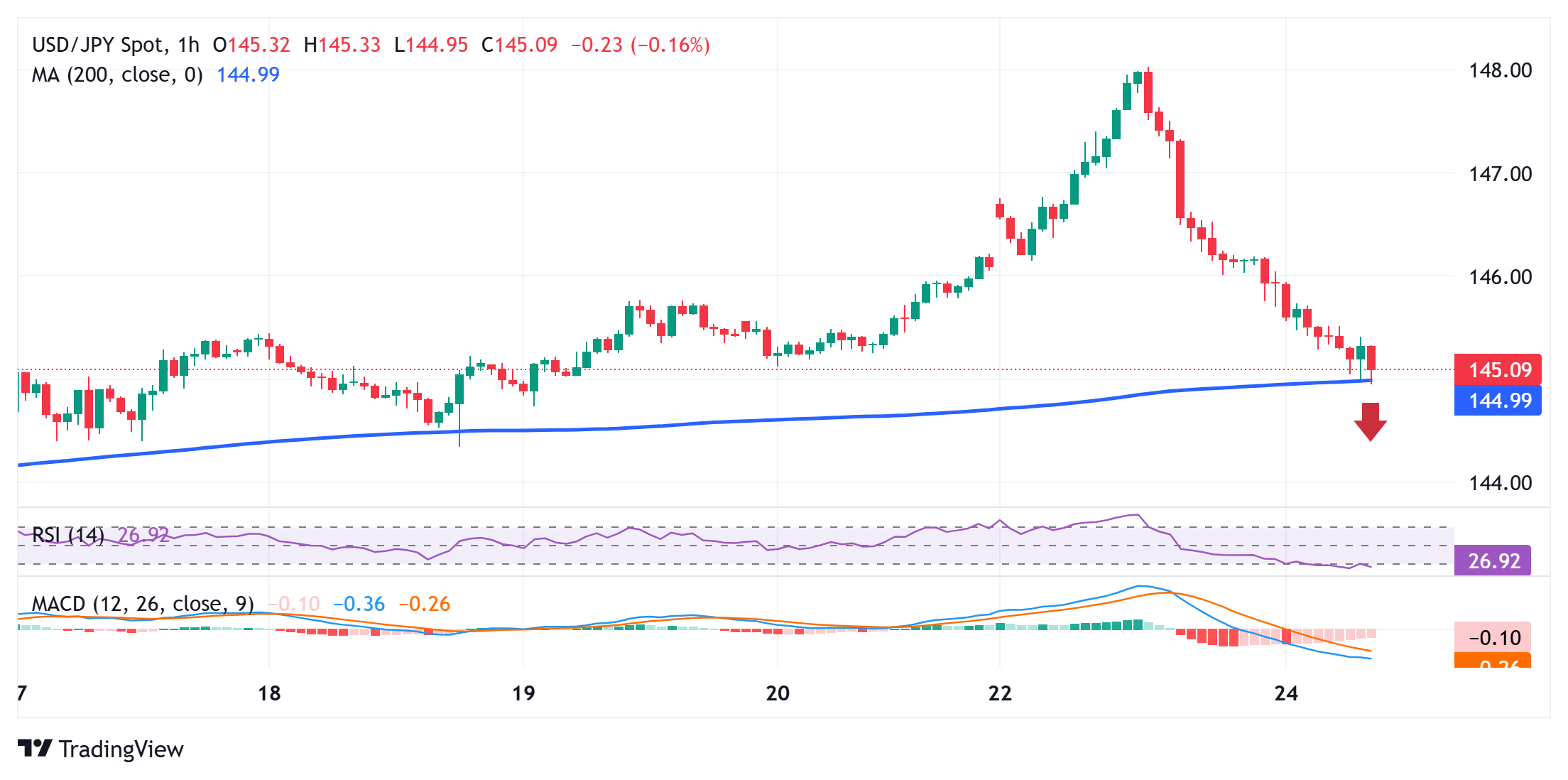
USD/JPY 1-hour chart
Technical Outlook
The overnight rejection near the 148.00 mark and the subsequent slump below the 145.35-145.25 resistance-turned-support could be seen as a key trigger for the USD/JPY bears. However, oscillators on the daily chart are yet to confirm the negative outlook. Moreover, the hourly Relative Strength (RSI) is already flashing slightly oversold conditions, making it prudent to wait for some intraday consolidation or a modest bounce before the next leg down.
Any meaningful recovery attempted, however, might now attract fresh sellers near the 145.25-145.35 static barrier, above which a short-covering rally could allow the USD/JPY pair to reclaim the 146.00 mark. The momentum could extend further, though it runs the risk of fizzling out rather quickly near the 146.65-146.70 region. A sustained strength beyond the latter would negate the negative outlook and shift the near-term bias back in favor of bullish traders.
On the flip side, bears might now await some follow-through selling and acceptance below the 200-hour Simple Moving Average (SMA) before placing fresh bets. The USD/JPY pair might then accelerate the downfall towards the 144.40-144.35 intermediate support en route to the 144.00 round figure. The next relevant support is pegged near the 143.70-143.65 region, below which spot prices could aim to test sub-143.00 levels.
Author

Haresh Menghani
FXStreet
Haresh Menghani is a detail-oriented professional with 10+ years of extensive experience in analysing the global financial markets.