|

USD/JPY Forecast: This key MA is the level to beat for the bears

Seldom has the 100-day simple moving average (SMA) been so important in any market as it is for the USD/JPY pair.

This is because, throughout 2018, the long-term moving average has reversed pullbacks in the pair. As seen in the chart below, the pair scaled the 100-day SMA hurdle on April 25 and has since then charted higher lows along the SMA support.

Daily chart
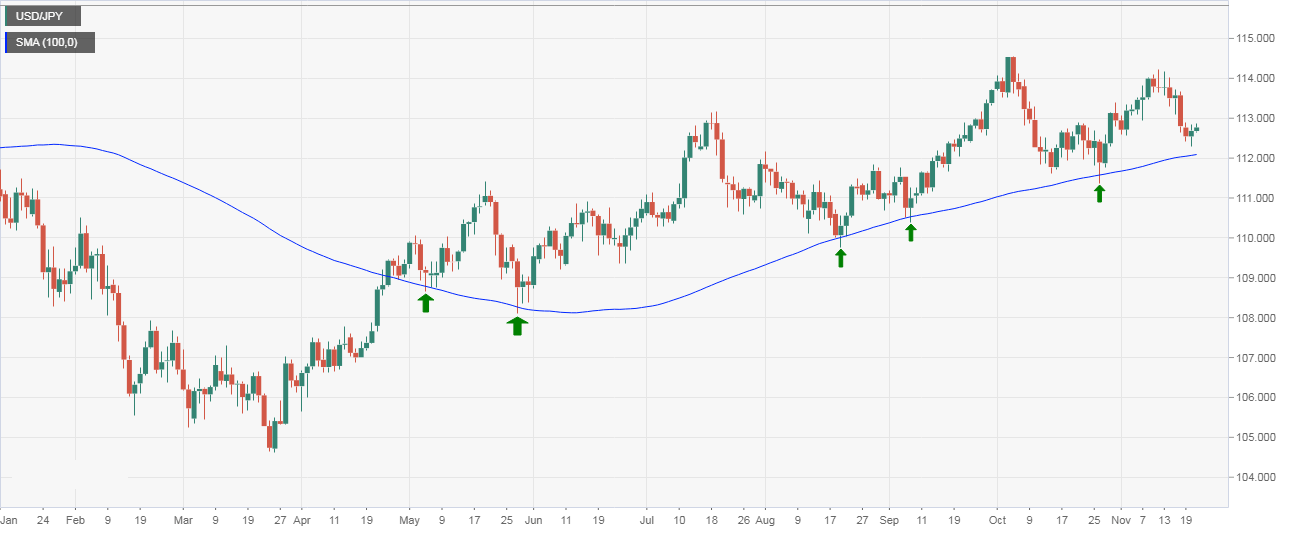
The above chart also shows that a rebound from the 100-day SMA has ended up creating a fresh higher high more often than not. For instance, the pair found takers around the 100-day SMA  on May 29 and went on to set a higher high of 113.18 (July 19 high) before falling back to the SMA support. On similar lines, the pair carved a higher high at 114.54 last month, having bounced off the 100-day SMA in September.

The pair's recent bounce from the 100-day SMA witnessed on Oct. 26, however, ended up carving a lower high at 114.23. While that is a cause for concern, a bearish reversal is still not confirmed as the spot is yet to breach the 100-day SMA support, currently at 112.08.  

As seen in the chart, the bears have persistently failed to breach the long-term SMA support on the daily closing basis. Therefore, a bullish-to-bearish trend change would be confirmed if the spot closes below the 100-day SMA. The breakdown, if confirmed, would open the doors for a deeper sell-off to levels below 110.00.

Notably, the likelihood of the pair finding acceptance below the 100-day SMA in the next few days is quite high as:

  • Markets have begun pricing in the possibility of a Fed rate hike pause in 2019. Fed's Powell took note of the domestic and overseas risks to the US economy forcing many to question the central bank's commitment to raising rates three times in 2019.
  • The US 10-year treasury yield is threatening a double top breakdown. The bearish pattern, if confirmed, could drive the USD lower across the board.
  • The USD/JPY bulls have likely run out of steam as indicated by the pair's failure to create a higher high above 114.55 despite the strong bounce from the 100-day SMA, as seen on Oct. 26.

At press time, the pair is trading at 112.79, having clocked a low of 112.30 yesterday.

Author

Omkar Godbole

Omkar Godbole

FXStreet Contributor

Omkar Godbole, editor and analyst, joined FXStreet after four years as a research analyst at several Indian brokerage companies.


More from Omkar Godbole
Share:

Editor's Picks

AUD/USD trims losses, still near 0.6900

AUD/USD remains well on the defensive, adding to Wednesday’s pullback and trading close to the key 0.6900 contention zone ahead of the opening bell in Asia. Discouraging prints from the Australian labour market report have weighed on the Aussie, which has remained unable to take advantage from the marked pullback in the Greenback.

USD/JPY slides back below 158.00 as USD reverses post-CPI gains

USD/JPY extends the previous day's pullback from a three-week high, attracting follow-through selling and sliding below 158.00 during Thursday's Asian session. Traders remain on high alert amid speculation that authorities will step in to prop up the Japanese Yen. The US Dollar, meanwhile, reverses Wednesday's hot CPI-led gains to April 2025 highs as US bond yields retreat on China bond-buying talk, further pressuring the pair.

Gold: Upside remains capped by $4,200

Gold regains the smile and leaves behind three consecutive days of losses, advancing to the $4,170 region per troy ounce on Thursday. The precious metal’s recovery comes amid the fresh offered stance in the Greenback and declining US Treasury yields while investors remain cautious ahead of the Fed’s Warsh speech on Friday.

Ethereum reclaims $2,400 as PPI hits 6.3% and yields fall
Ethereum (ETH) is back above $2,400 on Thursday, rebounding from a brief decline toward $2,340, which was sparked by an upside surprise in the US wholesale inflation report. The Producer Price Index (PPI) increased 1.3% monthly and 6.3% annually in September, far above expectations of 0.5% and 5.3%, respectively.
The Iran war will eventually end. Tariffs won't. Here's the problem
Two cost shocks are in the September Consumer Price Index (CPI), and they have different half-lives. Energy is up 20.4% on the year and accounts for about 1.3 points of the 3.7% headline, and that shock reverses when Oil does: Brent was back at its pre-war price on July 1 and above $100 again by the end of the month, after the ceasefire collapsed on July 8.
Everyone's dumping Gold after hot US inflation. Here's why $4,100 could be a floor, not a cliff
Gold (XAU/USD) is recovering from a sharp sell-off triggered by hotter-than-expected United States (US) inflation data released on Wednesday. The precious metal briefly plunged toward $4,073 as investors increased their bets on further Federal Reserve (Fed) interest rate hikes before recovering as US Treasury yields and the US Dollar (USD) reversed their initial gains.















