USD/JPY Forecast: Rising in an uptrend channel, all eyes on the Fed
- The USD/JPY extended its gains on higher yields and as markets ignored the tariffs.
- The Fed decision is left, right, and center in the last week of September.
- The pair is trading in an uptrend channel on the daily chart. The FX Poll shows a bearish tendency.

This was the week: Ignoring trade, yielding to yields
The US finally announced its decision to slap a 10% tariff on $200 billion worth of Chinese goods. The announcement came after an extended period of communicating its intentions, and this is one of the reasons for the relatively muted reaction in markets. The relative calm sent the US Dollar lower against many currencies but not against the safe-haven yen. The reaction may change later on.
More: Trump tariffs: 5 reasons why markets ignored them and how that could change.
The greenback received a boost from higher US bond yields. The 10-year Treasury yield, a global benchmark, topped 3% once again and became comfortable around this level. A break above 3.13% could be even more meaningful.
The Bank of Japan left its policy unchanged and did not adhere to PM Shinzo Abe's comments about monetary policy not being loose forever. With very low inflation, it is hard to see a change of heart at the central bank. Abe won an internal leadership contest at his LDP party and is set to remain PM for the next three years.
Second-tier data played second-fiddle.
Fed will hike now, probably in December, but what's next?
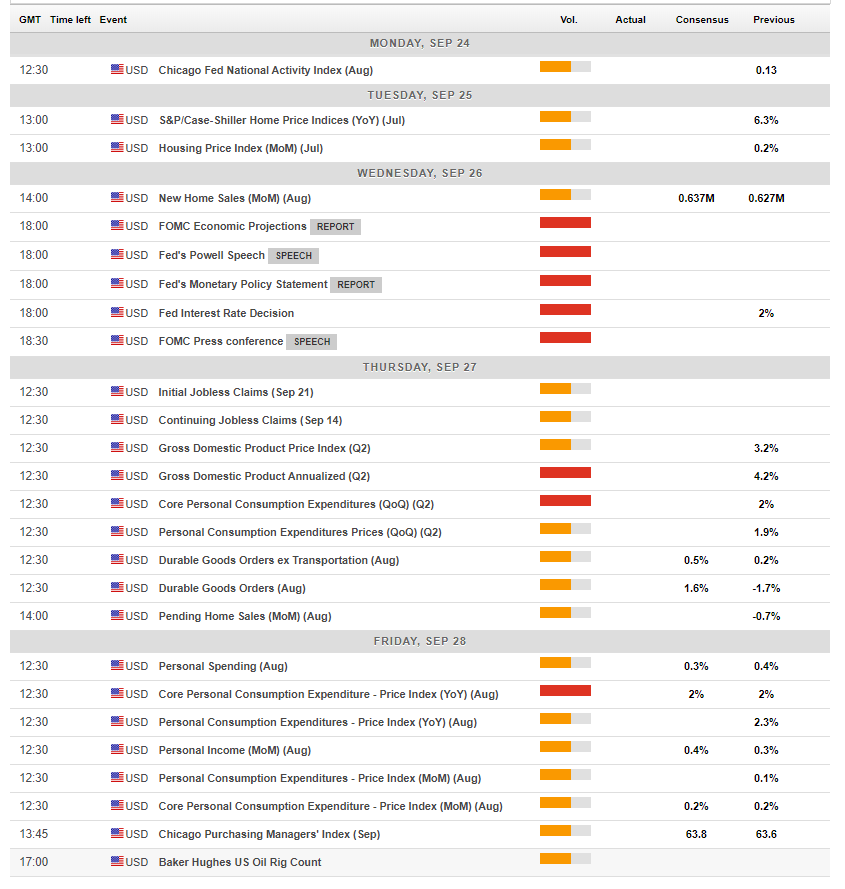
The Federal Reserve will raise rates on September 26th. The probability is 100%. They have communicated it in a clear manner, as they did in the past. The economy is growing at a rapid clip, wage growth has recently accelerated, and inflation is on target despite the recent slide.
A rate hike in December is also high on the cards. The Fed's recent dot-plot forecast the fourth hike in 2018, and there is little reason to doubt the move. Markets will want to see a confirmation of the Fed's intentions.
The bigger question is the direction of monetary policy in the future. During the post-crisis years, the policy has been accommodative: interest rates were below the inflation rate. With the Federal Funds Rate topping 2%, the policy is now neutral.
Some Fed officials want a neutral rate, matching inflation. However, Fed Governor Lael Brainard and Chicago Fed President Charles Evans hinted at setting the rate above neutral: a tight monetary policy, at least for some time. Both of them used to be doves. Are the hawks taking over?
The fresh dot-plot may provide some answers and will likely trigger the initial market reaction. The other forecasts in the document relate to growth, inflation, and employment. will be of lesser importance.
The regular statement that the FOMC publishes will be scrutinized first and foremost for any new commentary on inflation. Fed Chair Jerome Powell said that inflation is not accelerating in his Jackson Hole speech. What are the views now? Comments on wages after their recent acceleration are also of interest ahead of insights on employment and global developments.
After the initial rush related to the dot-plot and the statement, markets will have 30 minutes until Chair Powell begins his press conference. Powell has tiptoed around sensitive political questions such as trade, but he is indeed not shy about monetary policy. He can trigger another round of volatility in his 45-50 minutes long presser.
Further reactions to this substantial rate decision are due at the Tokyo open, on Thursday's European open and most probably later int he week.
Other US events: GDP, durables
The first events of the week are second-tier ones, and tension will be high towards the FOMC meeting. New home sales are expected to rise after a few months of declines.
On Thursday, the final read of US GDP for Q2 will try to distract markets from the Fed decision on the previous day. According to the second release, the economy grew at a robust rate of 4.2% annualized. The final read will likely confirm it. Any significant deviation, below 4% or above 4.5% could rock the dollar.
Durable goods orders for August are also of high interest. The data is eyed by the Fed and also feeds into GDP figures for Q3. Core orders and the no-defense, ex-air measure matter more than the headline figure.
The Fed's favorite inflation measure, the Core PCE Price Index, is due on Thursday. After August's Core CPI number slipped from 2.4% to 2.2%, also the Core PCE will likely drop from 2% seen in July. The extent of the fall is unknown as the methodology is different. Accompanying figures such as Personal Income and Personal Spending will also be of interest.
Friday is also the final day of the month and the quarter, and this could trigger last-minute moves by portfolio managers.
Here are the top US events as they appear on the forex calendar:
Japan: Tokyo CPI and also NK, trade
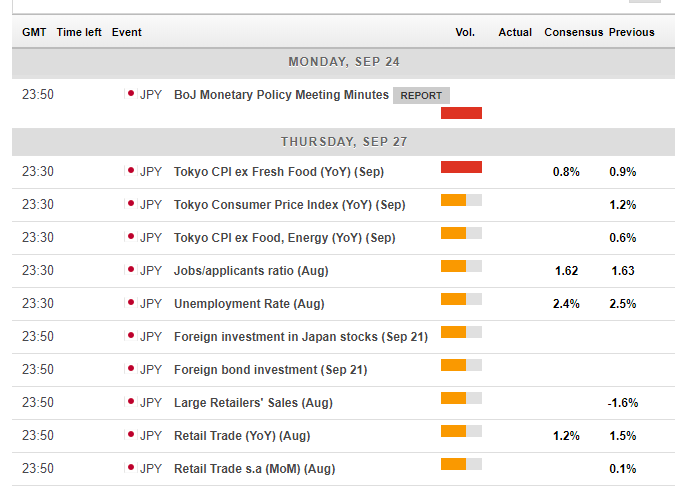
The week begins with the meeting minutes from the previous BOJ decision. They may reveal differences between the members, but the earth-shattering news is not expected. The Tokyo CPI is of interest. The capital region publishes its inflation figures before the rest of the country. The measure excluding Fresh Food is the most significant one. It showed sub a 1% increase in prices back in July and is unlikely to get remotely close to the BOJ's elusive 2% target.
The acceleration in negotiations with North Korea may also have an impact on the safe-haven Yen. A breakthrough in talks will likely send the Japanese currency lower while a breakup of discussions can trigger safe-haven flows to the Yen.
And while markets remain calm with Trump's recent tariffs, any trade headlines may change the picture. The US President continued bashing the world's second-largest economy, and stock markets may take note.
Here are the events lined up in Japan:
USD/JPY Technical Analysis
The USD/JPY is trading in a steep upwards channel, a bullish sign. The Relative Strength Index is above 50 but below 70, thus not indicating overbought conditions. Momentum remains positive, and the pair is trading above the 50-day and the 200-day Simple Moving Averages. All in all, the bias is bullish.
112.90 was the peak on September 20th and is initial resistance. 113.15 was a high point in July and remains significant. 113.45 capped the USD/JPY in January and the next level to watch is 113.75 that dates back to December.
Looking down, 112.15 was a swing high in early August and switches to support. 111.85 capped the pair in late September. 111.45 held the USD/JPY down in mid-August, and 110.70 served as support before the recent upturn.
-636731222146058592.png)
USD/JPY Sentiment
The Fed will likely be quite hawkish, and this is not priced into the price. Therefore, there is room to the upside. It is important to note that Trump can always spoil the party.
The FXStreet forex poll of experts shows a bearish tendency on all timeframes, but the forecasts have been upgraded from the previous week. Forecasts converge around the 112.00 level.
Related Forecasts
Author

Yohay Elam
FXStreet
Yohay is in Forex since 2008 when he founded Forex Crunch, a blog crafted in his free time that turned into a fully-fledged currency website later sold to Finixio.
















