|

USD/JPY Forecast: Eyes three-month long rising trendline, US-JP yield spread narrows

  • Tuesday's bearish outside-day candle makes today's close pivotal.
  • 10-year US-Japan bond yield differential is charting a head-and-shoulders pattern.
  • USD/JPY risks falling below the three-month-long rising trendline.

The USD/JPY pair is trading at 110.40 in Asia - down 0.15 percent on the day.

Having defended the confluence of rising trendline and 50-day MA in the last week of June, the USD/JPY convincingly crossed the falling trendline (drawn from May 21 high and June 16 low) on Monday and hence, was expected to re-test May 21 high of 11.40 this week.

Instead, it ran into offers at a high of 111.13 on Tuesday and ended up creating a bearish outside-day candle (bearish reversal pattern). Further, a short-lived break above the falling trendline (drawn from May 21 high and June 16 low) (or fake breakout) has weakened the bull case.

Daily chart

A close today below 110.50 (previous day's low) would validate the bearish outside-day candle and fake breakout and would shift risk in favor of a break below the trendline sloping upwards from the March 26 low and May 29 low.

A daily close below the three-month rising trendline would mean the rally from the March 26 low of 104.63 has ended and would put the focus back on the big bearish outside-week candle of May, allowing a deeper drop to 108.82 (38.2% Fib R of 104.63-111.40).

The 10-year US-Japan bond yield spread chart favors a convincing break in USD/JPY below the three-month-long rising trendline support, currently seen at 110.06.

Yield spread daily chart
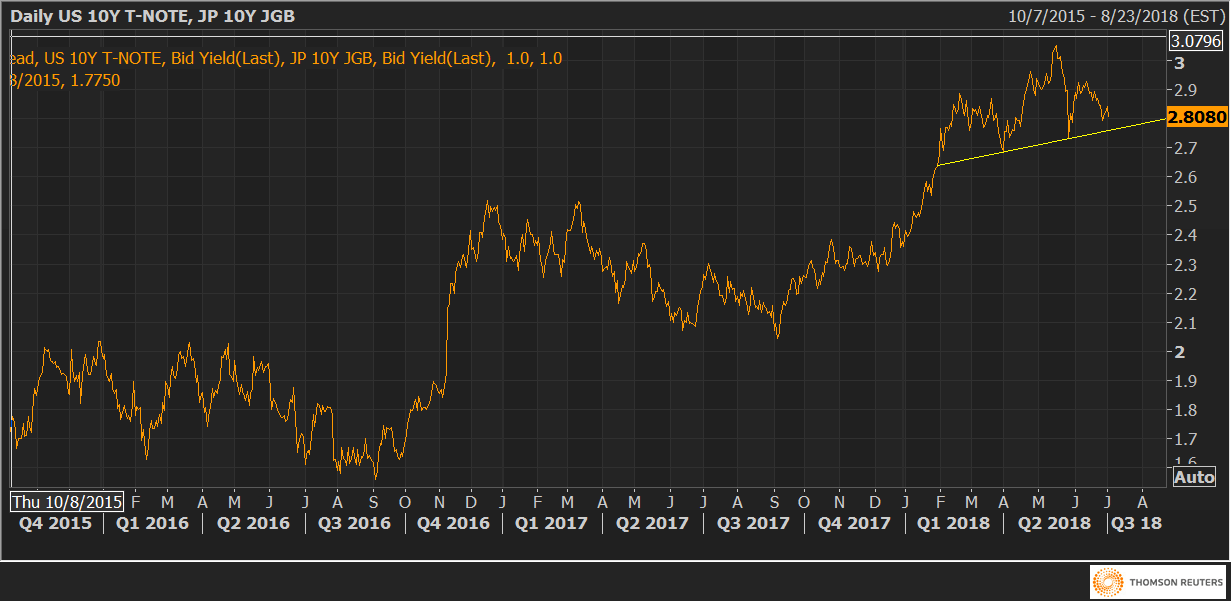
The yield differential fell to 280 basis points on Tuesday from Monday's high of 284 basis points and is charting a head-and-shoulders bearish reversal pattern with neckline support around 2.75 percent. Acceptance below that level would open up downside towards 2.45 percent and a sharp drop in the USD/JPY pair.

Author

Omkar Godbole

Omkar Godbole

FXStreet Contributor

Omkar Godbole, editor and analyst, joined FXStreet after four years as a research analyst at several Indian brokerage companies.


More from Omkar Godbole
Share:

Editor's Picks

GBP/USD extends recovery, trades above 1.3200

GBP/USD clings to modest gains above 1.3200 on Friday after closing in positive territory on Thursday. Still, the cautious market mood makes it difficult for the pair to gather bullish momentum as investors remain focused on US-Iran conflict and the volaility surrounding global technology shares.

EUR/USD rebounds to 1.1400 as USD corrects lower

EUR/USD builds on Thursday's moderate recovery gains and advances to the 1.1400 area on Friday. The US Dollar (USD) struggles to find demand and helps the pair edge higher as investors keep a close eye on headlines coming out of the Middle East and the action in global technology stocks.

Gold clings to small gains above $4,000 but Fed hike bets cap the upside

Gold moves sideways in a tight channel above $4,000 after posting modest gains on Thursday. Nevertheless, the precious metal finds it difficult to gather bullish momentum as markets grow increasingly convinced about a hawkish Federal Reserve policy outlook.

Ripple price clings to $1 as long liquidations deepen bearish trend

Ripple (XRP) trades near the key psychological support level of $1 after losing more than 8% so far this week. CoinGlass liquidation data shows that over 97% XRP long positions were wiped out over the past 24 hours. In addition, derivatives metrics continue to favor the bears.

The Mag 7 trade is ending – The AI cash-flow divorce is just beginning

The AI boom is not weakening. The market is simply becoming less willing to reward companies for writing ever-larger infrastructure cheques without a clearer cash-return timetable. Microsoft, Amazon, Alphabet and Meta are becoming the financing arm of the AI cycle, while chips, memory, networking and power infrastructure increasingly look like the early cash beneficiaries.

Regime change: Inside Kevin Warsh's first move to make the Fed unreadable on purpose

The rate did not move. That was the least interesting thing about Kevin Warsh's first meeting in charge of the Fed. The FOMC held its benchmark at 3.50%-3.75% for the fourth straight meeting, exactly as priced, and then the new chair used his first press conference to dismantle the machinery the market has leaned on for a decade.














