|

USD/JPY Forecast: Bulls in control as yields keep raising

USD/JPY Current price: 109.66

  • US Treasury yields continued advancing amid inflationary pressures concerns.
  • Speculative interest awaits US employment-related figures for additional clues.
  • USD/JPY trades near May high and is poised to extend its advance.
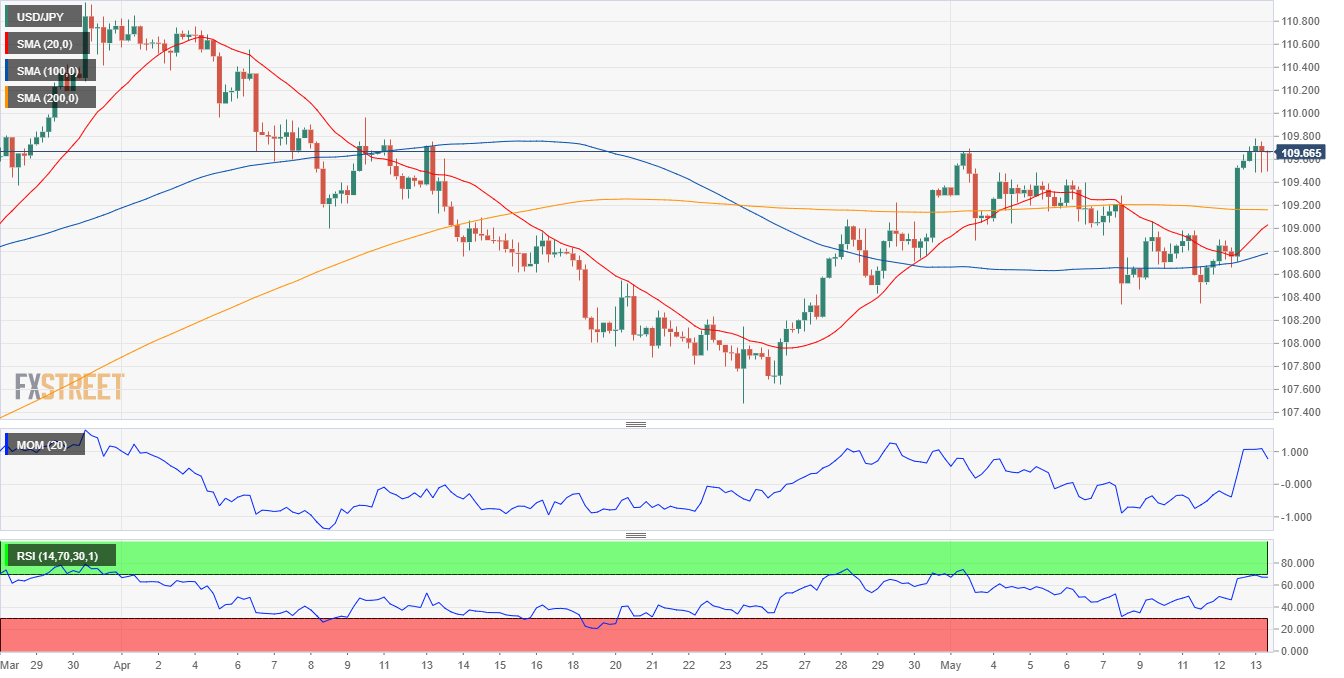
The American dollar remains the strongest currency across the FX board after the release of above expected US April´s inflation. The USD/JPY pair trades at the upper end of its monthly range, near a fresh May high at 109.78. Sharp losses in Wall Street dragged south overseas counterparts, with European and Asian equities trading well in the red. Meanwhile, government bond yields keep running, with the yield on the 10-year US Treasury note at the critical 1.70% level.

Japanese data published at the beginning of the day failed to impress. The Trade Balance posted a surplus of ¥983.1 billion in March, surpassing expectations, although the April Eco Watchers Survey Outlook contracted to 41.7. The US will publish the April Producer Price Index and Initial Jobless Claims for the week ended May 7, foreseen at 490K.

USD/JPY short-term technical outlook

The USD/JPY pair is bullish in the near-term and would likely extend its advance in the upcoming hours. Much will depend on how US Treasury yields develop. From a technical point of view, the 4-hour chart shows that the pair is comfortable well above all of its moving averages, with the 20 SMA advancing between the longer ones. Technical indicators resumed their advances after correcting overbought conditions, reflecting strong buying interest.

Support levels: 109.25 108.80 108.30  

Resistance levels: 109.75 110.10 110.50  

View Live Chart for the USD/JPY 

Author

Valeria Bednarik

Valeria Bednarik was born and lives in Buenos Aires, Argentina. Her passion for math and numbers pushed her into studying economics in her younger years.


More from Valeria Bednarik
Share:

Editor's Picks

AUD/USD recovers toward 0.7000 amid improving mood

AUD/USD is firming up toward 0.7000 in Asia on Tuesday, helped by improving market mood. A pause in the US Dollar rebound also aids the pair's upside. However, geopolitical risks and caution ahead of AI tech earnings report could limit the pair.

USD/JPY flatlines near 158.50 as markets seek direction

USD/JPY steadies around 158.50 in the Asian trading hours on Tuesday. Traders prefer to wait on the sidelines ahead of Japan’s National Consumer Price Index inflation data later on Friday. Meanwhile, elevated US bond yields provide some support to the US Dollar against the Japanese Yen.

Gold slides amid recovery in bond yields, higher oil prices

Gold price declines to near $4,120 in the early European trade. The precious metal faces selling pressure amid a recovery in yields on United States bonds and rising oil prices. US Treasury Yields have shown signs of recovery, with US hyperscalers set to report their Q3 earnings in near time. As of writing, 10-year US Treasury Yields are down 0.35% to near 5.13%

NEAR Protocol: Mild correction persists despite resilient ETF inflows

NEAR Protocol price is down nearly 2% on Tuesday, mirroring its 2% decline from the previous day. Institutional demand remains firm, with Bitwise’s NEAR-focused Exchange Traded Fund (ETF) recording over $5 million in inflows on Monday.

Chip bounce fails to inspire Asia and France weighs on Europe
Preview: US chips rebound, but Europe and Asia slide; oil firms on Gulf supply fears. Risk caught a bid on Monday, buoyed by better-than-expected Chinese Q3 26 GDP growth and a rebound in chipmakers. US equity benchmarks recovered most of Friday’s lost ground, with the S&P 500 touching gloves with the underside of its 50-day SMA around 7,705 and the Nasdaq 100 leading the way, adding 1.2%.
The US Dollar fell. Gold didn't rally. That tells you everything
Gold (XAU/USD) is struggling to capitalize on a weaker US Dollar (USD), after repeatedly failing to establish itself above the $4,200 level. The precious metal remains confined to a relatively narrow trading range despite a combination of developments that would normally support higher prices.