|

USD/JPY Forecast: Back to its comfort zone above 107.00

USD/JPY Current Price: 107.21

  • Japan Jibun Bank Manufacturing PMI improved to 42.6 in July, according to preliminary estimates.
  • US Treasury yields under pressure amid stubbornly high new daily coronavirus cases worldwide.
  • USD/JPY recovered the 107.00 threshold, but its bullish potential is well-limited.
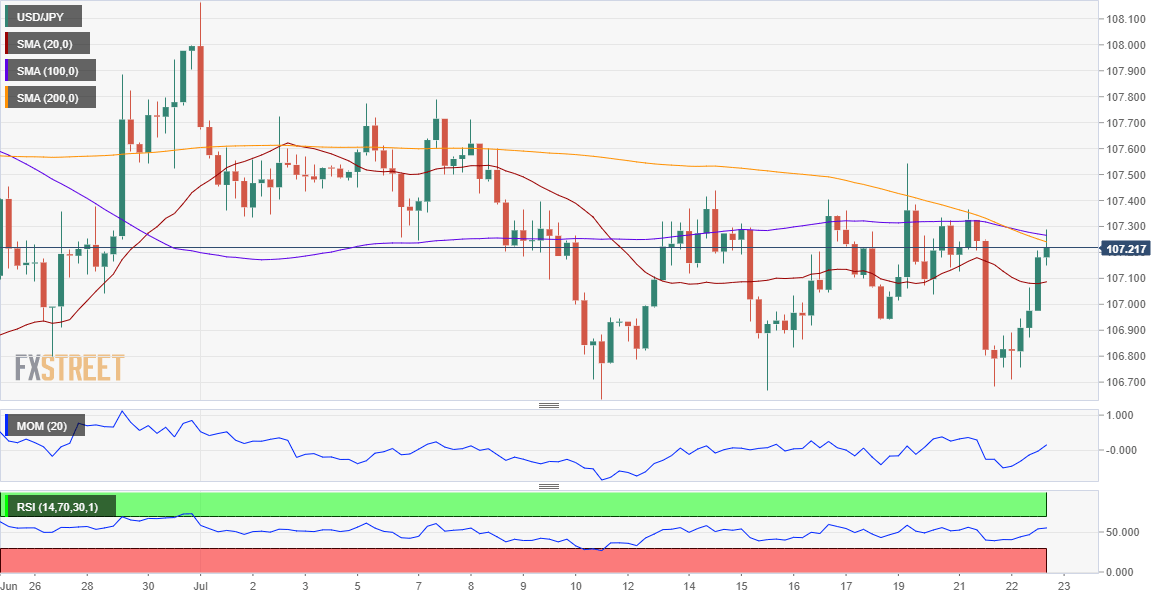
The USD/JPY pair recovered once again from the 106.60 price zone and returned to its comfort zone a few pips above the 107.00 level. The sentiment remained sour throughout the day, fueled by US-China tensions and pandemic-related headlines. Nevertheless, a modest advance in US indexes has helped the pair to recover above 107.00 during US trading hours. US Treasury yields, in the meantime, edged lower with the yield on the benchmark 10-year note down to 0.58%, as concerns about the stubbornly high number of new daily coronavirus cases undermined the market’s mood. Over the last 24 hours, the world reported roughly 240,000 new contagions, with 67,000 of those coming from the US.

Japan published at the beginning of the day the preliminary estimate of the July Jibun Bank Manufacturing PMI, which came in better than anticipated, printing at 42.6 also improving from the previous 40.1. Japan will be on holiday this Thursday, as it celebrates Marine Day.

USD/JPY short-term technical outlook

The USD/JPY pair bounced from the base of its latest range, losing the bearish strength seen on previous updates. The pair is now neutral, according to the 4-hour chart, as technical indicators turned flat after reaching their midlines. In the mentioned time-frame, it has settled above its 20 SMA but remains below the largest one. The bullish potential seems well-limited by the broad dollar’s weakness.

 Support levels: 106.95 106.60 106.20

Resistance levels: 107.45 107.80 108.15

 View Live Chart for the USD/JPY

Author

Valeria Bednarik

Valeria Bednarik was born and lives in Buenos Aires, Argentina. Her passion for math and numbers pushed her into studying economics in her younger years.


More from Valeria Bednarik
Share:

Editor's Picks

AUD/USD flatlines as US yield ripples meet RBA hawks

The Australian Dollar is virtually unchanged against the US Dollar on Wednesday amid a light economic calendar, with the US Treasury's announcement of a buyback for the September 10 auction boosting the Greenback. The AUD/USD trades at 0.7219, flat.


USD/JPY rises above 153.50 on renewed USD strength

USD/JPY shakes off the bearish pressure and trades above 153.50 in the American session on Wednesday. The US Dollar (USD) stages a rebound following the US Treasury buyback announcement and helps the pair gain traction. Nevertheless, solid Japanese data reinforce expectations that the BoJ will continue normalising monetary policy, lending further support to the Yen and capping the pair's upside for now.

Gold regains balance above $4,400

Gold rebounds on Wednesday, snapping a three-day losing streak and reclaiming the are beyond the key $4,400 mark per troy ounce. The precious metal’s bounce comes amid further selling pressure on the US Dollar and steady uncertainty on the geopolitical front.

Bitcoin and Gold Outlook: BTC and XAU kick-start recovery ahead of key economic events
Bitcoin (BTC) holds above $79,000, maintaining resilience on Wednesday as the broader cryptocurrency market consolidates gains. Gold (XAU) is steady above $4,400, underpinned by a measured shift toward risk-on sentiment among investors.
Venezuela’s 65-billion-barrel Oil deal could reshape America’s inflation fight
The United States (US) has secured unprecedented access to part of Venezuela’s vast Oil reserves. The timing is particularly significant as the war with Iran is disrupting Middle Eastern supplies, keeping energy prices elevated and reviving concerns about inflation.
Venezuela’s 65-billion-barrel Oil deal could reshape America’s inflation fight
The United States (US) has secured unprecedented access to part of Venezuela’s vast Oil reserves. The timing is particularly significant as the war with Iran is disrupting Middle Eastern supplies, keeping energy prices elevated and reviving concerns about inflation.