USD/JPY falls for third straight day: Yen supported by BoJ decision
USD/JPY dipped to 157.32 on Friday. The Japanese yen strengthened for a third straight session after the Bank of Japan held its key interest rate at 1.25%, as expected.
At the same time, the BoJ sent a more important signal about future policy: core inflation has finally reached the 2% target. This increases the likelihood of another rate hike as early as December.
The decision was approved by an 8–1 vote. Board member Hajime Takata advocated an immediate rate hike to 1.5%, saying economic conditions have entered a new phase and require a faster move towards neutral rates.
Additional support for the yen came from demand for safe-haven assets following weak reports from major technology companies, which again raised doubts about the scale of investment in AI and triggered another equity sell-off. Meanwhile, global asset managers are beginning to return to the Japanese debt market: improved domestic demand and more favourable monetary policy expectations are increasing the appeal of Japanese bonds and supporting the yen.
Technical analysis
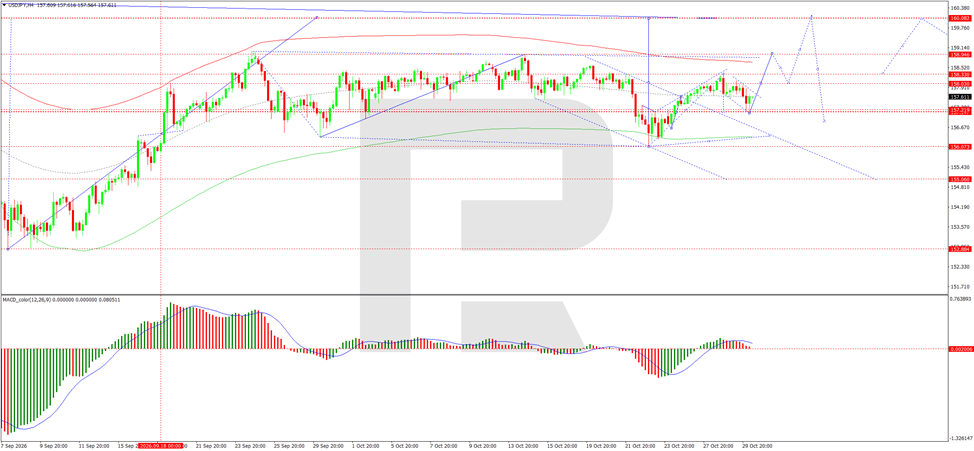
On the four-hour USD/JPY chart, the market formed an upward impulse towards 158.33, after which it corrected downwards towards support at 157.14. This level acts as a local pivot point and remains significant for the further development of the ascending structure. The current price is around 157.61. The main scenario envisages further growth towards resistance at 158.03. A break above this level would open the way to 158.94, with the main target at 160.08 in sight. The MACD indicator supports this scenario. Its signal line is above zero, but the shrinking positive histogram indicates a temporary weakening of the upward impulse. To confirm continued growth, the indicator would need to regain positive momentum. Key support remains the 157.14–157.22 area; a break below it would create the conditions for a decline towards 156.07.
On the hourly USD/JPY chart, the market is forming a local consolidation following the corrective decline from 158.03. The price is holding above support at 157.14 and attempting to recover towards resistance at 157.57. A close above this level would confirm the likelihood of a new upward wave developing. The Stochastic oscillator shows its signal lines above 50 and pointing upwards, reflecting a recovery in buying activity. The nearest target is 158.03, followed by 158.94.
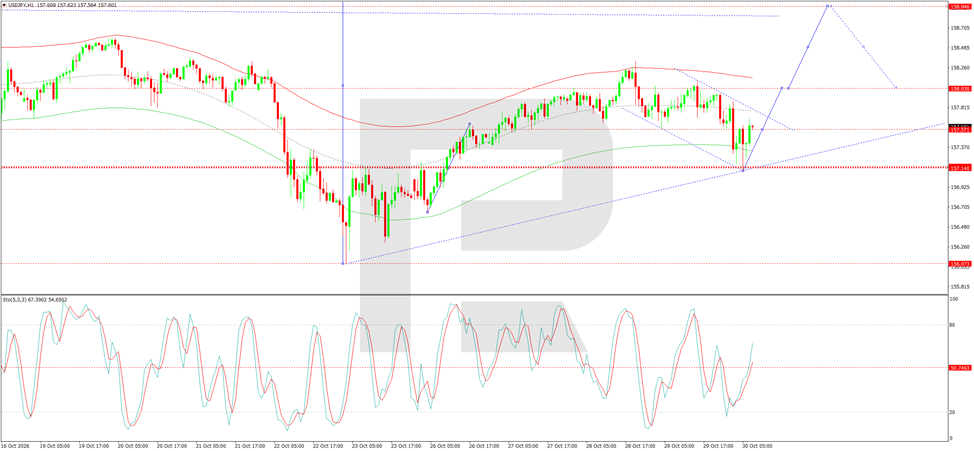
For the upcoming trading session, the upward scenario remains the priority while support at 157.14 holds. A decisive break above 158.03 would strengthen buyers’ positions and confirm upward momentum. Until such confirmation, short-term consolidation within the current range is likely.
Conclusion
USD/JPY has declined for a third consecutive session as the yen benefits from the Bank of Japan’s decision to hold rates at 1.25% and its signal that core inflation has reached the 2% target, raising the prospect of a December rate hike. The 8–1 vote, with one member calling for an immediate increase to 1.5%, underscores the growing hawkish sentiment within the BoJ. Additional support for the yen came from safe-haven demand amid weakness in technology stocks and a gradual return of global asset managers to Japanese bonds. Technically, the pair remains in an upward structure above support at 157.14, with resistance at 158.03 and targets at 158.94 and 160.08 if the recovery resumes. A break below 157.14 would shift the outlook and expose 156.07. The near-term direction will hinge on whether buyers can break above 158.03.
Author

RoboForex Analysis Department
RoboForex
RoboForex Analysis Department provides timely market insights, expert technical analysis, and actionable forecasts across forex, commodities, indices, and equities.