|

USD/JPY analysis: poised to test 114.54, October high

USD/JPY Current price: 113.79

  • Easing Treasury yields weighed on the pair Friday despite broad dollar's strength.
  • Japan inflation at factory levels to be out this Monday.
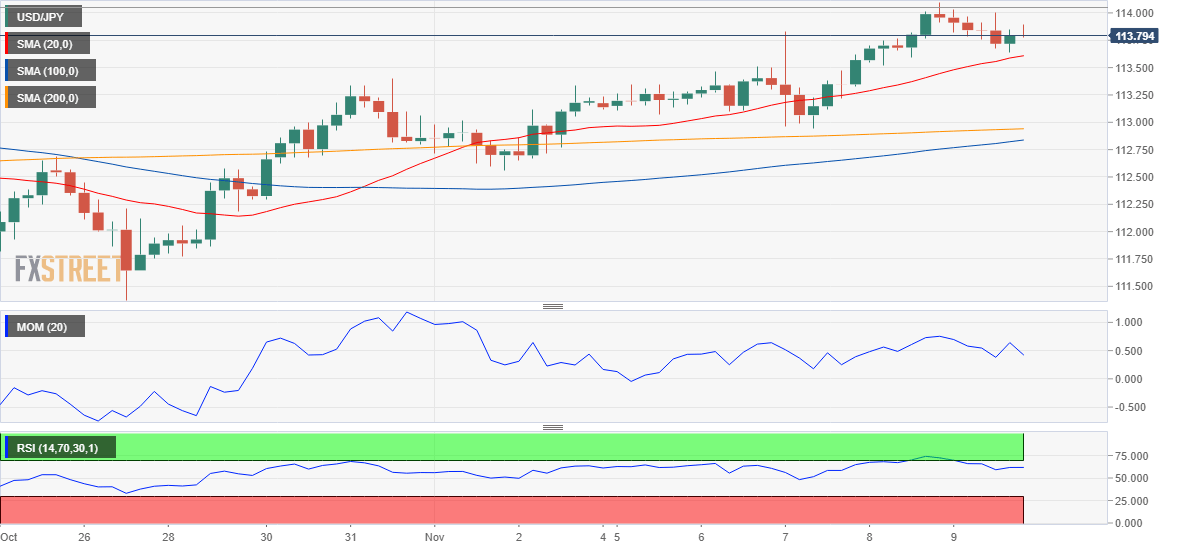
US Treasury yields pulled back from two-week highs on Friday, dragging the USD/JPY pair lower. The pair settled at 113.80, after hitting a monthly high of 114.08, up for a second consecutive week. Yields eased on the back of signs indicating rising inflation in the US, as producer prices were 2.9% higher YoY in October, just two days after the US Federal Reserve indicated that will keep on rising rates, with the next one expected for December. The benchmark yield for the 10-year Treasury note settled at 3.18% after peaking mid-week at 3.24%. Japan will release the October Domestic Corporate Price Index at the beginning of the week, previously at 3.0%  YoY and Machine Tools Orders for the same period.

The USD/JPY pair maintains its positive tone in the daily chart, although the upward momentum seems limited, as it develops well above a bullish 100 DMA, while technical indicators ease within positive ground. In the shorter term, and according to the 4 hours chart, the technical picture is quite alike, as the 100 and 200 SMA are some 100 pips below the current level, while technical indicators hold well into positive territory but without offering directional clues, the Momentum easing modestly and the RSI flat around 60. Beyond 114.10, the pair could extend its gains up to 114.54, October monthly high, with gains beyond this last unclear at the time being.

Support levels: 113.85 113.40 113.00    

Resistance level: 114.10 114.55 114.90

View Live Chart for the USD/JPY

Author

Valeria Bednarik

Valeria Bednarik was born and lives in Buenos Aires, Argentina. Her passion for math and numbers pushed her into studying economics in her younger years.


More from Valeria Bednarik
Share:

Editor's Picks

GBP/USD remains slightly bid near 1.3300

GBP/USD now advances marginally and manages to dispute the 1.3300 region on Tuesday. Indeed, Cable regains some balance on the back of the lacklustre performance of the Greenback, all preceding the Fed’s meeting on Wednesday and the BoE’s gathering on Thursday.

EUR/USD recedes from tops, back below 1.1400

EUR/USD manages to set aside part of the recent weakness and clinches decent gains on Tuesday. Indeed, spot keeps the trade below the 1.1400 mark amid acceptable losses in the US Dollar, all following rising optimism of a US-Iran deal and steady caution prior to the FOMC gathering on Wednesday.

Gold bounces on poor US data

Gold remains under marked downside pressure on Tuesday, although the $4,000 zone per troy ounce emerges as a decent support for now. The precious metal’s pullback comes despite the modest losses in the US Dollar in a context of easing geopolitical tensions ahead of the key Fed event on Wednesday.

XRP falls toward $1.00 despite dwindling exchange reserves
Ripple (XRP) continues to trade under increasing pressure on Tuesday. This marks the second consecutive day of declines, reflecting broader risk-off sentiment as investors appear to shift gears in anticipation of the Federal Reserve (Fed) interest rate decision. On Wednesday, the Federal Open Market Committee (FOMC) is widely expected to leave interest rates unchanged in the 3.50%-3.75% range.
Warning signs in the stock market: Is this the top, or just a very short fuse?
Overnight, South Korea's Kospi fell more than 10%, SK Hynix lost close to 15% and Samsung Electronics lost 13%. Into that, Dow Jones Industrial Average futures traded up around 1% on paint and soft drinks, and S&P 500 futures sat roughly flat. An index that absorbs a memory-chip panic and prints nothing is not a calm market.
US Dollar mid-year outlook: Exceptional currency, exceptional risks?
The US Dollar enters the second half of 2026 in a markedly different position from a year ago. The King currency has recovered, reflecting persistent US inflation, changing expectations for Fed policy, geopolitical tensions and renewed demand for defensive assets.