|

USD: How effective will the Fed's measures be for the dollar's prospects?

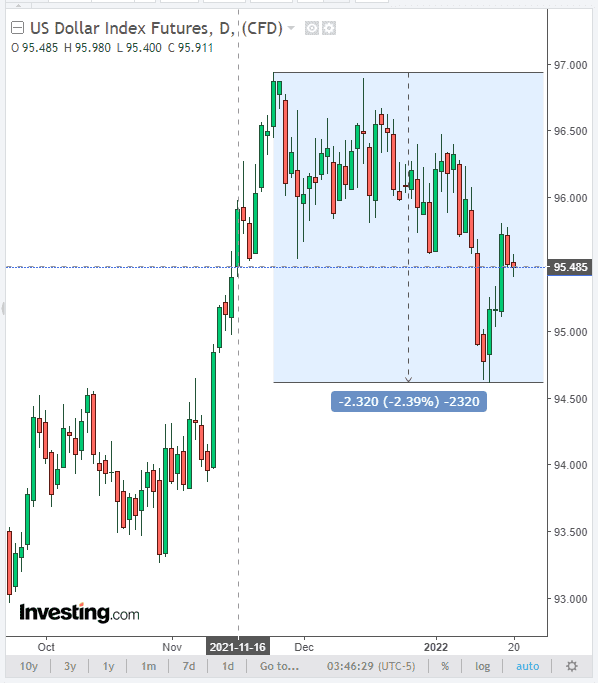
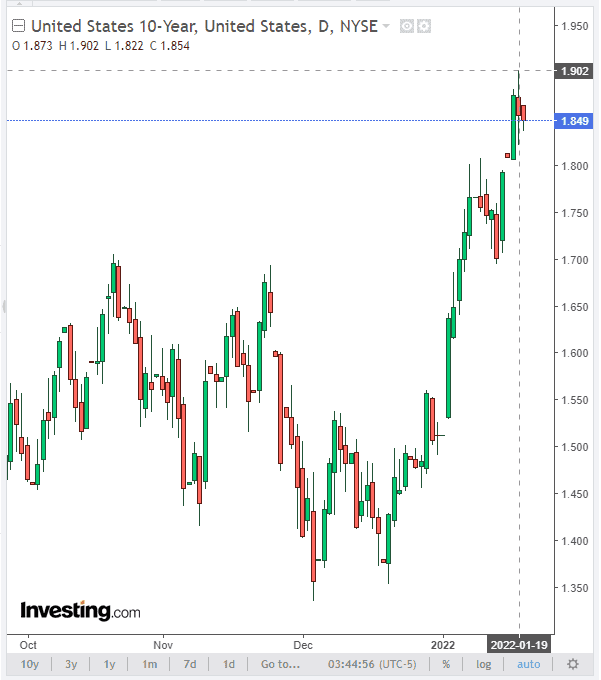
US government bond yields have stalled. At the time of publication of this article, the yield on 10-year US bonds was 1.849%, down from a local 2-year high of 1.897% reached on Wednesday. Along with the decline in government bond yields, the dollar is also declining. Thus, the DXY dollar index, which reflects the value of the dollar against a basket of 6 major currencies, was at the time of publication of this article near the 95.49 mark, remaining in the area below the recent range between the levels of 96.94 and 95.54.
fxsoriginal
Chart

Investors are evaluating the prospects for the dollar (in line with the upcoming Fed rate hikes) and the threat of accelerating inflation in the US. Earlier this month, the US Department of Labor Statistics reported that consumer prices rose 7.0% (on an annualized basis) in December after rising 6.8% in November. This corresponds to highs almost 40 years ago. Core inflation (excluding food products and energy) rose in December by 5.5% (in annual terms). Thus, inflation has been exceeding the Fed's target of 2% for several months in a row, and its growth at such a pace is forcing investors to fix long positions on the dollar: they fear that the Fed may be late with measures to tighten monetary policy. Market participants have already priced in 3 Fed rate hikes this year, and it appears that some of them believe that this will not be enough to curb skyrocketing inflation in the US.

On the other hand, if the Fed starts raising interest rates at an accelerated pace, then the higher cost of financing could negatively affect demand and economic growth, while inflation remains high for some time. So quickly curb it, most likely, will not work. In response to such a scenario, the dollar may be inclined to weaken. Recall that the next meeting of the Committee on operations on the open market of the US Federal Reserve should be held on January 25-26.

Author

Yuri Papshev

Yuri Papshev

Independent Analyst

Independent trader and analyst at Forex market. Trade experience - more than 10 years. In trade Yuri Papshev uses a combination of fundamental and technical analysis.


More from Yuri Papshev
Share:

Editor's Picks

AUD/USD stalls rebound above 0.7050 amid fresh Mideast tensions

AUD/USD stalls its rebound from almost two-month lows and treads water near 0.7050 in Asia on Monday, as the US Dollar pauses following Friday's upbeat US NFP-led blowout rally to a two-month high. However, renewed geopolitical tensions, along with surging bets on Fed rate hikes, continue to act as a tailwind for the USD, capping the higher-yielding Aussie.

USD/JPY holds higher ground toward 160.50 despite 'Yentervention' fears

USD/JPY holds higher ground toward 160.50 in Monday's Asian trading, despite intervention fears. Japan’s revised GDP print, which confirmed that the economy lost momentum in the first quarter, weighs on the Japanese Yen. Meanwhile, Friday's upbeat US NFP report and fresh Israel-Iran attacks favor the US Dollar bulls, underpinning the currency pair.

Gold set for more pain amid renewed Mideast hostilities

Gold is licking its wounds, hanging close to three-month lows of $4,300 in Asia on Friday. The bright metal is consolidating before resuming Friday’s sell-off amid re-escalation in the Middle East and hawkish US Federal Reserve expectations.

Bitcoin under pressure, Ethereum breaks support and XRP weakens targets $1

Bitcoin, Ethereum, and Ripple remain under pressure at the start of this week after losing more than 14%, 15%, and 13%, respectively, in the previous week. BTC struggles below $63,000, ETH loses key support zones, while XRP’s momentum indicators continue to favor further downside.

Week ahead – Fed countdown begins amid US inflation data and geopolitical risks

Fed Chair Warsh’s first meeting approaches as key US inflation data could reshape expectations. Oil prices remain elevated as US-Iran talks continue; tariffs also return to the spotlight. ECB is expected to hike; will it be a one-off move or is July live?

The US economy defies the rules: 100 days into the Oil shock and the recession signal is still missing

More than three months after the start of the Iran war and the resulting disruption to global energy markets, the US economy continues to display remarkable resilience. The conflict has triggered a sharp rise in Oil prices, reignited inflationary pressures and fueled widespread concerns about a potential economic slowdown.














