|

USD/CAD’s trade range is turning gloomy

  • USD/CAD meets a make-or-break point after a weekly decline.

  • Technical picture favors the bears, but confirmation needed below 1.3730.

USDCAD

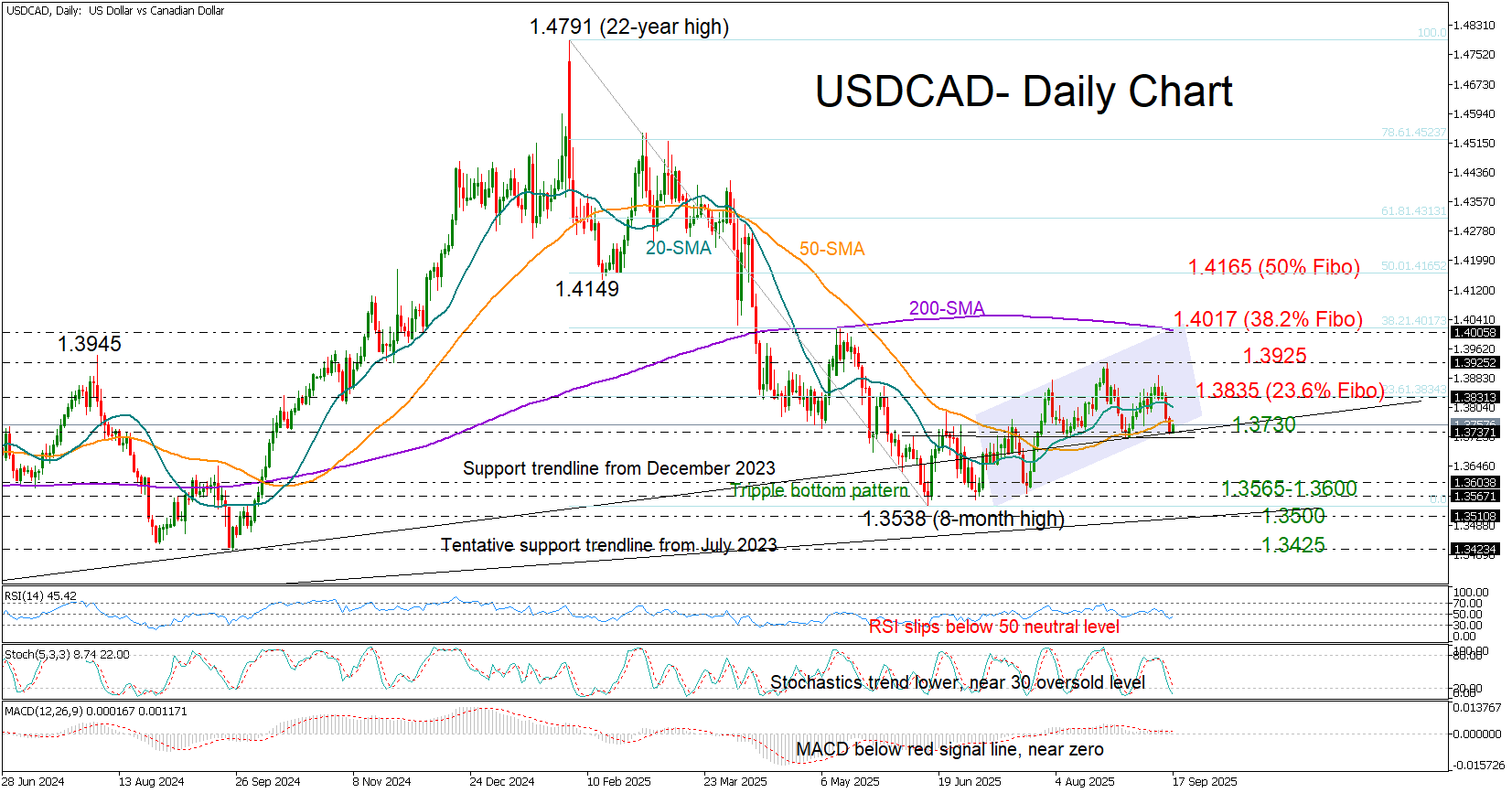
USD/CAD will take cues from the Bank of Canada and FOMC policy decisions later today, as sellers aim to dissolve the two-month sideways trajectory on the downside. What began as a promising triple-bottom pattern in July has shifted into a bearish head-and-shoulders setup, but confirmation requires a decisive move beneath the neckline of 1.3730.

Both central banks are expected to cut rates, though the BoC confronts clearer signs of slowing demand. Canada’s unemployment rate has reached a three-year high, inflation is easing, and Q2 GDP slipped into contraction. If the BoC signals a steeper path of easing than the Fed, the pair may find near-term support.

Yet, the technical signals are somewhat discouraging. The RSI has dropped below 50, the Stochastic is nearing oversold territory, and a cross under the 50-day simple moving average (SMA) has clouded the outlook further.

Should selling pressures intensify, the price could sink towards the 1.3565–1.3600 region, with the 2023 trendline offering additional support near 1.3510. A deeper drop could expose the September 2024 low of 1.3430.

On the upside, the bulls need to crawl above 1.3835 – the 23.6% Fibonacci retracement of the January–June slide – to retest the August high at 1.3925. A sustained move higher could then meet resistance at the 200-day SMA and the 1.4000 zone, where the 38.2% Fibonacci level lies.

Overall, the short-term bias remains tilted to the downside, with a close below 1.3730 sealing the bearish case.

Author

Christina Parthenidou

Christina joined Trading Point in May 2017. She holds a master degree in Economics and Business from the Erasmus University Rotterdam with a specialization in International economics.


More from Christina Parthenidou
Share:

Editor's Picks

GBP/USD: Downward-sloping trendline near 1.3470 remains key barrier

The British pound faces selling pressure against its major currency peers, trading 0.1% lower at around 1.3420 against the US Dollar during the European trading session on Tuesday.

Euro defends the 1.1500 level ahead of a string of US labour data

The Euro (EUR) posts marginal gains against the US Dollar (USD) on Tuesday as Monday’s reversal from three-week highs at 1.1560 has been contained at 1.1500 so far. A mild risk appetite on hopes of a negotiating process in Iran and investors’ cautiousness ahead of the release of key US labour indicators are providing some support to the pair on Tuesday.

Aave: Bearish RSI divergence risks a 20% drop despite steady DeFi deposits

Aave (AAVE) extends a mild near-term recovery on Tuesday, holding above its 50-day Exponential Moving Average at $90.80. Aave protocol’s V3 deployment on Monad blockchain recorded over $500 million in deposits over the last month, reflecting increased user adoption.

US JOLTs report in focus
In the US, the June JOLTs report will be in the spotlight. Job openings have increased modestly this year, which has historically predicted rising wage cost pressures ahead. June trade balance data will also be released in the afternoon and the preliminary reading pointed towards a stable trade deficit from May. The Fed's Schmid (non-voter, hawk) will be on the wires overnight.
9-3: Is the Federal Reserve’s vote tally Warsh's new forward guidance?
The rate did not move. Neither did the statement, and that’s the more interesting fact. Set the July 29 Federal Open Market Committee (FOMC) statement beside the one issued on June 17, and the two documents are identical apart from a single verb and a paragraph at the bottom naming three dissenters.