USD/CAD Weekly Forecast: Is WTI vulnerable?
- USD/CAD returns to the top of its eight-month range.
- WTI gains 1.9% to $103.48, range continues to shrink.
- Federal Reserve poised to hike on May 4 matching the Bank of Canada.

THE USD/CAD finished on Friday at a three week high of 1.2855, marking the second time this year the pair has reversed at 1.2500 and subsequently climbed to the top of the range.
In late mid-January the turn to peak completion took six weeks (1/20-3/8). This current reversal began on April 4, and at Friday's close had taken just three weeks.
 intro-637868664832183760.png)
Policy equivalence between the Bank of Canada (BoC) and the Federal Reserve has kept the two nations’ bond yields nearly equal. The BoC raised its overnight rate 50 basis points to 1.0% on April 13 and the Fed is universally expected to do the same on May 4. At the close on Friday, the US 10-year Treasury yield was 2.937% and its Canadian counterpart was 2.872%.
After Russia’s invasion of Ukraine on February 24 drove West Texas Intermediate (WTI) briefly over $125.00, and subsequent volatility helped boost the Canadian dollar to 1.2500 by the end of March. Since then the stalemated conflict and falling prices and volatility in the energy market have returned the advantage to the US dollar and bought the USD/CAD back to the top of its range.
 intro 2-637868671675568515.png)
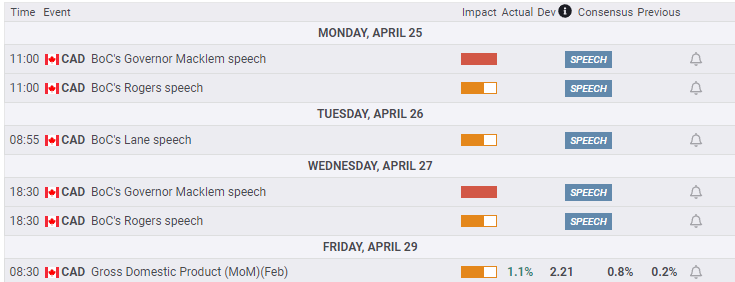
Canadian economic data was sparse with only February GDP a minor surprise at 1.1% on a 0.8% forecast and January’s 0.2%.
In the US, Durable Goods Orders in March were better than expected and Initial Jobless Claims remained at near historic lows. The initial shock of -1.4% GDP in the first quarter, far below its 1.1% forecast, had almost no negative market impact. A widening trade deficit and lower inventory restocking by businesses subtracted about 4% from the GDP accounting while consumer spending remained healthy at 2.7%, promising a better performance in the second quarter.
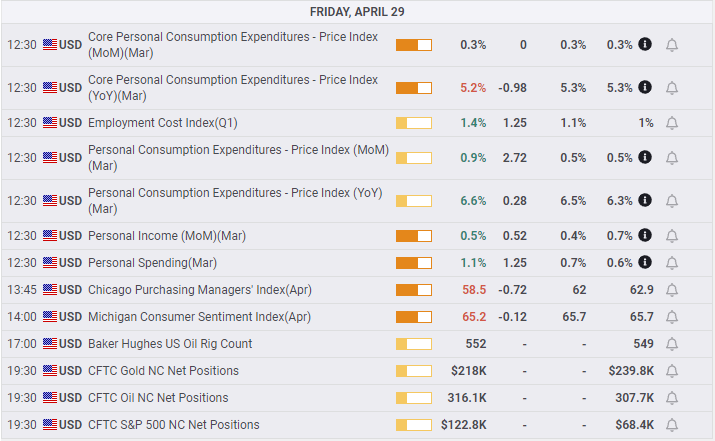
Personal Consumption Expenditure prices rose to 6.6% in March, slightly more than predicted but core PCE prices were 5.2%, a bit less than forecast. Personal Income and Spending were marginally stronger than anticipated in March and revised upward for February giving credence to the idea that however unhappy consumers say they are in sentiment surveys, they are not about to stop spending.
USD/CAD outlook
Energy prices remain the differential for USD/CAD. Fed policy, which has given the US dollar such an advantage in other currency pairs, has been matched by Tiff Macklem and the bankers of Ottawa.
The contracting triangle pattern of WTI suggests that a break is imminent. The stalemate in Ukraine and the failure of Russian sanctions to force negotiations and the balancing inability of Europeans to forgo Russian energy suggest that the threat to global energy supplies is fading and that the break in WTI will be lower. If that happens the Canadian dollar will lose its main prop and the USD/CAD will join the rest of the currency market in endorsing the US dollar.
 outlook-637868670460322191.png)
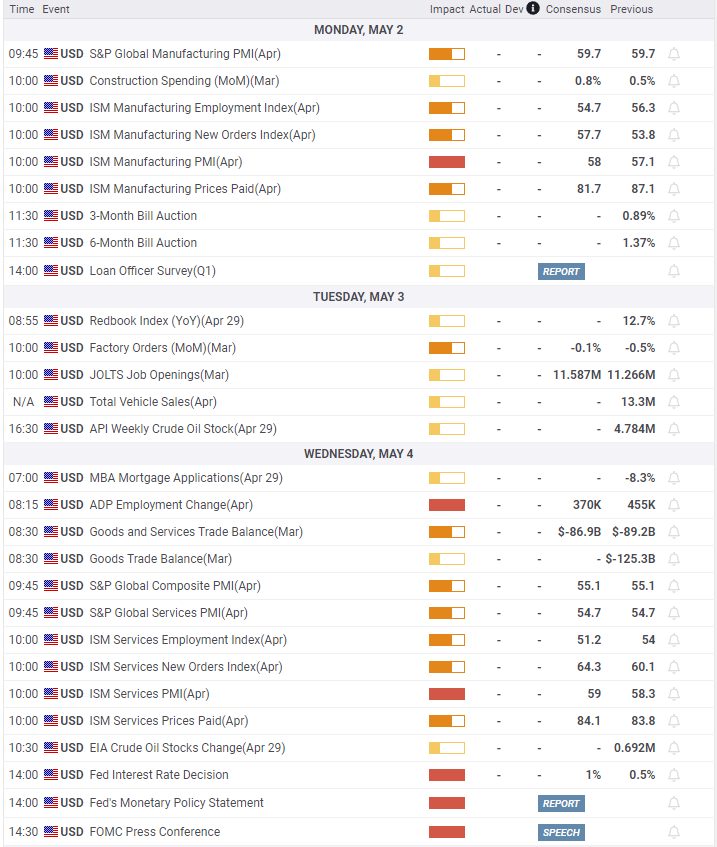
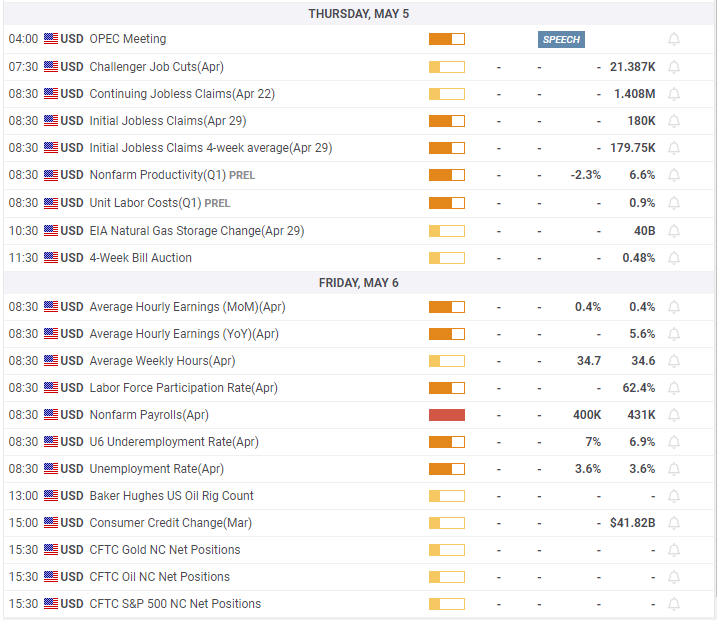
Canada's employment report on Friday is mated with the US payroll report. Neither is expected to stray from recent trends or provide market direction.
In the US, the Fed meeting on Wednesday will dominate markets. Treasury futures predict the fed funds at 2.75% or higher by the end of the year. How soon that is achieved is undetermined and not known to the Fed governors themselves. A 0.5% hike next week is assured but whether that continues in June depends on the rate of inflation and the disposition of the US consumer. Thus far Americans have, despite all, continued to show confidence in the future. Domestic consumption has remained strong.
The Federal Open Market Committee (FOMC) is also expected to start a passive reduction of its $9 trillion balance sheet. If that does not take place, or the governors elect an active role, selling from the bank's portfolio rather than letting bonds roll-off at maturity, markets will respond by selling or buying the US dollar.
The immediate outlook for the USD/CAD remains range bound with knowledge that a breakdown in crude pricing will send the pair higher.
Canada statistics April 25–April 29
FXStreet
US statistics April 25–April 29

FXStreet
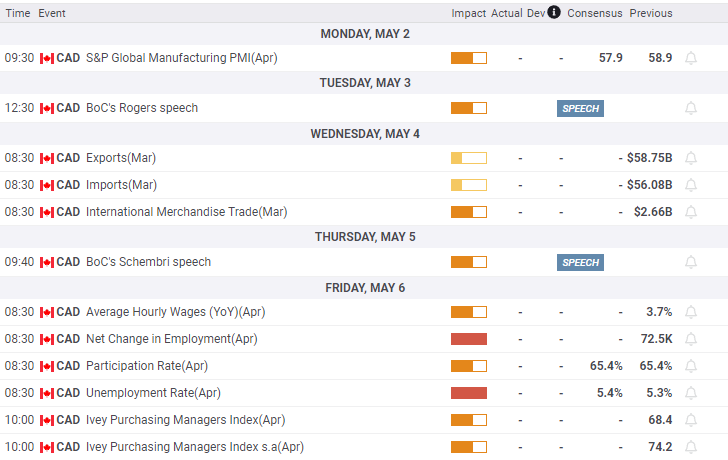
Canada statistics May 2–May 6
FXStreet
US statistics May 2–May 6
USD/CAD technical outlook
No range lasts forever. Dollar Canada's day may be approaching. The 1.2500 to 1.2900 play for the last six months and the wider 1.2300 to 1.2900 range since last July have balanced the loonie benefit from the long upward trend in energy prices against the slow then quickening rise of the US dollar. The precarious position of WTI is a warning for USD/CAD shorts.
The MACD (Moving Average Convergence Divergence) has opened its widest positive price to signal spread this year. The Relative Strength Index (RSI) is at its highest level since last November. Volatility has been rising for the last two weeks and can be expected to surge if 1.2900 is surmounted. These indicators point higher.
 tech 1-637868681012954039.png)
The steep rise in the USD/CAD over the past two weeks has brought the 21-day moving average (MA) at 1.2634 in contact with the 200-day MA, at 1.2633, 20 points from the 50-day MA at 1.2656, and 50-points from the 100-day MA at 1.2682. The short-term trend appears ready to overtake the longer versions with the cross of the 200-day the most important.
 tech 2-637868688972170540.png)
Resistance is weak above the current market with just three lines based on a few days of trading in Mach and last December. Before that, the earliest references are from December 2020.
 tech 3-637868689602547783.png)
Moving Averages: 21-day 1.2634, 50-day 1.2656, 100-day 1.2682, 200-day 1.2633
Resistance: 1.2900, 1.2940, 1.2965
Support: 1.2825, 1.2800, 1.2765, 1.2750, 1.2720, 1.2700, 1.2675
Premium
You have reached your limit of 3 free articles for this month.
Start your subscription and get access to all our original articles.
Author
Joseph Trevisani
FXStreet
Joseph Trevisani began his thirty-year career in the financial markets at Credit Suisse in New York and Singapore where he worked for 12 years as an interbank currency trader and trading desk manager.

















