|

USD/CAD to 1.30? Not so fast — Confluence Detector

The USD/CAD made a big breakout as the US prepares to exit the Iran deal and the pair is trading at the highest in six weeks, approaching 1.30. Will it make the break? Technical Confluences Indicator shows that fierce resistance awaits at C$1.2980. This is the convergence line of the Pivot Point one-week R2, the Bolinger Band one-day Upper, and the Fibonacci 161.8% one-day.

If the pair does make the break 1.3020 provides another cap. It is the confluence of the Pivot Point one-month R1 and the Pivot Point one-week R3.

Support is found at around 1.2890. This is where the Fibonacci 61.8% one-day, the 4h-High, the Fibonacci 23.6% one-week, the Simple Moving Average 100-15m, the Bolinger Band 15m-Lower, and the Bolinger Band 1h-Middle.

Further below, 1.2860 is another line of support with the SMA5-one day, the Fibonacci 23.6% one-day, the SMA200-1h, and the SMA50-1h awaits. 

Tha battle lines are well drawn for the next fight.

Here is how it looks on the tool:
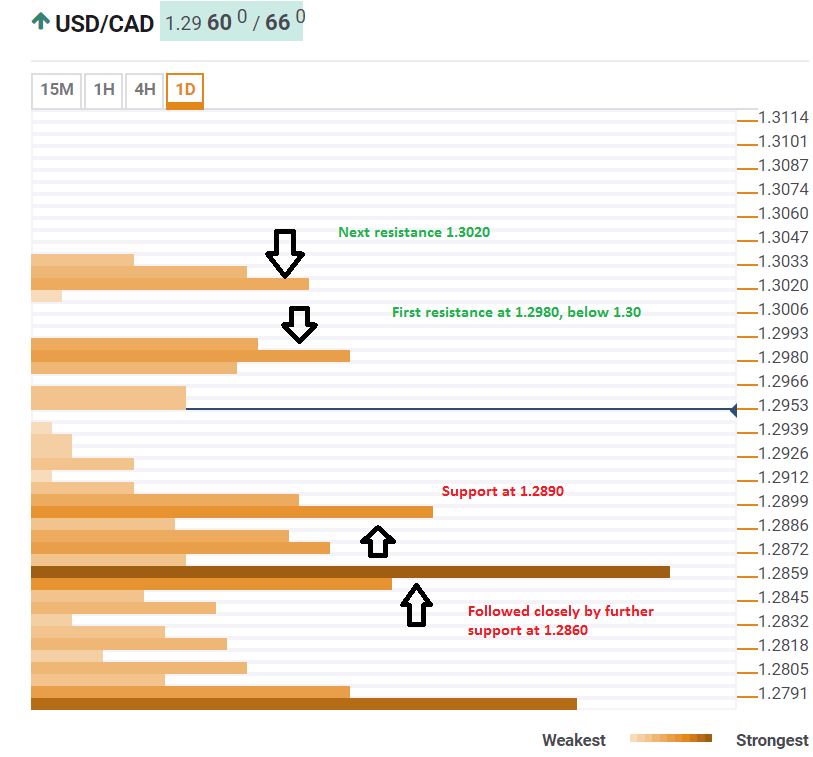
USDCAD technical confluence levels May 8 2018

Confluence Detector

The Confluence Detector finds exciting opportunities using Technical Confluences. The TC is a tool to locate and point out those price levels where there is a congestion of indicators, moving averages, Fibonacci levels, Pivot Points, etc. Knowing where these congestion points are located is very useful for the trader, and can be used as a basis for different strategies.

This tool assigns a certain amount of “weight” to each indicator, and this “weight” can influence adjacents price levels. This means that one price level without any indicator or moving average but under the influence of two “strongly weighted” levels accumulate more resistance than their neighbors. In these cases, the tool signals resistance in apparently empty areas.

Learn more about Technical Confluence

Author

Yohay Elam

Yohay Elam

FXStreet

Yohay is in Forex since 2008 when he founded Forex Crunch, a blog crafted in his free time that turned into a fully-fledged currency website later sold to Finixio.


More from Yohay Elam
Share:

Editor's Picks

GBP/USD remains offered; bears target 1.3600

GBP/USD now leaves behind part of its recent recovery and revisits the low 1.3600s at the beginning of the week. Indeed, Cable trades with a mild downward bias amid decent gains in the Greenback as investors remain wary of upcoming US data releases and the Jackson Hole event.

EUR/USD remains sidelined above 1.1650

EUR/USD trades on the defensive following the closing bell on Wall Street on Monday, hovering around the 1.1660 region and adding to Friday’s small decline. The pair’s pullback comes in response to an acceptable rebound in the US Dollar in a context of generalised caution ahead of key US data releases and Chair Warsh’s speech in Jackson Hole.

Gold advances to over three-month high as bulls look to reclaim $4,700

Gold climbs to a fresh high since mid-May, with bulls now eyeing $4,700 and extending the rally witnessed since the beginning of this month. The US Treasury's bond market intervention failure fuels concerns about fiscal sustainability and boosts demand for bullion as an alternative store of value. Moreover, the US Dollar struggles to attract any meaningful buyers, which, along with receding bets for an immediate Fed rate hike, continues to benefit the non-yielding yellow metal.

Ethereum: BitMine scoops 32K ETH, hints at further gains
Ethereum (ETH) treasury company BitMine Immersion Technologies (BMNR) expanded its digital asset holdings last week with another round of acquisitions. The firm purchased 32,447 ETH during the week, lifting its holdings to 5.847 million ETH. That represents its largest purchase since the first week of July.
Will Jackson Hole ignite Gold and Silver’s next explosive breakout?
The 2026 Jackson Hole Economic Policy Symposium arrives at a pivotal moment. The U.S economy faces record debt, elevated borrowing costs, a weaker dollar and renewed momentum across hard assets. For The Gold & Silver Club, the backdrop increasingly validates its early-year call: “2026 will be the Year of Hard Assets.”
$20 billion offered, $2 billion taken: Why Treasury doubled its buyback cap

The US Treasury moved off its own calendar on Wednesday, and that is the part worth sitting with. At 12:32 GMT, the department said it would at least double the size of liquidity support buyback operations in the 10-year to 20-year and 20-year to 30-year sectors, lifting the maximum from $2 billion per operation to at least $4 billion, effective September 9 and running to November 4.















