USD/CAD Price Forecast: Sits above 1.3900, highest since August ahead of Fed’s Powell
- USD/CAD climbs to its highest level since early August amid sustained USD buying.
- The BoC’s dovish tilt overshadows rising Oil prices and also undermines the Loonie.
- The USD bulls seem cautious and opt to wait for Fed Chair Jerome Powell’s speech.

The USD/CAD pair trades with a positive bias for the fourth successive day on Friday and hovers around the 1.3915 region, or a three-month top during the early part of the European session. The US Dollar (USD) prolongs its weekly uptrend and climbs to the highest level since August 5 amid the diminishing odds for a more aggressive policy easing by the Federal Reserve (Fed). Apart from this, the cautious market mood further benefits the Greenback's safe-haven status, which turns out to be a key factor acting as a tailwind for the currency pair.
The Canadian Dollar (CAD), on the other hand, continues with its relative underperformance amid expectations that the Bank of Canada (BoC) would cut interest rates in the coming months, bolstered by softer consumer inflation figures. Statistics Canada reported on Tuesday that the annual inflation rate eased from 1.9% in the prior month to 1.7% in July, marking the lowest rise in over a year. This adds to worries over Canada’s softer economic momentum on the back of persistent trade-related uncertainties and overshadows a further rise in Crude Oil prices.
The black liquid edges higher for the third straight day and touches a nearly two-week top amid fading hopes for an imminent Russia-Ukraine peace deal. This, however, does little to support the commodity-linked Loonie. The USD bulls, however, seem reluctant and opt to wait for Fed Chair Jerome Powell's speech at the Jackson Hole Symposium for cues about the interest rate outlook amid bets that the US central bank will lower borrowing costs in September. Moreover, traders have been pricing in the possibility of two 25-basis-point (bps) rate cuts by the year-end.
The bets were reaffirmed by weaker US data released on Thursday, which showed that Jobless Claims rose by the most in about three months, and people collecting unemployment relief in the prior week climbed to the highest level in nearly four years. The data indicated that the recent labor market softness continued into August. Moreover, the Philly Fed Manufacturing Index tumbled to -0.3 in August, from 15.9 the prior month, renewing concerns about slowing US economic growth. This backs the view that the Fed would resume its rate-cutting cycle next month.
Hence, Powell's comments will play a key role in influencing market expectations about the future rate-cut path, which, in turn, will drive the USD demand. Apart from this, Oil price dynamics should provide some impetus to the USD/CAD pair and assist traders in grabbing short-term opportunities heading into the weekend. Nevertheless, spot prices remain on track to register gains for the second straight week – also marking the third week of a negative close in the previous four.
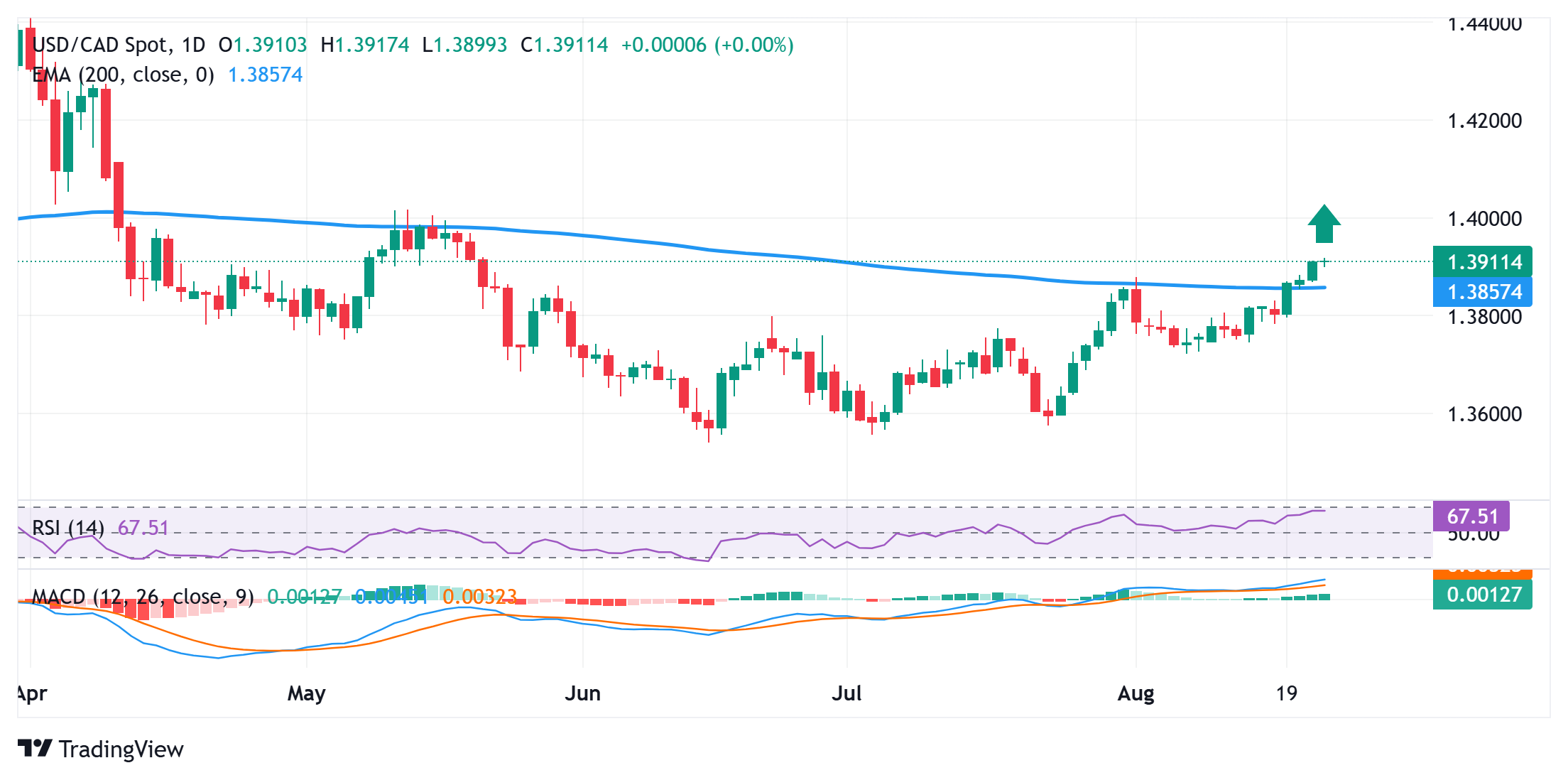
USD/CAD daily chart
Technical Outlook
This week's sustained breakout and acceptance above the 100-day Simple Moving Average (SMA) was seen as a key trigger for the USD/CAD bulls. A subsequent strength beyond the 1.3900 mark and positive oscillators on the daily chart validate the near-term constructive outlook for spot prices. Hence, some follow-through move higher towards the next relevant hurdle near the 1.3950 region, en route to the 1.4000 psychological mark, looks like a distinct possibility.
On the flip side, any corrective pullback below the 1.3880 area could be seen as a buying opportunity and remain limited near the 1.3800-1.3790 region, or the 100-day SMA. The latter should act as a strong base, which, if broken decisively, might prompt some technical selling and drag the USD/CAD pair to the 1.3755-1.3750 horizontal zone. This is followed by the 1.3720 region and the 1.3700 mark. Failure to defend the said support levels would shift the back in favor of bearish traders.
Author

Haresh Menghani
FXStreet
Haresh Menghani is a detail-oriented professional with 10+ years of extensive experience in analysing the global financial markets.