USD/CAD Price Forecast: Could appreciate further amid bearish Oil prices, ahead of Fed’s Powell
- USD/CAD attracts some follow-through buyers amid a combination of supporting factors.
- Bearish Oil prices and the BoC’s dovish stance undermine the Loonie and act as a tailwind.
- The emergence of some USD dip-buying contributes to the move up ahead of Fed Chair Powell.

The USD/CAD pair scales higher for the second successive day – also marking the fourth day of a positive move in the previous five – and climbs to an over one-week high, closer to mid-1.3800s during the first half of the European session on Tuesday. Crude Oil prices languish near a multi-month low and undermine the commodity-linked Loonie. This, along with the emergence of some US Dollar (USD) dip buying, turns out to be another factor acting as a tailwind for the currency pair.
Iraq’s federal and Kurdish regional governments reached a preliminary agreement with oil firms to resume crude exports via Turkey on Monday. This comes on top of the OPEC+ decision to boost oil production from October by 137,000 barrels per day (bpd), and worries about the economic fallout from US tariffs, which adds to oversupply concerns and keeps Crude Oil prices depressed. Adding to this, the Bank of Canada's (BoC) continued easing bias, due to a slowing economy and labor market, is seen weighing on the Canadian Dollar (CAD) and supporting the USD/CAD pair.
The USD, on the other hand, stalls the previous day's retracement slide from an over one-week high amid a hawkish assessment of Federal Reserve (Fed) Chair Jerome Powell's comments last Wednesday. Powell said that the move to lower interest rates was a risk management cut and added that he doesn't feel the need to move quickly on rates as risks to inflation remain tilted to the upside. This, in turn, helps limit the downside for the Greenback and contributes to the bid tone surrounding the USD/CAD pair. That said, dovish Fed expectations might cap the USD and the currency pair.
The US central bank lowered its benchmark rate for the first time since December and indicated the need for two more rate cuts this year amid concerns about a softening US labor market. Moreover, traders believe that interest rates will drop much faster than the Fed is projecting and are betting on the possibility that the short-term rate, currently in the 4.00%-4.25% range, will fall under 3% by the end of 2026. This, in turn, warrants some caution for the USD bulls and positioning for any further appreciating move for the USD/CAD pair ahead of Powell's scheduled speech later today.
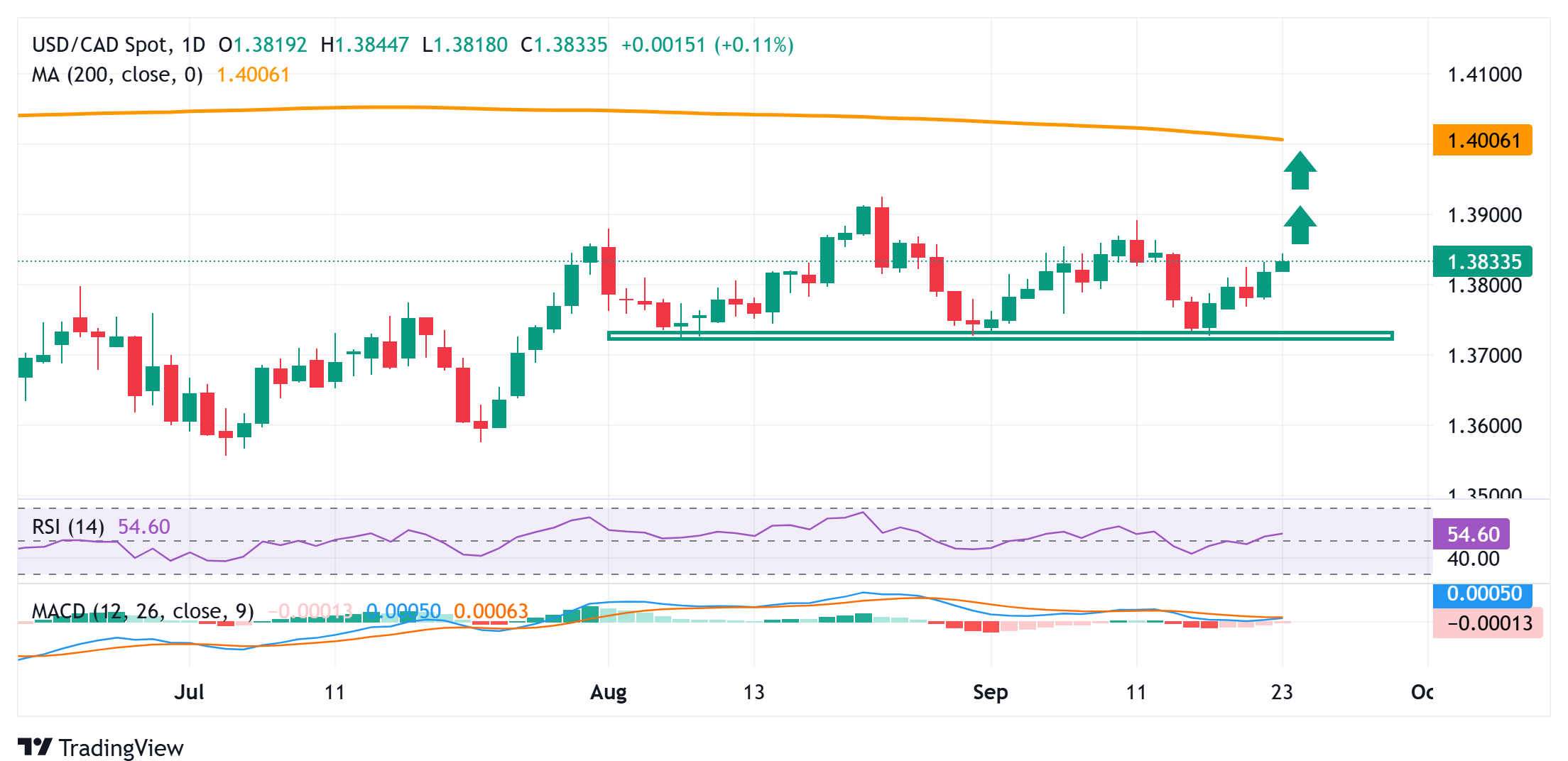
USD/CAD daily chart
Technical outlook
From a technical perspective, the recent repeated rebounds from 1.3725-1.3720 horizontal support and the subsequent move up favor the USD/CAD bulls. Moreover, oscillators on the daily chart have just started gaining positive traction and are still away from being in the overbought zone. This, in turn, backs the case for a further appreciating move towards the monthly swing high, just above the 1.3900 mark.
Some follow-through buying beyond the August swing high, around the 1.3925 region, will reaffirm the constructive outlook and allow spot prices to aim towards reclaiming the 1.4000 psychological mark. The latter represents the very important 200-day Simple Moving Average (SMA), which, if cleared decisively, will suggest that the USD/CAD pair has bottomed out and pave the way for a further appreciating move.
On the flip side, the 1.3800 round figure now seems to protect the immediate downside. Any further decline might continue to attract buyers and find decent support near the 1.3725-1.3720 region. However, some follow-through selling, leading to a further decline below the 1.3700 round figure, might shift the bias in favor of bearish traders. The USD/CAD pair might fall to the 1.3655 intermediate support en route to the 1.3600 mark.
Author

Haresh Menghani
FXStreet
Haresh Menghani is a detail-oriented professional with 10+ years of extensive experience in analysing the global financial markets.