USD/CAD Forecast: Bias seems tilted in favour of bearish traders, BoC decision awaited
- USD/CAD languishes near the lowest end of its weekly range, around mid-1.3300s.
- Bets for smaller Fed rate hikes continue to weigh on the USD and act as a headwind.
- The downside seems cushioned as investors await the BoC decision on Wednesday.

The USD/CAD pair struggles to gain any meaningful traction and languishes near the lower end of its weekly range through the Asian session on Wednesday. The upside remains capped amid the underlying bearish sentiment surrounding the US Dollar, which continues to be weighed down by firming expectations for a less aggressive policy tightening by the Fed. The markets seem convinced that the US central bank will soften its hawkish stance amid signs of easing inflationary pressures and have been pricing in a smaller 25 bps rate hike in February. This, along with a positive tone around the Asian equity markets, weighs on the safe-haven greenback and acts as a headwind for the major.
That said, the overnight pullback in crude oil prices undermines the commodity-linked Loonie and helps limit losses for the USD/CAD pair, at least for the time being. The prospect of slowing global economic growth, along with signs of another major build in US inventories, overshadows the latest optimism over an improvement in Chinese fuel demand. In fact, data from the American Petroleum Institute (API) pointed to a bigger-than-expected 3.4-million-barrel build in US crude inventories in the week of January 20. This, in turn, could cap the upside for the black liquid and lend some support to the pair. Traders also seem reluctant ahead of the Bank of Canada (BoC) monetary policy meeting.
The Canadian central bank is scheduled to announce its decision later during the early North American session and is expected to deliver a 25 bps rate hike. The markets, however, are pricing in a small chance of the BoC leaving rates unchanged amid looming recession risks. Apart from this, the focus will be on the accompanying monetary policy statement and the post-meeting press conference. This, in turn, should play a key role in determining the near-term trajectory for the Canadian Dollar and provide some impetus to the USD/CAD pair. Hence, it will be prudent to wait for strong follow-through selling before positioning for a further near-term depreciating move for the major.
Technical Outlook
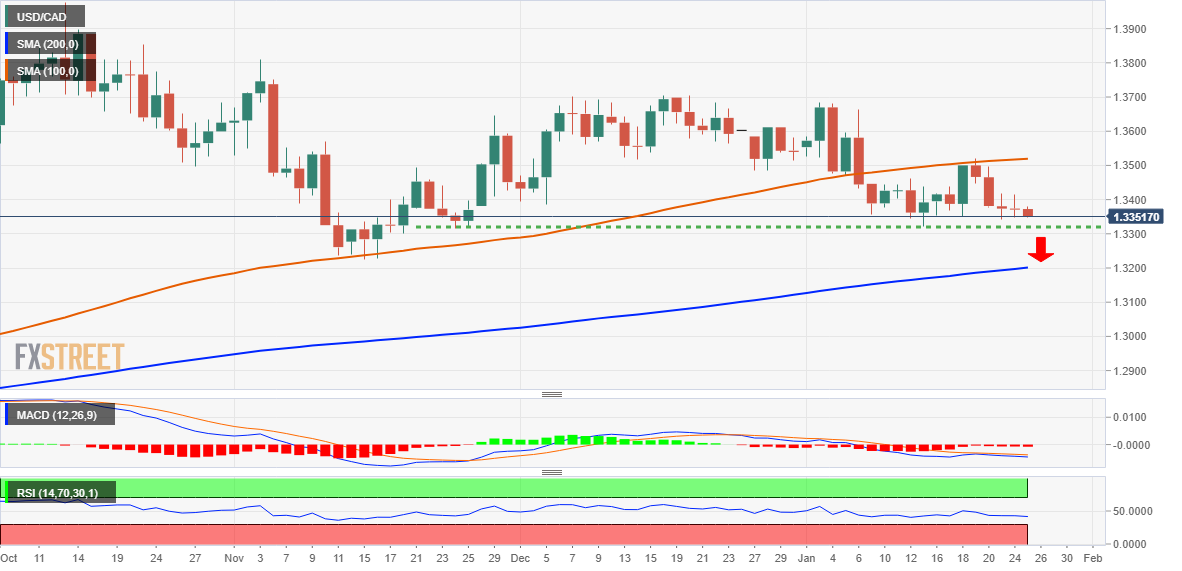
From a technical perspective, last week's failure to find acceptance above the 100-day SMA suggests that the recent downtrend might still be far from being over. That said, bearish traders might wait for a subsequent slide below the monthly swing low, around the 1.3320 area, before placing fresh bets. This is closely followed by the 1.3300 round figure, below which the USD/CAD pair could slide to sub-1.3200 levels. The latter coincides with the very important 200-day SMA, which if broken decisively will mark a fresh bearish breakdown and pave the way for a further near-term depreciating move.
On the flip side, any attempted recovery might continue to attract some sellers near the 1.3400 round-figure mark. This, in turn, could cap the USD/CAD pair near the weekly high, around the 1.3415-1.3420 zone. Some follow-through buying, however, might trigger a short-covering rally and lift spot prices towards the 1.3500 psychological mark en route to the 100-day SMA, currently around the 1.3515-1.3520 region. The latter should act as a pivotal point, which if cleared decisively will negate any negative bias and shift the near-term bias in favour of bullish traders.
Premium
You have reached your limit of 3 free articles for this month.
Start your subscription and get access to all our original articles.
Author
Haresh Menghani
FXStreet
Haresh Menghani is a detail-oriented professional with 10+ years of extensive experience in analysing the global financial markets.