USD/CAD Forecast: Bears might await FOMC decision on Wednesday before placing fresh bets
- USD/CAD consolidates Friday’s upbeat Canadian jobs data-inspired heavy losses.
- The divergent BoC-Fed policy expectations back the case for further depreciation.
- Traders, however, seem reluctant ahead of the key FOMC decision on Wednesday.

The USD/CAD pair oscillates in a narrow trading band near its lowest level since September 23 touched earlier this Monday, and seems vulnerable to slide further amid a bearish fundamental backdrop. The Canadian Dollar (CAD) continues with its relative outperformance on the back of Friday's upbeat domestic employment details, which reaffirmed the Bank of Canada's (BoC) hawkish outlook. This, along with the recent move up in Crude Oil prices, underpins the commodity-linked Loonie and weighs on the currency pair amid a bearish US Dollar (USD).
The latest figures published by Statistics Canada showed on Friday that the number of employed people rose for the third straight month, by 53,600 in November, and the unemployment rate unexpectedly fell to 6.5% from 6.9% in the previous month. This comes after the BoC signal in October that it is likely finished cutting interest rates for now, and boosts the CAD. The USD, on the other hand, languishes near its lowest level since late October amid bets for more rate cuts by the US Federal Reserve (Fed) and validates the negative outlook for the USD/CAD pair.
According to the CME Group's FedWatch Tool, traders are pricing in a nearly 90% chance that the US central bank will lower borrowing costs by 25 basis points (bps) at the end of a two-day policy meeting on Wednesday. The bets were lifted by a delayed report published by the US Commerce Department on Friday, which showed that the Personal Consumption Expenditures (PCE) Price Index matched consensus estimates and rose 2.8% on a yearly basis in September. Moreover, the core PCE Price Index, the Fed's preferred inflation gauge, rose 2.8% compared to 2.9% in August.
This comes on top of signs of a cooling US labor market backs the case for more easing by the Fed. This marks a significant divergence in comparison to the hawkish BoC and suggests that the path of least resistance for the USD/CAD pair is to the downside. Traders, however, might refrain from placing aggressive bearish bets and opt to wait for more cues about the Fed's rate-cut path. Hence, the focus will be on the updated economic projections, including the so-called dot plot, and Fed Chair Jerome Powell's comments during the post-meeting press conference.
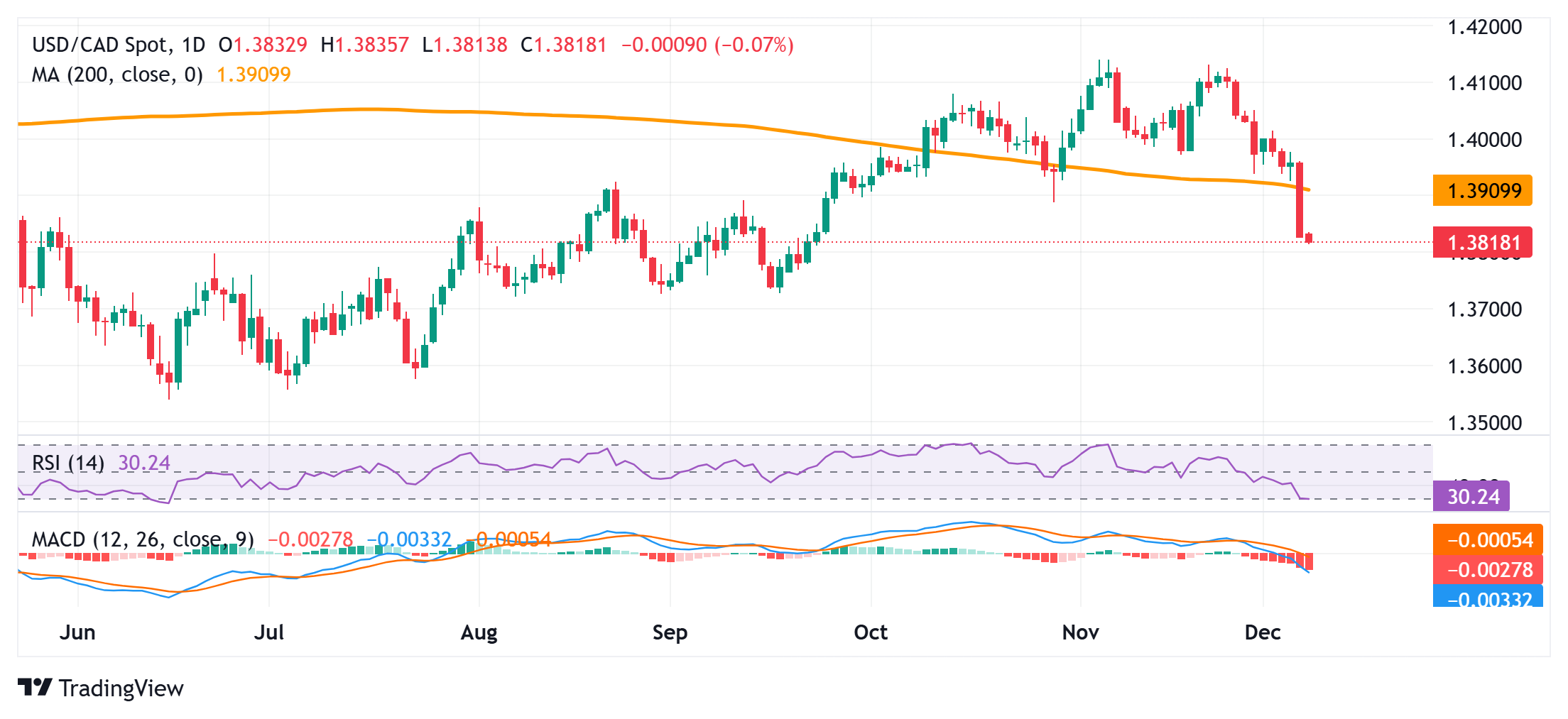
USD/CAD daily chart
Technical Outlook
Against the backdrop of the recent repeated failures ahead of the mid-1.4100s, Friday's sustained break and close below the 200-day Simple Moving Average (SMA), around the 1.3900 mark, favors the USD/CAD bears. However, the daily Relative Strength Index (RSI) is already flashing slightly oversold conditions and makes it prudent to wait for some near-term consolidation or a modest rebound before positioning for further losses heading into the key central bank event risks.
In the meantime, the 1.3860 immediate hurdle is likely to cap any attempted recovery ahead of the 1.3900 mark, or the 200-day SMA. A sustained strength beyond the latter could trigger a short-covering rally and lift the USD/CAD pair beyond the 1.3950-1.3955 intermediate hurdle, towards reclaiming the 1.4000 psychological mark. Some follow-through buying would negate the negative outlook and shift the near-term bias back in favor of bullish traders.
On the flip side, weakness below the 1.3800 round figure could find some support near the 1.3770 region ahead of the September swing low, around the 1.3720 region. Failure to defend the said support levels would make the USD/CAD pair vulnerable to extend the decline further towards the 1.3660-1.3655 intermediate support before eventually dropping to test sub-1.3600 levels.
Author

Haresh Menghani
FXStreet
Haresh Menghani is a detail-oriented professional with 10+ years of extensive experience in analysing the global financial markets.