US: Trade War impact is just getting started


Summary
- By early May, equity markets recouped most of the trading losses sustained during the first few weeks of April, and despite dire warnings, recent economic reports have not yet shown the bottom falling out beneath economic activity.
- After surging to highs last seen during the pandemic at the start of April, the VIX index has come down sharply with readings in the low 20s as of this writing, only slightly above the 25-year average of 19.8.
- The economy is not out of the woods yet. Our forecast looks for the big drag from trade that swamped robust domestic demand in Q1 to reverse in the remaining quarters of the year, with domestic demand coming down and net exports providing a modest, but fading, lift through year-end. The upshot is a bumpy ride for GDP growth.
- We anticipate some stomach-turning turbulence this year, particularly in the third quarter, when an air pocket in consumer and business spending follows in the wake of the pre-tariff spending surge that likely carried into early Q2. Look out for an outright decline in GDP growth during that period.
- Although the monthly jobs reports have revealed an orderly slowing thus far, we look for the early signs of moderation already evident in the labor market to slow to a standstill by late summer and a rising unemployment rate by year-end.
- The last time FOMC policymakers were in a similar spot with the labor market was in September 2024, and they lowered the fed funds rate by a total of 100 bps over the course of three meetings at the end of that year. We forecast a nearly identical cadence in our updated forecast with the top end of the range for fed funds rate coming down to 3.50% in the second half of this year before policymakers pivot back to a familiar holding pattern throughout 2026.
- A key difference this autumn compared to last autumn is that inflation is apt to be rising rather than coming down. We expect the Fed to look through the price level increase caused by tariffs, provided that long-term measures of inflation expectations remain anchored.
Trade war impact is just getting started
In the immediate wake of the tariff announcements on April 2, financial markets reeled, with the S&P 500 index notching a greater than 12% decline in under a week, and some economic forecasters braced for the worst. Just one month on, it is still early days, but equity markets broadly recouped most of the trading losses from the first few weeks of April and the monthly indicators (even those that include April data) have not yet shown the bottom falling out beneath economic activity.
Yes, the economy technically contracted in the first quarter, with the preliminary estimate of GDP growth showing the economy shrank at a 0.3% sequential annualized rate. While recession risks remain elevated, this Q1 decline is not the start of a sustained downturn, in our view. The Q1 contraction in GDP reflects instead the sudden change in trade policy that culminated in the biggest drag from net exports going back more than a half century.
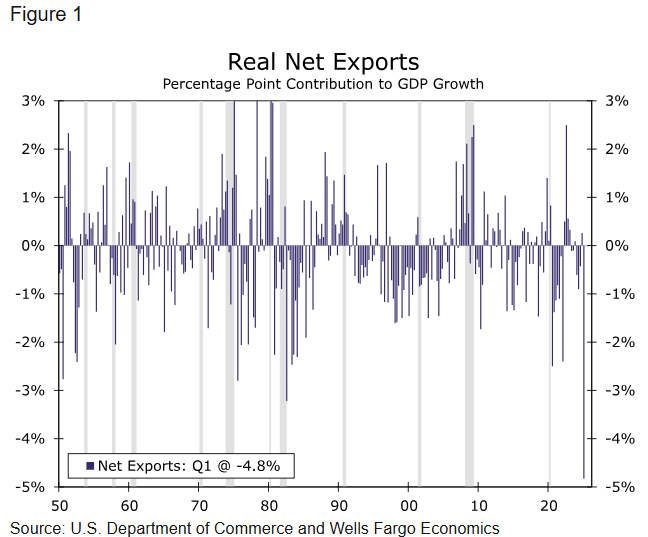
Real net exports lopped 4.8 percentage points off of first quarter GDP growth. It is rare for a drag that large to come from a comparatively small component of GDP such as net exports. This is not because trade activity was grinding to a halt, but rather because imports shot up as firms tried to pull forward needed industrial supplies and retailers stocked their shelves with consumer goods ahead of tariffs.
Even if tariffs are rolled back significantly in the weeks or months ahead, the large front-running that has occurred means businesses won’t need to source as much product as they unwind inventory. This is a theme evident in our forecast, with fading boosts to headline growth from trade in each remaining quarter of this year and fading drags to headline growth from inventories.
It is difficult to sidestep tariff effects in the midst of a trade war, but we can look to real final sales to domestic private purchasers for a somewhat cleaner measure of underlying domestic demand. This measure rose at a 3.0% annualized pace in Q1, suggesting a relatively steady pace of growth. Yet, even this measure isn't a perfect indication of underlying demand today, given consumers may have pulled forward some purchases toward the tail-end of the quarter. Businesses likely did the same. Equipment investment received a jolt, up at a 22.5% annualized pace in Q1, due to a pickup in spending on aircraft and also on computer and electronics products.
The tariffs do inject pronounced uncertainty into the outlook, but our forecast plots a narrow path through which the U.S. economy can avoid a sharp economic downturn. To thread that needle, a few things must fall into place. We need (1) tangible examples of successful dealmaking to avoid some fallout from tariffs. We also need (2) enough of a slowdown in the labor market to compel the Fed to lower rates in the back half of this year, yet (3) not enough of an about-face in the labor market to forestall income growth from sustaining consumer spending. It will be difficult to stick the landing; here is how we see it unfolding:
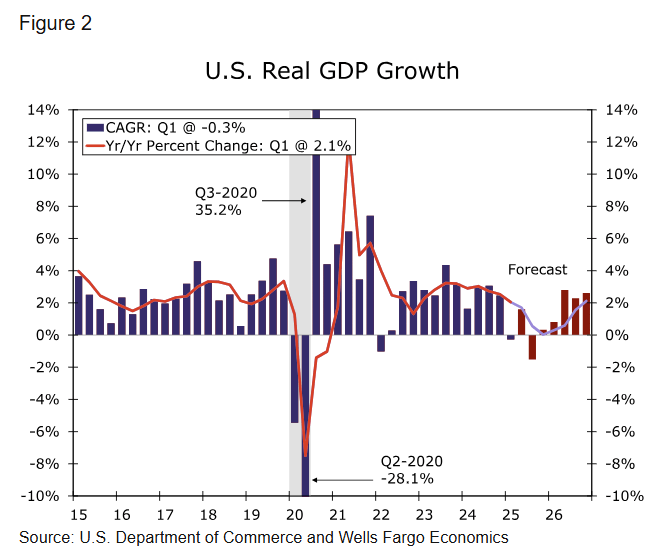
Start with dealmaking. We have maintained it would be a bit extreme to simply assume tariff rates remain at current levels. The Trump administration could reduce tariffs, at least partially, if it is able to strike deals with other countries, a development that the president and some of his top deputies have alluded to in recent weeks. But the 10% minimum tariff that the president has put into effect leads us to believe that a return to the 2.3% effective tariff rate of last year is not in the cards, at least not in the foreseeable future. The numbers in our forecast convey our expectations under the explicit assumption that the effective tariff rate will recede to about 15% and remain there through the end of our forecast period in Q4-2026.
Author
Wells Fargo Research Team
Wells Fargo

















