US trade deficit widened to close a volatile year for trade


Summary
The U.S. trade deficit widened in December to finish what was a volatile year for international trade flows. While 2022 marked the largest deficit on record, the U.S. trade balance narrowed over the course of the year. Trade flows will remain under pressure in 2023 amid slow global growth and a normalization in U.S. demand.
Largest deficit on record in 2022, but balance narrowed on trend recently
Amid a partial reversal in the sharp drop in November imports, the U.S. trade balance widened to a deficit of $67.4 billion in December. For the year as a whole, the U.S. trade deficit grew 12.2% to a record deficit of $948 billion, but after peaking in March the deficit has narrowed over the course of the year--the deficit now stands about $20 billion smaller that it was at the start of the year (chart).
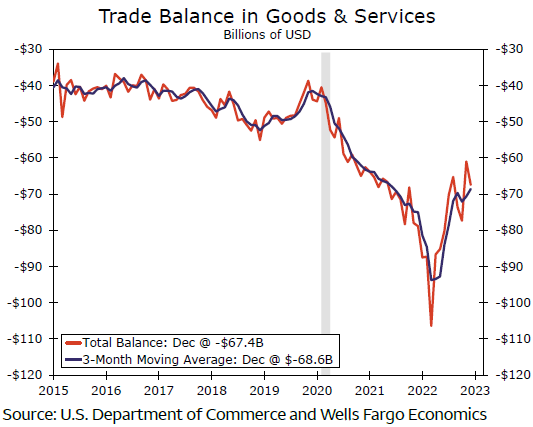
International trade flows have been volatile on a monthly basis, but cutting through the noise, a slowdown in global growth is weighing on exports while import growth continues to normalize after the pandemic-induced surge (chart).
The $2.2 billion decline in exports marked the fourth consecutive monthly drop. But after adjusting for a larger decline in export prices in December, real goods exports actually rose $2.4 billion. Imports rebounded by $4.2 billion in December, only reversing a fraction of the $20.5 billion decline a month earlier. In real terms, goods imports advanced $4.9 billion.
Today's report largely confirms what we learned in the recent fourth quarter GDP report. While real imports rebounded faster at the end of the quarter, imports still declined faster than exports in Q4 and caused net exports to boost real GDP growth by 0.6 percentage points (chart).
International trade flows remain under pressure. Decreased growth abroad will likely continue to weigh on demand for U.S. exports. At the same time, demand for consumer durables is slowing after being pulled forward during the pandemic, and a gradual slowdown in capex investment are weighing on U.S. imports from the rest of the world.
Author
Wells Fargo Research Team
Wells Fargo