US trade deadline extended, RBA holds rates unchanged


RBA defies market expectations and holds ground
Following what was a subdued economic calendar, overnight featured an update from the Reserve Bank of Australia (RBA). Defying the majority of economists who forecast a 25-basis point (bp) rate cut, the central bank held the cash rate at 3.85%. This consequently sent the Australian dollar (AUD) north versus its G10 peers, along with the ASX 200 stock index dipping lower.
The RBA emphasised a cautious stance amid global uncertainty, noting that it requires more data to confirm inflation is sustainably returning to its 2.5% target. Despite this, markets are currently pricing in an 87% probability of a 25 bp cut materialising at August’s meeting.
In Monday’s ‘Levels of the Day’ post, the FP Markets Research team had highlighted possible upside in the AUD/NZD cross (Australian dollar versus the New Zealand dollar) following a moderate daily close north of resistance at NZ$1.0822. If you drill down to the M5 timeframe, you will note that there was a short-term scalping opportunity, with data pushing the cross north of resistance at NZ$1.0856, which was then followed up with a retest as support.
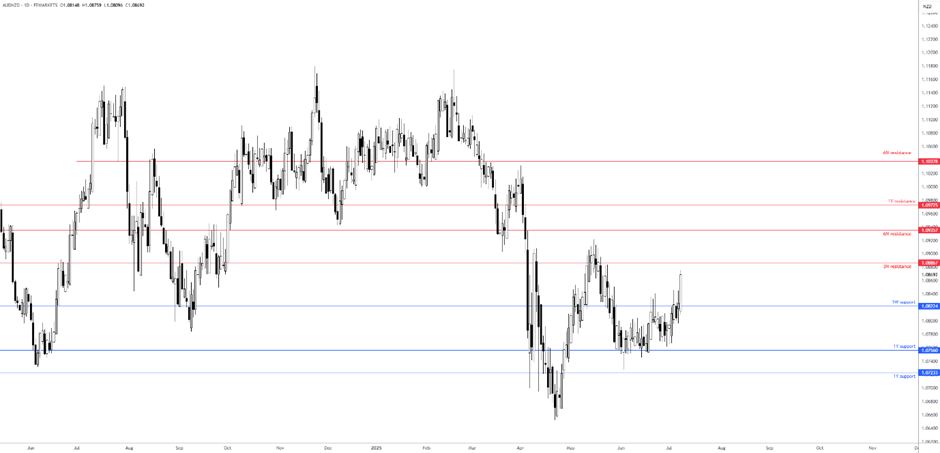
Should the Reserve Bank of New Zealand (RBNZ) come in more hawkish than expected at tomorrow’s meeting, this could provide traders a fading opportunity from 3M resistance at NZ$1.0887 on the AUD/NZD daily chart. As a reminder, the RBNZ is expected to leave the cash rate at 3.25%, following three consecutive rate reductions this year, totalling 100 bps of easing. Sticking to a hold is unlikely to strike much of a reaction, but if the RBNZ signal that they are nearing the end of the rate cutting cycle, this could prompt an NZD long.
Trump’s tariff negotiating deadline extended to 1 August
The goalpost has been moved yet again; US President Donald Trump announced another extension to the trade deadline, pushing it out to 1 August.
During US trading hours yesterday, Trump also sent letters to various countries, essentially outlining their new respective tariff rates effective 1 August. Among the countries that received letters were Japan, Malaysia, and South Korea, who each will be tariffed by 25%, along with 40% tariffs for Laos and Myanmar. Additionally, South Africa will face a 30% levy.
Trump was recently asked whether the deadline was set in stone, to which he replied ‘I would say firm, but not 100% firm’ – so not firm then. The President added that if countries call and he likes what he hears, he’ll make a deal.
The question is whether the deadline will continue to keep moving out further into the year. I believe it will. We have to remember that trade negotiations can take months to hash out, if not years in some cases.
The single currency (EUR) is getting a bit of a lift versus the USD this morning (up 0.2%) on reports that a preliminary trade deal between the European Union and the US is inching closer. The US offered a 10% deal on most exports, with some caveats, according to Politico.
In terms of where we are on the USD index, longer-term flow continues to rebound from monthly channel support (drawn from the low of 72.70), though daily price action is within striking distance of retesting resistance from 97.72. I remain in the ‘sell-the-rally’ camp for the USD right now, and continue to closely monitor said resistance.
European stocks are rangebound, with US equity index futures echoing a similar picture. We are also virtually unchanged in the bond markets, and commodities remain stable. I think it is a case of markets currently focussing more on the trade extension, rather than Trump’s recent ‘letters’.
Finally, we have another rather thin docket ahead of us today, with the macro focus largely now on the RBNZ meeting tomorrow at 2:00 pm GMT.
Author
Aaron Hill
FP Markets
After completing his Bachelor’s degree in English and Creative Writing in the UK, and subsequently spending a handful of years teaching English as a foreign language teacher around Asia, Aaron was introduced to financial trading,

















