US tariffs here to stay, trade deals ‘largely symbolic’

Despite legal challenges to IEEPA tariffs, US trade policy remains firm. Tariffs on steel and aluminium have doubled, and new sectoral tariffs are expected. Trade deals may emerge, but most will be symbolic. Effective tariff rates will stay high throughout 2025.
In recent weeks, two major developments have shaped the trade landscape: a US court ruling questioning the legality of tariffs imposed under the International Emergency Economic Powers Act (IEEPA), and the doubling of tariffs on steel, aluminium, and related derivatives, effective from 4 June.
Despite these major developments, we believe that the average tariff rate is unlikely to shift significantly, as other tariff measures are expected to offset any reductions resulting from trade deals or court rulings.
The US Court of International Trade ruled on 28 May that President Donald Trump exceeded his authority using the 1977 IEEPA to impose tariffs. Directly affected by this ruling are the 10-30% tariffs on China, Canada, Mexico, and the rest of the world. A stay is currently in place pending appeal, following the US administration’s immediate objection to the initial court ruling. The Court of Appeal has scheduled arguments for 31 July, meaning that tariffs under currently-used laws can stay in effect at least until then.
Despite the legal setback, the tariff landscape is unlikely to shift
Even if the IEEPA tariffs are ultimately overturned, we do not anticipate a significant shift in the overall tariff landscape. For once, there are fallback options such as Section 122 (Trump can impose tariffs of up to 15% or quotas on all imports for up to 150 days to address balance-of-payments deficits. Extending tariffs beyond 150 days requires Congressional approval) or Section 338 (the president can impose new or additional duties on imports from a foreign country of up to 50%, or exclude its products from importation if the foreign country imposes unreasonable charges or discriminates against US commerce).
We still expect Section 232 and Section 301 tariffs to intensify over the next few months. While individual sectoral country tariffs and subsequent reductions are possible, most sectoral tariffs will stay irrespective of trade deals due to national security reasons, especially if tariffs under IEEPA are struck down. We expect that:
- Car tariffs will remain at a minimum of 10%, depending on trade deals, but for the majority of trade partners will remain at 25%.
- Steel tariffs will remain at 50% and will not fall back to 25%.
- Aluminium tariffs, however, are more likely to fall back to 25% as US production is pretty much limited.
- Other sectoral tariffs will most likely come in 3Q/4Q, probably in the range of 10-25% (copper, trucks, cranes, aircraft, pharma, etc.)
No US appetite for reciprocity with tariff revenue remaining strong
In general, we expect higher tariffs to stay. US Commerce Secretary Howard Lutnick made clear during a recent Senate Appropriations Committee hearing that the US is not looking for real reciprocity. Judging from his statements, the US is not interested in zero-for-zero deals or eliminating all trade barriers, as this would undermine the US agenda to generate new revenues and gain relative advantages vis-à-vis its trading partners.
Up to 30 April, revenues under IEEPA tariffs have totalled $13.7bn, while tariff revenues under Section 201, 232 or 301 duty assessments total $26.8bn for the 2025 fiscal year (October 2024 to September 2025).
Trade remedy duties on imported goods via IEEPA (as of 30 April, in $bn)
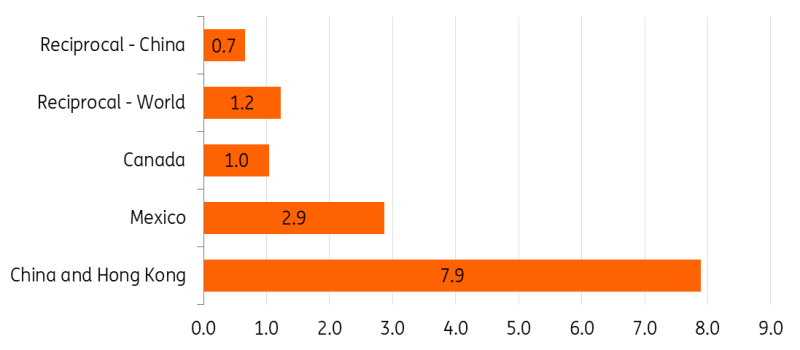
Source: US Customs and Border Protection, ING
Trade deals: ‘Showcase’ or the ‘real deal’?
While a temporary tariff truce between the US and its trade partners is in place – ideally lasting until 8/9 July for most partners and 12 August for China – ongoing trade talks remain clouded by uncertainty. Several countries are engaged in negotiations with the US, but the nature and substance of any potential trade deal remain unclear, largely due to the lack of a defined US position.
Talks with the EU and China are reportedly progressing, with the US and China having reached a framework on 10 June. Yet there is no clarity on what a final agreement might entail. The risk of talks breaking down persists, and in such a scenario, the EU, Canada, and other stakeholders are preparing to implement (additional) retaliatory measures. Current discussions with China are centred on technology export controls and rare earths, and both sides have agreed to ease some of these export restrictions, though specific details have not been disclosed. Meanwhile, a limited agreement with India is anticipated before the July deadline.
Overall, we expect most outcomes to be ‘showcase’ deals – agreements crafted for political optics rather than meaningful economic change. The US-UK case exemplifies the core issue: talks are happening successfully, but delivery is not.
It also means that by year-end, we do not expect the effective average tariff rate to be much different from its current value, meaning that the average effectively applied tariff rate will stay around its current level, i.e.
- EU: 10-15%.
- China: 50%.
- World: 10-15%.
A reduction in tariff lines via trade deals or court rulings will be offset by other tariff measures.
Read the original analysis: US tariffs here to stay, trade deals ‘largely symbolic’
Author
ING Global Economics Team
ING Economic and Financial Analysis
From Trump to trade, FX to Brexit, ING’s global economists have it covered. Go to ING.com/THINK to stay a step ahead.